「插隊」別說 insert the line!排隊英文這樣說

插隊英文怎麼說?排隊、插隊、請人去排後面一次學 | MJ英語 Daily English | 生活英語

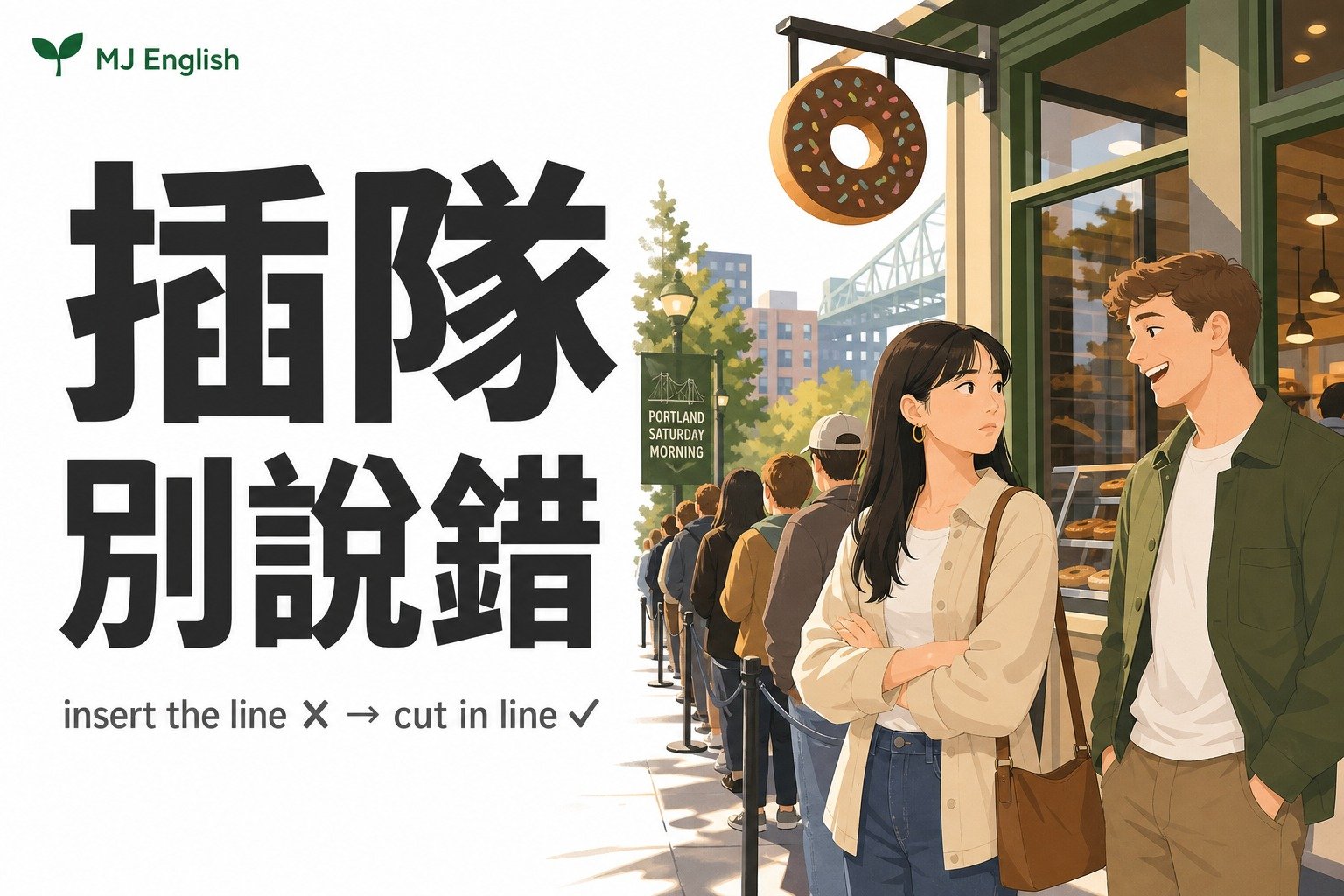
週六早上去排超紅的甜甜圈店,隊伍歪歪扭扭,你想問旁邊的人「你在排隊嗎?」,脫口而出 “Are you line up?”——接著有人直接走到你前面,你想說「他插隊!」卻只想到 “He inserted the line!”

「你在排隊嗎?」是 Are you in line?;「插隊」是 cut in line;請對方去排後面,說 The line starts back there. 或 the end of the line,不是 the tail of the line。

💡 先搞懂:排隊是「在隊伍裡」:be in line

中文說「在排隊」,很多人會直翻成 Are you line up?,但 line up 是「排成一排」的動詞片語,Are you 後面不能直接接原形動詞,意思也不是「在隊伍裡」。問人家是不是在排隊,最自然就是 Are you in line?。「插隊」別用 insert,英文說 cut in line 或 cut in front of someone。最後,「隊伍最後面」不是隊伍的尾巴 tail,而是 the end of the line(也常說 the back of the line)。

台灣人最容易卡的雷:① Are you line up? → Are you in line?;② He inserted the line! → He cut in line!;③ The tail of the line is over there. → The line starts back there.


情境對話 Dialogue

邊聽邊學

這一集完整音檔就在這裡,也可以到 Apple 或 Spotify 收聽

立即播放約 6 分

場景:週六早上,在波特蘭念書的台灣女生 Amy,跑去排一家超紅的甜甜圈店。隊伍歪歪扭扭,她不確定旁邊的 Kevin 是不是在排隊。


Amy

Excuse me, are you line up?

不好意思,你在排隊嗎?(要說 Are you in line?)

Kevin

Am I in line? Yeah, I’m in line. It’s really long today, huh?

我有沒有在排隊?有啊,我在排。今天隊伍超長的,對吧?

Amy

Super long. Okay, then I’ll get in line behind you.

超長。好,那我排你後面。

Kevin

Sure. Trust me, the maple donut is worth the wait.

好啊。相信我,楓糖甜甜圈值得等。

Amy

Wait, did you see that? That man just inserted the line!

等等,你有看到嗎?那個男的剛剛插隊!(要說 cut in line)

Kevin

He cut in line? Wow, yeah. He just cut right in front of us.

他插隊?哇,真的耶。他直接插到我們前面。

Amy

That’s so rude. Should I say something?

也太沒禮貌了。我要不要說點什麼?

Kevin

Sure, just be nice about it. What would you say?

可以啊,口氣好一點就好。你會怎麼說?

Amy

Um, “Excuse me, the tail of the line is over there.”

嗯,「不好意思,隊伍的尾巴在那邊。」(要說 the end of the line)

Kevin

You’re close! We say the end of the line. Or just, “Excuse me, the line starts back there.”

很接近了!我們會說 the end of the line。或直接說:「不好意思,隊伍從後面那邊開始喔。」

Amy

Excuse me, sir? The line starts back there. Oh, he said sorry and went to the back!

先生,不好意思?隊伍從後面那邊開始喔。喔,他說抱歉,去後面排了!

Kevin

Nice! Polite and clear. And now we’re one spot closer to those donuts.

讚!有禮貌又清楚。而且我們離甜甜圈又近了一格。

🎯 30 秒快速複習

在排隊=be in line/插隊=cut in line/隊伍最後面=the end of the line

①你在排隊嗎?=Are you in line?
②這是排隊的隊伍嗎?=Is this the line?
③我排你後面=I’ll get in line behind you.
④值得等=It’s worth the wait.
⑤他插隊!=He cut in line!
⑥他插到我們前面=He cut in front of us.
⑦隊伍最後面=the end of the line
⑧隊伍從後面那邊開始喔=The line starts back there.

下次這樣說 Next Time

問人有沒有在排隊、說有人插隊、請人去排後面,台灣人排隊最常卡住的三句。

① 你在排隊嗎

❌ 中文腦會說

Are you line up?

line up 是動詞片語,直接接在 Are you 後面文法不通

✅ 該這樣說

Are you in line?

你在排隊嗎?

為什麼:「在隊伍裡」英文是 be in line;line up 是「排成一排」的動作,不能直接接在 Are you 後面。

② 插隊

❌ 中文腦會說

He inserted the line!

insert 是「插入、放進去」

✅ 該這樣說

He cut in line!

他插隊!

為什麼:insert 是把東西放進去(insert a card),插隊要用 cut:cut in line、cut in front of someone。

③ 隊伍最後面

❌ 中文腦會說

The tail of the line is over there.

直翻「隊尾」

✅ 該這樣說

The line starts back there.

隊伍從後面那邊開始喔。

為什麼:隊伍最後面是 the end of the line 或 the back of the line;請人去排後面,說 The line starts back there. 最客氣。


重點單字 Vocabulary Boost

in line/ɪn laɪn/ phr.

在排隊、在隊伍裡。

Are you in line?(你在排隊嗎?)

get in line/ɡɛt ɪn laɪn/ phr.

去排隊、加入隊伍。

Let’s get in line before it gets longer.(趁隊伍還沒更長,我們先去排。)

worth the wait/wɝθ ðə weɪt/ phr.

值得等。

The donuts were totally worth the wait.(那家甜甜圈完全值得等。)

cut in line/kʌt ɪn laɪn/ phr.

插隊。

Someone just cut in line.(剛剛有人插隊。)

cut in front of/kʌt ɪn frʌnt ʌv/ phr.

插到(某人)前面。

He cut in front of me at the register.(他在收銀台插到我前面。)

rude/rud/ adj.

沒禮貌的。

Cutting in line is so rude.(插隊很沒禮貌。)

the end of the line/ði ɛnd ʌv ðə laɪn/ phr.

隊伍最後面。

The end of the line is around the corner.(隊伍最後面在轉角那邊。)

spot/spɑt/ n.

(隊伍中的)位置。

Can you save my spot? I’ll be right back.(可以幫我顧一下位置嗎?我馬上回來。)


重點句型 Sentence Patterns

1. 你在排隊嗎 → Are you in line?

「在排隊」是一種狀態,用 be in line。

例:”Excuse me, are you in line?”(「不好意思,你在排隊嗎?」)
例:”Is this the line?”(「這是排隊的隊伍嗎?」)
例:”Is this the line for the restroom?”(「這是排廁所的隊伍嗎?」)
line up 是「排好隊」的動作,常用在叫大家排隊:Please line up here.(請在這裡排隊。)

2. 我排你後面 → get in line behind you

加入隊伍用 get in line,後面加 behind 某人。

例:”I’ll get in line behind you.”(「我排你後面。」)
例:”Are you last in line?”(「你是排最後一個嗎?」)
例:”Can you save my spot? I’ll be right back.”(「可以幫我顧一下位置嗎?我馬上回來。」)
save my spot 就是「幫我佔位置」,排隊排到一半要去廁所時超好用。

3. 插隊 → cut in line

插隊的「插」英文用 cut,不用 insert。

例:”He just cut in line!”(「他剛剛插隊!」)
例:”She cut in front of me.”(「她插到我前面。」)
例:”No cutting, please.”(「請不要插隊。」)
英國人常說 jump the queue,美國比較常聽到 cut in line;insert 是把東西放進去,像 insert your card(插卡)。

4. 請人去排後面 → The line starts back there.

想提醒插隊的人,不用直接說「你插隊」,指出隊伍從哪裡開始就好。

例:”Excuse me, the line starts back there.”(「不好意思,隊伍從後面那邊開始喔。」)
例:”The end of the line is over there.”(「隊伍最後面在那邊。」)
例:”Sorry, I think I was here first.”(「不好意思,我好像先到的。」)
隊伍最後面說 the end of the line 或 the back of the line,不要直翻成 the tail of the line。

5. 口氣好一點 → be nice about it

要提醒別人時,先說 Excuse me,語氣放輕,對方通常就會配合。

例:”Just be nice about it.”(「口氣好一點就好。」)
例:”Excuse me, sir?”(「先生,不好意思?」)
例:”Polite and clear.”(「有禮貌又清楚。」)
be nice about it 的 it 指「這件事」,意思是「處理這件事時客氣一點」。

逐字稿 Transcript

J
Have you ever waited in a really long line, and then someone just walks right in front of you? I’m Jason, and welcome to MJ English. Today we fix three mistakes people make in that exact moment.你有沒有排過超長的隊,結果有人直接走到你前面?我是 Jason,歡迎來到 MJ English。今天我們來修正大家在這種時刻會犯的三個錯。
J
Here’s the story. Amy is a Taiwanese student in Portland. On Saturday morning, she goes to a super popular donut shop. The line is a little messy, and she isn’t sure if the guy next to her is in it.故事是這樣的。Amy 是在波特蘭念書的台灣女生。週六早上,她去一家超紅的甜甜圈店。隊伍有點亂,她不確定旁邊那個男生是不是在排隊。
J
So she asks Kevin, “Excuse me, are you line up?” Okay, that’s our first mistake. In English, that sounds a little off, right?所以她問 Kevin:”Excuse me, are you line up?” 好,這是我們的第一個錯誤。在英文裡聽起來怪怪的,對吧?
J
Here’s the fix. Being in a line is a state, so we use be in line. Kevin says, “Am I in line? Yeah, I’m in line. It’s really long today, huh?” See? He uses in line, just like we should.正確說法來了。「在隊伍裡」是一種狀態,所以用 be in line。Kevin 說:”Am I in line? Yeah, I’m in line. It’s really long today, huh?” 看,他用的就是 in line,我們也該這樣說。
J
Line up is the action. Like when a teacher says, “Please line up here.” So here’s an easy way to remember it. For a state, say in line. For an action, say line up.line up 是動作。像老師說:”Please line up here.” 所以有個簡單的記法:狀態用 in line,動作用 line up。
J
Amy says, “Super long. Okay, then I’ll get in line behind you.” And Kevin says, “Sure. Trust me, the maple donut is worth the wait.” Worth the wait means it takes time, but it’s totally worth it.Amy 說:”Super long. Okay, then I’ll get in line behind you.” Kevin 回:”Sure. Trust me, the maple donut is worth the wait.” worth the wait 的意思是要等一下,但真的很值得。
J
Then something happens. Amy says, “Wait, did you see that? That man just inserted the line!” That’s our second mistake. In English, insert is for putting something into something.接著事情發生了。Amy 說:”Wait, did you see that? That man just inserted the line!” 這是第二個錯誤。在英文裡,insert 是把東西放進某個東西裡。
J
Think about the phrase insert your card. You put a card into a machine. But a person walking in front of you? We say cut. Kevin says, “He cut in line? Wow, yeah. He just cut right in front of us.”想想 insert your card,你把卡片放進機器裡。但一個人走到你前面呢?我們說 cut。Kevin 說:”He cut in line? Wow, yeah. He just cut right in front of us.”
J
So you have two good options. He cut in line. Or, he cut in front of us. And if it makes you mad, you can say what Amy says next: “That’s so rude.”所以你有兩個好用的說法:He cut in line,或 he cut in front of us。如果你很生氣,可以像 Amy 接下來那樣說:”That’s so rude.”
J
Now, should Amy say something? Kevin says, “Sure, just be nice about it. What would you say?” Be nice about it just means keep your voice friendly.那 Amy 要不要開口呢?Kevin 說:”Sure, just be nice about it. What would you say?” be nice about it 就是口氣放友善一點。
J
Amy says, “Um, excuse me, the tail of the line is over there.” That’s our third mistake. A tail is an animal’s tail, so the tail of the line sounds funny. Kevin says, “You’re close! We say the end of the line.”Amy 說:”Um, excuse me, the tail of the line is over there.” 這是第三個錯誤。tail 是動物的尾巴,所以 the tail of the line 聽起來很好笑。Kevin 說:”You’re close! We say the end of the line.”
J
You can also say the back of the line. But Kevin has an even nicer idea: “Excuse me, the line starts back there.” It’s polite and clear. Amy tries it, and the man goes to the back.你也可以說 the back of the line。不過 Kevin 有個更客氣的說法:”Excuse me, the line starts back there.” 有禮貌又清楚。Amy 試了,那個男的就去後面排了。
J
One small bonus. If you need to step out of line for a minute, you can ask a friend, “Can you save my spot? I’ll be right back.” Save my spot means keep my place in line.來個小小加碼。如果你要暫時離開隊伍一下,可以問朋友:”Can you save my spot? I’ll be right back.” save my spot 就是幫我留位置。
J
Okay, quick recap. One: ask, Are you in line? Two: say, He cut in line, not inserted the line. Three: say the end of the line, or, The line starts back there.好,快速複習。第一:問 Are you in line? 第二:說 He cut in line,不是 inserted the line。第三:說 the end of the line,或 The line starts back there。
J
Okay, we’re almost done. Let’s hear the whole conversation one more time. This time, listen for three things: in line, cut in line, and the line starts back there.好,我們快結束了。再來聽一次完整的對話。這次請注意聽三個地方:in line、cut in line,還有 the line starts back there。
🔁 [DIALOGUE REPLAY] 重播情境對話
J
The second time through, you can hear each mistake turn into the right phrase. Are you line up becomes Are you in line, and inserted the line becomes cut in line.第二次聽,你可以聽到每個錯誤是怎麼變成正確說法的。Are you line up 變成 Are you in line,inserted the line 變成 cut in line。
J
Now it’s your turn. Tell me in the comments, what’s the craziest line-cutting you’ve seen? Write one sentence, like, Someone cut in line at the airport. Thanks for hanging out with me, and I’ll see you on MJ English!換你了。請在留言告訴我,你看過最誇張的插隊是什麼情況?寫一句就好,例如 Someone cut in line at the airport. 謝謝你陪我聊天,我們在 MJ English 見!

延伸學習 Keep Going

在國外遇到小狀況、想客氣開口,這幾集一起看。

用英文留言:你遇過最誇張的插隊是什麼情況?例如 Someone cut in line at the airport.,我們幫你看寫得對不對!

留言你在國外最常卡住的生活英文,我們排進之後的節目。

追蹤 MJ英語 podcast,下次見。

標題和URL已復制