💡 先搞懂:Gen Z 流行語的重點不是字,是「語氣」
同一個字,看你怎麼說,可以是稱讚也可以是羞辱。帶著微笑說 slay(表現超神)是在捧人;聳個肩說 mid(普通)是在默默碾壓人。據 皮尤研究中心(Pew Research)的調查,Z 世代是史上最「線上」的世代,很多用法直接從社群平台長出來,更新得超快、也更看語境。
你不用每個都會用。對台灣學習者來說,先求「聽懂、看懂氛圍」就贏一半了——知道對方在誇你還是酸你,比硬擠一個 slang 出來重要得多。
台灣人最容易卡的雷:想稱讚就只會 “very good”、想同意就只會 “okay”。換成 slay、no cap、bet,整個人就從課本走進真實對話。但切記——用太勤、太刻意,反而會變成下面會講到的 try-hard(用力過頭)。
情境對話 Dialogue
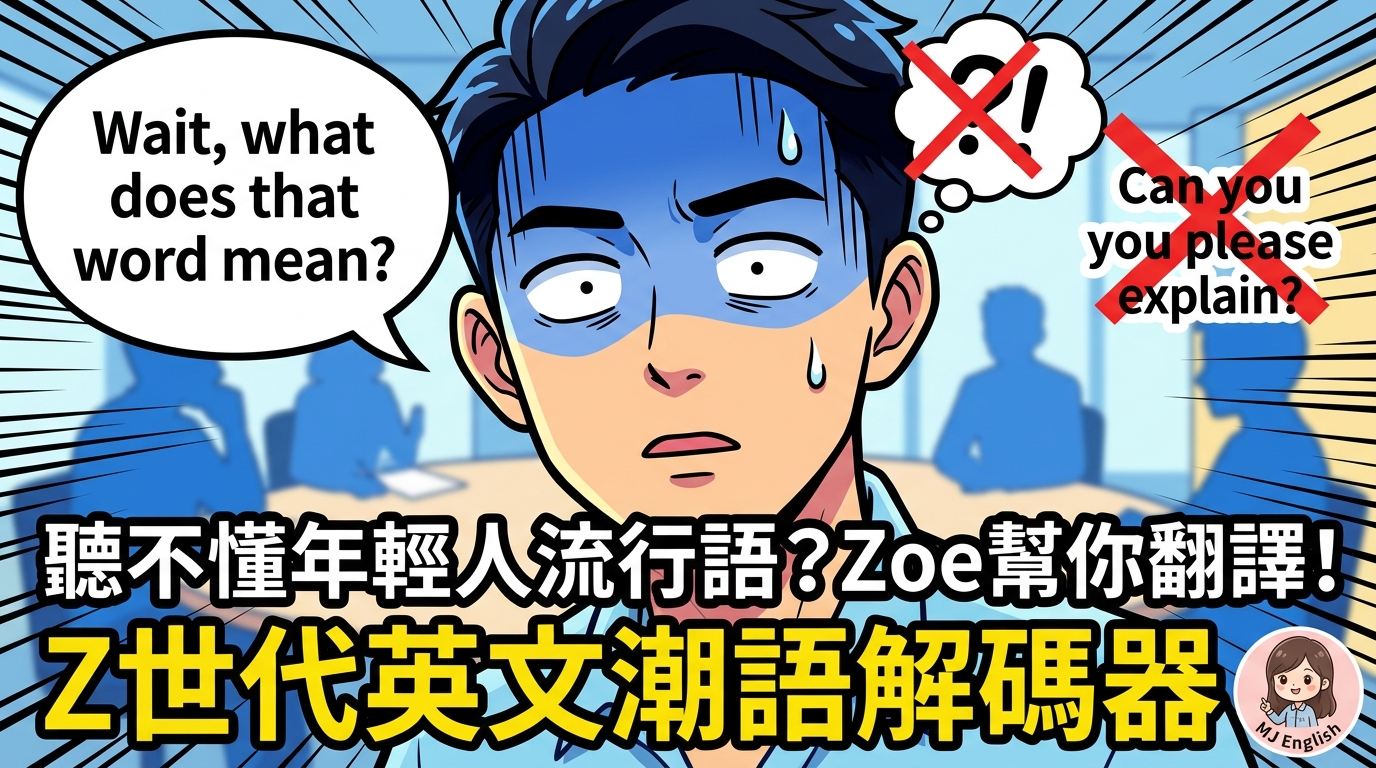
場景:Kevin 開會時一直聽到年輕同事 Zoe 在飆流行語,霧煞煞的他終於忍不住請 Zoe 幫他翻譯一下——一個狀況外的主管,一個耐心當人肉字典的 Gen Z。
Kevin
Zoe, you keep dropping the word rizz in meetings. I’m lowkey lost — what does that even mean?
Zoe,你開會一直冒出「rizz」這個字,我有點霧煞煞(lowkey lost)——這到底是什麼意思啊?
Zoe
Oh gosh, okay. Rizz is basically charm — how good you are at winning people over. That new client? You walked in with major rizz.
天啊,好。rizz(魅力)基本上就是魅力——你有多會擄獲人心。那個新客戶?你一進門就帶著滿滿的 rizz。
Kevin
Huh. So when I closed the deal, that was… rizz?
蛤。所以我談成那筆案子,那就是……rizz?
Zoe
No cap, that was elite rizz. The whole pitch was straight-up giving CEO energy.
真的不騙你(no cap),那是頂級的 rizz。整場簡報根本(straight-up)散發出 CEO 的氣場。
Kevin
Wait — “giving”? Giving what, exactly?
等等——「giving」?是給什麼啊?
Zoe
It’s giving means something gives off a vibe. Your slides were giving expensive, in the best way.
「It’s giving」是說某個東西散發出某種氛圍。你的投影片散發著「高級感」,是稱讚喔。
Kevin
I’ll take it. So was the meeting a slay too?
那我就收下了。所以那場會議也算「slay」(表現超神)嗎?
Zoe
Ha! Slay is when you completely nail it. Just don’t overuse it, or it starts giving try-hard.
哈!slay 是你完全表現超神的時候。不過別亂用,不然會開始散發「用力過頭」(try-hard)的味道。
Kevin
Noted. My nephew called my playlist mid. Should I be offended?
了解。我姪子說我的播放清單「mid」(普通),我該生氣嗎?
Zoe
Oof. Mid means average — not terrible, just nothing special. Sorry, Kevin.
唉。mid 是說很普通——不到爛,但也沒什麼特別。抱歉啦,Kevin。
Kevin
Brutal. He also said he’s delulu about some girl in his class.
好殘忍。他還說他對班上某個女生「delulu」(妄想、不切實際地暗戀)。
Zoe
Delulu is short for delusional — crushing on someone out of reach. We even say “delulu is the solulu,” like stay hopeful and it works out.
delulu 是 delusional(妄想的)的縮寫——暗戀一個根本追不到的人。我們還會說「delulu is the solulu」,意思是保持妄想,最後就會成真。
Kevin
Weirdly inspiring. Bet — did I use that right?
莫名有點勵志。Bet(好啊、成交)——我這樣用對嗎?
Zoe
You said “bet”! That’s “okay, I’m in.” Kevin, you’re lowkey fluent now — it’s giving cool uncle.
你說了「bet」!那是「好,我加入」的意思。Kevin,你有點變流利了耶——根本散發著「潮叔」的氣場(it’s giving cool uncle)。
下次這樣說 Next Time
3 個跟年輕人聊天直接拿來用的場景。台灣人最容易只會 “very good / okay” 把天聊死,換成這幾句,稱讚、形容氛圍、答應都瞬間到位。
① 想稱讚某人「表現超神」
You did very well. Your presentation was really good.
你做得很好。你的簡報真的很棒。
You totally slayed that presentation — no cap.
你那場簡報根本封神——真的不騙你。
為什麼:”very good” 文法對,但平淡得像在打考績。slay(表現超神)+ no cap(不騙你)才是年輕人真心激動時的講法,一聽就知道你是發自內心在誇。
② 想形容某個東西「散發某種質感」
This café feels very fancy and expensive.
這家咖啡廳感覺很高級、很貴。
This café is giving expensive — in the best way.
這家咖啡廳散發著「高級感」——是稱讚的那種。
為什麼:”feels very fancy” 沒錯但很描述性。”is giving + 氛圍” 是 Gen Z 最潮的句型,一句就把「氣場、質感、vibe」全包了,後面接名詞、形容詞都行。
③ 想答應、同意朋友的提議
Okay, I agree. That sounds good to me.
好的,我同意。那聽起來不錯。
Bet. I’m in.
好啊,我加入。
為什麼:”Okay, I agree” 太正式,像在會議上表決。朋友揪你 “Pizza tonight?” 回一個 “Bet.”(好啊)又短又道地,瞬間從同事變麻吉。
重點單字 Vocabulary Boost
rizz/ rɪz / n.
魅力、把人擄獲的社交吸引力。普遍說法是從 charisma(領袖魅力)中間挖出來的字,唸 cha-RIZ-ma 的中段。不只用在把妹,任何「電到全場」的時刻都行。
You walked in with major rizz. (你一進門就帶著滿滿的魅力。)
no cap/ noʊ kæp / phr.
我說真的、不騙你。cap 在這裡=謊言,no cap=沒在唬爛。可掛在句首或句尾加強誠意,是年輕人版的「我發誓」。
This is the best ramen in Tokyo, no cap. (這是東京最好吃的拉麵,真的不騙你。)
slay/ sleɪ / v.
表現超神、做得超棒。原意是「殺死」,引申成「強到把它打趴」。誇人也誇自己,但別狂用會變浮誇(變 try-hard)。
You slayed that presentation! (你那場簡報根本封神!)
mid/ mɪd / adj.
普通、不上不下、沒什麼特別。比「難吃/難看」更傷,因為連個性都沒有——是 Gen Z 最安靜的吐槽。
The movie wasn’t bad, it was just mid. (那部電影不算爛,就是很普通。)
delulu/ dɪˈluːluː / adj.
妄想的、不切實際地樂觀(delusional 的可愛縮寫)。常用在暗戀追不到的人;名句「delulu is the solulu」=妄想就是解方。
She’s a little delulu if she thinks he’ll text back. (她要是覺得他會回訊息,那有點妄想了。)
bet/ bet / interj.
好啊、沒問題、成交。答應或同意的超短回應,等於 “okay, I’m in” 或 “deal”。年輕人聊天最高頻的一個字。
“Pizza tonight?” “Bet.” (「今晚吃披薩?」「好啊。」)
try-hard/ ˈtraɪ hɑːrd / n./adj.
用力過頭、刻意到很尷尬的人或行為。諷刺的是:流行語用太勤,自己就變成 try-hard 了。
Wearing a suit to a picnic is a bit try-hard. (穿西裝去野餐有點太刻意了。)
nail it/ neɪl ɪt / phr.
完美達成、一次到位。把事情做到無懈可擊,和 slay 是好朋友,但 nail it 更日常、不那麼浮誇。
You nailed the interview — they called back in an hour. (你面試表現完美,他們一小時內就回電了。)
win someone over/ wɪn ˈsʌmwʌn ˈoʊvər / phr.
把某人收服、贏得好感。rizz 的「正式版」說法,談判、約會、面試都好用,正式場合也不失禮。
It took a while, but she won the whole team over. (花了點時間,但她收服了整個團隊。)
重點句型 Sentence Patterns
1. I’m lowkey + 形容詞 → 我有點/偷偷地…
lowkey=「低調地、有點」,是替句子降溫的緩衝詞,比直接說 very 更含蓄。雙胞胎是 highkey(公開地、超級)。
例:I’m lowkey nervous about tomorrow. (我對明天有點緊張。)
例:I’m highkey proud of you. (我超級以你為傲,不演了。)
2. It’s giving + 氛圍(名詞/形容詞)→ 散發出…的感覺
最難抓但最潮的一個。「It’s giving ___」=「它給人…的感覺」,後面接名詞、形容詞、一整個氛圍都行。
例:Your outfit is giving main character. (你今天的穿搭很有主角光環。)
例:That email was giving passive-aggressive. (那封信散發著一股陰陽怪氣。)
3. What does ___ even mean? → …到底是什麼意思?
關鍵在那個 even。”What does that mean?” 是中性提問;加了 even 就帶一點「我真的搞不懂、有點無奈」的情緒。
例:What even is this? (這到底是什麼鬼?)
例:Why does he even care? (他到底是在在意什麼?)
4. straight-up + 形容詞/動詞 → 根本就…、完全…
straight-up=「不誇張、老實說、完全地」,是個增強器,加在形容詞或動詞前面讓語氣更有力。和 no cap 是同一掛的「我說真的」家族。
例:That’s straight-up genius. (那根本是天才。)
例:He straight-up lied to my face. (他根本當著我的面說謊。)
5. ___ is short for ___ → …是…的縮寫
Gen Z 超愛把字砍短、加疊字(delusional → delulu)。學會這句,遇到任何聽不懂的縮寫都能直接開口問,不用裝懂。
例:”Info” is short for “information.” (info 是 information 的縮寫。)
例:What’s that short for? (那是什麼的縮寫?)
逐字稿 Transcript
J: Most people think Gen Z slang is just random nonsense — a pile of made-up words designed to make anyone over thirty feel ancient. Here’s the twist: it’s not random at all. There’s a logic, a rhythm, even a kind of poetry to it. I’m Jason, and on today’s MJ English, we’re cracking the code.
J: 大多數人以為 Gen Z 流行語只是一堆亂編的廢話,專門讓三十歲以上的人覺得自己很老。但好玩的就在這:它一點都不亂。它有邏輯、有節奏,甚至帶點詩意。我是 Jason,今天的 MJ English,我們來破解這套密碼。
M: And I’m Mary. Because here’s the real problem — you can study English for ten years, ace every grammar test, and still freeze when a twenty-two-year-old says your outfit is “giving.” Today we follow Kevin, a manager who’s completely lost, and Zoe, his Gen Z coworker who patiently translates the internet for him. Honestly? It’s a public service.
M: 我是 Mary。因為真正的問題是——你可以學英文學十年、每個文法考試都拿高分,結果一個二十二歲的人說你的穿搭「giving」,你還是當場僵住。今天我們跟著 Kevin,一個完全狀況外的主管,還有 Zoe,他那位 Gen Z 同事,耐心地幫他翻譯整個網路世界。老實說?這簡直是做公益。
M: It kicks off with Kevin admitting something brave. He says, “I’m lowkey lost.” Lowkey — one of the most useful words in the whole Gen Z dictionary. It means “kind of,” “secretly,” “a little.” “I’m lowkey lost” is softer than “I’m completely lost.” Its twin is highkey — that’s “openly, totally.” So you can be lowkey tired, or highkey obsessed. Notice how Kevin slipped it in naturally? That’s the goal.
M: 對話一開始,Kevin 就很勇敢地承認:「I’m lowkey lost.」lowkey(有點、偷偷地)是整本 Gen Z 字典裡最好用的字之一。它的意思是「有點、私底下、一點點」。「I’m lowkey lost」比「I’m completely lost」更柔和。它的雙胞胎是 highkey(公開地、完全地)。所以你可以 lowkey 累,也可以 highkey 著迷。有注意到 Kevin 多自然地把它塞進句子嗎?那就是我們的目標。
J: Then he asks the big one: “What does that even mean?” Listen to that little word — even. “What does that mean?” is neutral. “What does that even mean?” carries a tiny edge — confusion, mild frustration, a hint of “I give up.” That even is doing emotional work. Drop it into your questions and you instantly sound more native.
J: 接著他問了那個大哉問:「What does that even mean?」聽聽那個小字——even。「What does that mean?」是中性的。「What does that even mean?」就帶了一點刺——困惑、一點點無奈、還有一絲「我放棄」。那個 even 扛的就是情緒。把它丟進你的問句,你馬上就更像母語者。
J: And the word he’s stuck on is rizz. Rizz is charm — specifically, your ability to attract or win someone over. It’s widely said to come from the middle of the word “charisma.” Cha-RIZ-ma. Somebody chopped out the center and kept the good part. Zoe says Kevin walked in with “major rizz” and closed the deal. So rizz isn’t just for dating — it’s any moment you charm a room.
J: 他卡住的那個字是 rizz(魅力)。rizz 就是魅力——更精確地說,是你吸引人、收服人的能力。普遍說法是它來自 charisma(領袖魅力)這個字的中段。cha-RIZ-ma。有人把中間挖出來、留下精華。Zoe 說 Kevin 帶著「major rizz」進門、把案子談成。所以 rizz 不是只有把妹在用——你電到全場的任何時刻,都是 rizz。
M: Then Zoe confirms it with two more gems: “No cap, that was elite rizz.” No cap means “no lie, I’m being totally honest.” Cap means a lie; no cap means no lie. You can tag it onto anything — “This coffee is amazing, no cap.” And elite here just means top-tier, the best. Gen Z loves taking a fancy word and using it casually.
M: 然後 Zoe 又補了兩個超道地的說法來佐證:「No cap, that was elite rizz.」no cap(真的不騙你)意思是「不騙你,我完全說真話」。cap 是謊言;no cap 就是沒在唬。你可以把它掛在任何句子後面——「This coffee is amazing, no cap.」而這裡的 elite(頂級的)就是最高等級、最強。Gen Z 很愛拿一個高級的字、然後超隨意地用。
J: Now we hit the trickiest one — “it’s giving.” Kevin’s so confused he asks, “Giving what?” Fair question. “It’s giving” means “it gives off the vibe of.” The pitch was “giving CEO energy” — it radiated boss vibes. Your slides were “giving expensive” — they looked luxurious. The structure is simple: it’s giving, plus whatever vibe you’re sensing. A noun, an adjective, a whole mood. “This café is giving Paris.” Try it.
J: 現在來到最難的一個——「it’s giving」。Kevin 困惑到直接問:「Giving what?」(給什麼?)問得好。「It’s giving」意思是「它散發出…的氛圍」。那場簡報「giving CEO energy」——散發出老闆的氣場。你的投影片「giving expensive」——看起來很高級。結構很簡單:it’s giving,加上你感受到的任何氛圍。一個名詞、一個形容詞、一整個情緒都行。「This café is giving Paris.」試試看。
M: And right before that, Zoe says the pitch was “straight-up giving CEO energy.” Straight-up is an intensifier — it means “completely, honestly, no exaggeration.” “I straight-up forgot.” “That’s straight-up genius.” It adds punch. Pair it with these slang terms and you sound effortless.
M: 而就在那之前,Zoe 說那場簡報「straight-up giving CEO energy」。straight-up(根本就、完全)是個增強器——意思是「完全地、老實說、不誇張」。「I straight-up forgot.」(我根本就忘了。)「That’s straight-up genius.」(那根本是天才。)它能加重語氣。把它跟這些流行語搭在一起,你講起來就超自然、毫不費力。
J: Next, Kevin asks if the meeting was a “slay.” Slay is when you absolutely nail something — you did so well you metaphorically destroyed it. “You slayed that interview.” But Zoe adds a warning every learner needs: don’t overuse it, “or it starts giving try-hard.” Try-hard — someone who’s trying way too obviously, forcing it. The irony is real: use slang too eagerly and you become the try-hard. Slang has a temperature. Too much, and it’s cringe.
J: 接著,Kevin 問那場會議算不算「slay」。slay(表現超神)是你把某件事做到完美的時候——表現好到,誇張點說根本把它「秒殺」了。「You slayed that interview.」但 Zoe 加了一個每個學習者都需要的警告:別亂用,「不然會開始 giving try-hard」。try-hard(用力過頭)——一個努力到太明顯、太刻意的人。諷刺的是:流行語用太勤,你自己就變成 try-hard 了。流行語是有溫度的。用過頭,就 cringe(尷尬)了。
M: Then comes the brutal moment. Kevin’s nephew called his playlist “mid.” Mid means mediocre — average, nothing special. Not terrible, just… fine. And somehow that’s worse, right? “Bad” at least has personality. “Mid” is the quiet insult. Zoe even apologizes: “Sorry, Kevin.” Because calling someone’s taste mid? That stings.
M: 接著是殘忍的時刻。Kevin 的姪子說他的播放清單「mid」。mid(普通)意思是平庸——很一般、沒什麼特別。不到爛,就是…還行。但不知怎地,這樣反而更慘,對吧?「爛」至少還有個性。「mid」是那種不動聲色的羞辱。Zoe 甚至道歉:「Sorry, Kevin.」因為說別人的品味很 mid?那很傷。
J: Our last big one is delulu. Kevin’s nephew is “delulu” about a girl in his class. Delulu is a playful shortening of delusional — having hopes that are, let’s say, unrealistic. Crushing on someone way out of your league. But here’s the beautiful part — Zoe quotes the full saying: “delulu is the solulu.” Delusional is the solution. Stay hopelessly optimistic, and somehow it works out. It’s a joke and a life philosophy at the same time.
J: 我們最後一個重點是 delulu(妄想的)。Kevin 的姪子對班上一個女生「delulu」。delulu 是 delusional(妄想的)的俏皮縮寫——抱著一些,怎麼說呢,不切實際的希望。暗戀一個遠超出你等級的人。但美的地方來了——Zoe 引用了完整版名句:「delulu is the solulu.」妄想就是解方。保持沒救的樂觀,然後不知怎地就成真了。它同時是個笑話,也是個人生哲學。
M: And the payoff is perfect. Kevin tries his very first slang word: “Bet.” Bet means “okay, I’m in,” “deal,” “sounds good.” Someone says “Pizza tonight?” — you say “Bet.” Kevin uses it correctly on the first try, and Zoe celebrates: “You said ‘bet’! Kevin, you’re lowkey fluent now — it’s giving cool uncle.” From clueless to cool uncle in one conversation. That’s the dream.
M: 而結局完美。Kevin 試了他人生第一個流行語:「Bet.」bet(好啊、成交)意思是「好,我加入」、「成交」、「聽起來不錯」。有人說「Pizza tonight?」——你就回「Bet.」Kevin 第一次就用對,Zoe 還幫他慶祝:「You said ‘bet’! Kevin, you’re lowkey fluent now — it’s giving cool uncle.」(你說了 bet!你有點變流利了耶——根本散發著潮叔的氣場。)一段對話,就從狀況外變成潮叔。這就是夢想啊。
M: So let’s run it back. This time, listen for the ladder of slang — rizz, no cap, slay, mid, delulu, bet — and notice how Zoe never lectures. She just explains in the flow of normal talk. Catch how “lowkey” and “it’s giving” attach to other words like little vibe-machines. Ready? Here it is again.
M: 那我們再聽一次。這次,聽聽這串流行語的階梯——rizz、no cap、slay、mid、delulu、bet——注意 Zoe 從來不說教。她只是在正常聊天的流動裡解釋。抓一下「lowkey」和「it’s giving」怎麼像小小的氛圍製造機一樣,黏在別的字上面。準備好了嗎?再來一次。
[DIALOGUE REPLAY]
[重播情境對話]
J: Hearing it twice, you notice the real lesson hiding underneath. Gen Z slang isn’t about memorizing a list — it’s about tone. The same word can be a compliment or an insult depending on how you say it. “Slay” with a smile lifts someone up; “mid” with a shrug quietly crushes them. Context is everything, no cap.
J: 聽第二次,你會發現藏在底下的真正課題。Gen Z 流行語不是在背一張清單——而是在抓語氣。同一個字,看你怎麼說,可以是稱讚也可以是羞辱。帶著微笑說「slay」是在捧人;聳個肩說「mid」是在默默碾壓人。語境就是一切,真的不騙你。
J: So next time a coworker says your presentation was “giving CEO energy,” you won’t freeze. You’ll know it’s a compliment, you’ll know to smile, and maybe — just maybe — you’ll fire back with a casual “Bet.” You don’t need to use every word. You just need to understand the room. All the terms are in the notes below.
J: 所以下次同事說你的簡報「giving CEO energy」,你不會僵住。你會知道那是稱讚、會知道要微笑,而且也許——只是也許——你還能隨口回一句「Bet」。你不用每個字都會用。你只需要讀懂現場的氣氛。所有的字都在下方的筆記裡。
M: I’m Mary. Stay curious, keep your ears open, and remember — language is always evolving, and that’s the fun part, not the scary one. Lowkey, you’ve got this. See you next time on MJ English.
M: 我是 Mary。保持好奇、豎起耳朵,記得——語言永遠都在進化,那是有趣的部分,不是可怕的部分。偷偷說,你一定可以的。下次 MJ English 再見。
最近有哪個 Gen Z 流行語,讓你一臉問號?
留言告訴我——是 rizz、no cap,還是哪個你怎麼查都查不懂的字?下集幫你破解。
追蹤 MJ英語 podcast,下次見。