
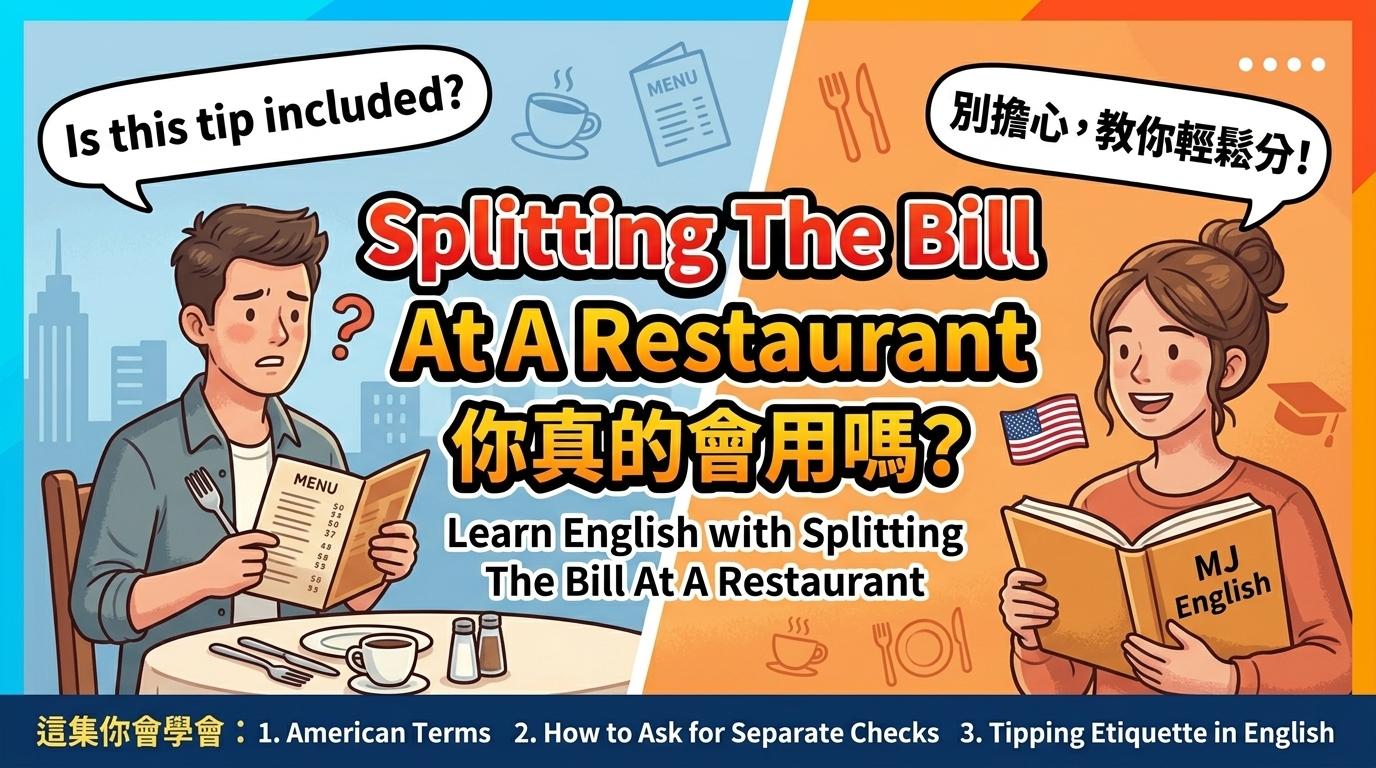
💡 先搞懂:美式拆帳跟台灣 100% 相反
台灣:一個人結帳,大家事後再 LINE 算或下次補回。不分帳是常態,分帳反而失禮。
美國:每個人付自己的份是預設值。一桌人各自拿出 Venmo、Cash App,誰吃多誰付多。連約會也可能 split。「我請客」反而要主動講出來,不講就是各付各的。
台灣人最容易踩的雷:默默期待對方搶單→沒人搶→錯過拆帳的開口時機→帳單擺著沒人動三分鐘。學會本篇 5 招,再也不冷場。
情境對話 Dialogue
場景:Amy 和 Ryan 在咖啡店吃完早午餐,帳單剛來,準備拆帳。
Amy
Alright, I think we’re done. Want me to grab the check?
好了,我覺得我們吃完了。要我去拿帳單嗎?
Ryan
Yeah, let’s wrap up. Should we split it?
好啊,收尾吧。我們要拆帳嗎?
Amy
Let’s see — wait, you only had the avocado toast, and I had the eggs Benedict plus the mimosa.
我看看——等等,你只點了酪梨吐司,我吃的是班尼迪克蛋加 含羞草。
Ryan
Right. Let’s just go down the list — it’ll be more fair.
對。逐項算就好——這樣比較公平。
Amy
Or we could just split it evenly. It’s like ten dollars difference.
不然平均分也行,差不多就差十塊。
Ryan
True, but I’m trying to be better about that stuff. Last time we did this I ended up covering a bunch of drinks I didn’t have.
是啦,但我最近想在這方面做好一點。上次平均分,我幫付了一堆我根本沒喝的飲料。
Amy
Fair point. Okay, itemized it is. You’re at — let’s see — sixteen plus tax and tip… call it twenty-two.
有道理。好,那就逐項。你那邊——我算——16 加稅加小費……算 22 塊吧。
Ryan
Sounds right. Venmo you?
差不多。Venmo 給你?
Amy
Yep, Venmo’s fine. Or Cash App, either works.
好啊 Venmo 可以。Cash App 也行,都可以。
Ryan
Cool. Hey — actually, you know what, I got it this time. You spotted me last week for the Uber.
好。欸——其實,這次我請了。上週 Uber 你幫我付了。
Amy
Oh — are you sure? It’s not that much.
喔——你確定?也沒多少錢。
Ryan
I insist. You can grab the next one.
我堅持。下次換你請。
Amy
Deal. Thanks, Ryan. Next brunch is on me.
成交。謝啦,Ryan。下次早午餐我請。
Ryan
Done. Let me just round it up for the tip and we’re out.
成交。我把零頭湊整當小費,我們就走人。
三句必背 Takeaway
三組「台灣人會說錯 vs 美國人這樣說」對比卡。記住差異點,下次拆帳不卡住。
① 開場拆帳
Do we pay together?
我們要一起付嗎?
Should we split it?
我們要拆帳嗎?
為什麼:split(拆帳)是美式餐廳專用動詞,自然輕鬆。”Pay together” 太書面,沒人這樣講,一聽就出戲。
② 我吃得比較少
I ate less than you, so I’ll pay less.
我吃得比你少,所以我付少一點。
I only had a salad, so I’ll Venmo you my share.
我只點了沙拉,我 Venmo 我那份給你。
為什麼:直接講「我點了什麼 + 我用 Venmo 給你」是行動方案。「ate less」聽起來在爭、像幼稚園分蛋糕;「only had X」是事實陳述,後面馬上接解決方法。
③ 我請客+留台階
I will pay for you.
我來付你的。
I got this one — you can grab the next one.
這頓我請——下次換你請。
為什麼:”Pay for you” 像高姿態施捨。”I got this one + grab the next one” 是平等的友誼貨幣——這頓我請,下次換你,潛台詞是「我們會繼續見面」。
重點單字 Vocabulary Boost
check/ tʃɛk / n.
帳單(美式)。英式叫 the bill,但美國餐廳一律 check。
Want me to grab the check? (要我去拿帳單嗎?)
split/ splɪt / v.
拆帳、分攤。可以 split evenly(平均分)或 split itemized(逐項分)。
Should we split it? (我們要拆帳嗎?)
go down the list/ goʊ daʊn ðə lɪst / idiom
逐項算錢(看菜單清單,誰點誰付)。比 itemize 更口語。
Let’s just go down the list — it’ll be more fair. (逐項算就好——這樣比較公平。)
cover (someone)/ ˈkʌvər / v.
代付、幫某人付他的份。語氣中性,不帶恩惠感。
I ended up covering a bunch of drinks I didn’t have. (結果我幫付了一堆我沒喝的飲料。)
Venmo/ ˈvɛnmoʊ / n. v.
美國最大的個人轉帳 App(PayPal 旗下)。可當動詞用。
Venmo me when you get home. (回家後 Venmo 給我。)
spot (someone)/ spɒt / v.
請客、先幫付(口語)。比 pay for 更朋友感、更輕。
You spotted me last week for the Uber. (上週 Uber 你幫我付了。)
round up/ raʊnd ʌp / phr. v.
湊整數(小費算法常用:41.30 湊到 50,差額當 tip)。
Let me round it up for the tip. (我湊個整數當小費。)
tip/ tɪp / n. v.
小費。美國非選擇性,sit-down 餐廳 15–20%。零小費 = 公開敵意。
Don’t forget to leave a tip. (別忘了留小費。)
grab the next one/ ɡræb ðə nɛkst wʌn / idiom
下次換你請。美式友誼貨幣的標準說法。
I got this — you can grab the next one. (這頓我請——下次換你。)
重點句型 Sentence Patterns
1. Should we split it? (我們要拆帳嗎?)
拆帳對話的萬用開場,9 成美國朋友會用這句問。Should 比 Will 軟,是「徵詢」不是「宣告」。
2. I only had X, so… (我只點了 X,所以…)
主張「我吃比較少所以付比較少」的禮貌句構。Only had 是事實陳述,不是抱怨。
3. I got this one — you can grab the next one. (這頓我請——下次換你)
美式請客+留台階的標準句構。”Got this” = 我這次付;”grab the next” = 下次你付。一前一後構成友誼循環。
4. Venmo me? / Cash App works. (Venmo 我?/Cash App 也行)
2026 年美國拆帳結尾必問句。Venmo 和 Cash App 是兩大支付 App,問哪個 App 就是問怎麼付。
5. Let’s just round it up for the tip. (湊整數當小費吧)
結帳最後一句的標準收尾。把總額湊到整數,差額就是 tip,乾淨俐落。
逐字稿 Transcript
J: Welcome back to MJ English. I’m Jason. Today’s the conversation Taiwanese visitors get wrong almost every single time we eat out abroad — splitting the bill. The check arrives, six pairs of eyes lock onto it, and somebody has to speak first. Amy and Ryan just modeled three different ways to handle this in under ninety seconds.
J: 歡迎回到 MJ English。我是 Jason。今天這場對話,台灣旅客在國外吃飯幾乎每次都會搞砸——拆帳。帳單一來,六雙眼睛盯著它,總得有人先開口。Amy 和 Ryan 剛剛用 90 秒示範了三種處理方式。
M: And I’m Mary. In Taiwan, one person usually covers the whole table and people quietly calculate later, or just let it slide. In the US, the default is the opposite. Everyone expects to pay their own share, and the rituals around that have specific vocabulary you cannot skip if you want to sound natural.
M: 我是 Mary。在台灣,通常一個人結整桌帳,大家事後默默算或乾脆算了。美國剛好相反——預設值是每個人付自己的那份,而圍繞拆帳的儀式有一套必學詞彙,少了就不像話。
J: Move one — the opener. Amy says, “Want me to grab the check?” Two pieces of vocab here. Check is the American word for what Brits call the bill. And the verb “grab” — “grab the check” — is the soft way to take responsibility for the next action without claiming to pay. Anyone can grab the check; that doesn’t mean they’re paying for it. It just means they’re handling it.
J: 第一招——開場。Amy 說 “Want me to grab the check?”。兩個詞要記。Check 是美國對帳單的用法,英國人說 the bill。動詞 grab——「grab the check」是一種柔性的「我來處理下一個動作」,並不等於「我來付」。任何人都能去拿帳單,不代表他要付。
M: Right after that, Ryan delivers the standard question: “Should we split it?” Split is the keyword for this whole episode. To split a bill is to divide it among people. In American restaurant culture, this question gets asked nine times out of ten. If nobody asks, the default assumption shifts to “everyone pays their own share anyway” — but the verbal handshake matters.
M: 緊接著 Ryan 丟出標準問句 “Should we split it?”。Split 是這集的關鍵字,意思是把帳單分給大家。在美國的餐廳文化裡,這句話幾乎是十次有九次都會被問出口。
就算沒有人真的問,大家心裡的「預設模式」其實也會自動變成「反正就是各付各的」——但把這句話講出來,等於是一種口頭上的默契確認。
J: Move two — the negotiation. Amy notices the imbalance: “You only had the avocado toast, and I had the eggs Benedict plus the mimosa.” She’s flagging that splitting evenly wouldn’t be fair. Ryan responds with the magic phrase: “Let’s just go down the list — it’ll be more fair.”
J: 第二招——協商。Amy 注意到不平衡:”你只點了酪梨吐司,我點班尼迪克蛋加含羞草。” 她在點出「平均分不公平」的事實。Ryan 用神奇句子回 “Let’s just go down the list — it’ll be more fair.”。
M: Go down the list means itemize — pay for what you specifically ordered. The other option is to “split it evenly,” which means divide the total by the number of people. Two completely different American restaurant rituals, and you need to know which one is happening. Even split when prices are similar; itemize when they’re not.
M: Go down the list 意思就是 itemize——你點什麼就付什麼。另一個選項是 “split it evenly”,把總額除以人數平均分。兩種完全不同的美國餐廳儀式,你必須知道現在在跑哪一種。價錢差不多就平均分;差很多就逐項。
J: And here’s a cultural nuance. Ryan’s line — “I’m trying to be better about that stuff. Last time we did this I ended up covering a bunch of drinks I didn’t have.” Covering someone means paying for their share. In American friendship, repeatedly covering people without reciprocation is a quiet way to feel taken advantage of. Itemized splits aren’t stingy — they’re considered respectful.
J: 這裡有一個文化細節。Ryan 那句 “I’m trying to be better about that stuff. Last time we did this I ended up covering a bunch of drinks I didn’t have.”。Covering 某人,意思就是幫他付他那份。在美式友誼裡,一直幫付而對方不回禮,是一種會默默累積委屈的事。逐項拆帳不是小氣——是被視為「尊重彼此」的做法。
M: Move three — the settling tools. Amy asks “Venmo you?” and Ryan says “Cash App, either works.” Venmo and Cash App are the two dominant peer-to-peer payment apps in the US. The verb “to Venmo someone” — “Venmo me” — means to send them money through the app. In 2026, asking “Venmo or Cash App?” is the equivalent of asking “Cash or card?” twenty years ago.
M: 第三招——結算工具。Amy 問 “Venmo you?”,Ryan 回 “Cash App, either works.”。Venmo 和 Cash App 是美國兩大個人轉帳 App。動詞「to Venmo someone」——”Venmo me” 意思就是用 App 轉錢給對方。2026 年問 “Venmo or Cash App?” 就等於 20 年前問「現金還是刷卡?」
J: A small detail — “Venmo’s fine” or “Cash App works” both signal you’re flexible. If someone says “Venmo only” or “Cash App only,” you need that specific app installed. Pro tip — install both before traveling. Splitting bills with friends in the US without these apps is genuinely awkward now.
J: 小細節——”Venmo’s fine” 或 “Cash App works” 都是在說「我都可以」。如果對方說 “Venmo only” 或 “Cash App only”,那你必須有那個 App。小撇步:去美國前兩個都下載。沒裝這兩個 App 在美國朋友圈拆帳,真的會超尷尬。
M: Move four — the gracious takeover. Ryan flips the script: “Actually, you know what, I got it this time. You spotted me last week for the Uber.” Two key phrases. “I got it” means I’ll pay for the whole thing. And to spot someone — “you spotted me last week” — means they paid for you at an earlier time. It’s how Americans track favors without bringing out a calculator.
M: 第四招——優雅接手。Ryan 翻轉劇情:”Actually, you know what, I got it this time. You spotted me last week for the Uber.”。兩個關鍵片語。”I got it” 意思是「我來付全部」。To spot someone——”you spotted me last week” 意思是「上次你幫我付了」。這就是美國人記人情的方法,不用算盤、不用計算機。
J: And then the magic closing line — “You can grab the next one.” Grab the next one is the verbal handshake of friendship economics in America. It means: I’m covering today, you cover next time. No tally, no spreadsheet, just trust. This is how friend groups in the US balance out over time without ever splitting itemized bills.
J: 然後那句魔術收尾——”You can grab the next one.”。Grab the next one 是美式友誼經濟學的默契,意思是:這頓我請,下頓你請。不記帳、不開試算表,純粹信任。美國朋友圈就是靠這套方式,長期把帳算平,連 itemize 都不用。
M: Move five — the tip and round up. Ryan says, “Let me just round it up for the tip and we’re out.” Round up means take the total and bring it up to a clean number — like rounding forty-one point three zero to fifty. The difference becomes part of the tip. Tipping in the US is non-optional. Fifteen to twenty percent for sit-down restaurants. Even more important — never zero. Zero tip is a statement, and it’s almost always read as hostile.
M: 第五招——湊整數和小費。Ryan 說 “Let me just round it up for the tip and we’re out.”。Round up 意思就是把總額拉到整數——例如 41.3 湊到 50。差額就變成 tip 的一部分。美國小費不是選擇題,sit-down 餐廳 15 到 20%。更重要的是——絕對不能零。Zero tip 是一種表態,幾乎都會被讀成「我很不爽」。
J: One subtle thing about the rhythm of this conversation. Notice how short Ryan’s sentences are. “Venmo you?” “Cash App, either works.” “I got it this time.” Americans don’t formalize money talk — they make it casual, fast, conversational. The longer your sentences when discussing the bill, the more uncomfortable you sound. Brevity equals confidence here.
J: 還有一個對話節奏的小細節。注意 Ryan 的句子有多短:”Venmo you?” “Cash App, either works.” “I got it this time.” 美國人不把錢的事弄得正式——他們讓它隨意、快速、像聊天。你討論帳單的句子越長,聽起來越彆扭。在這裡,簡短等於自信。
M: Let’s listen one more time. This time, count how many times the word “split” appears, and notice the exact moment Ryan flips from itemizing to covering. That transition — about ten seconds long — is the heart of this conversation. It’s where American friendship economics actually live.
M: 再聽一次。這次數 split 這個字出現幾次,並注意 Ryan 從「逐項算」翻轉到「這頓我請」的那個瞬間。那大約 10 秒的轉折,就是這場對話的核心,也是美式友誼經濟學真正活著的地方。
J: After the replay, you’ll notice the entire negotiation took less than two minutes. That’s the goal. Bill-splitting is supposed to be fast. The longer it takes, the more awkward it gets. The vocab and patterns we covered are designed to compress the whole thing into ninety seconds.
J: 重播後你會發現整場協商不到兩分鐘。這就是目標。拆帳本來就應該快。拖越久越尷尬。今天教的單字和句型,就是設計來把整件事壓到 90 秒內。
M: I’m Mary. Save “Venmo me?” and “Grab the next one” — these two phrases alone will solve eighty percent of your bill-splitting situations in the US.
M: 我是 Mary。把 “Venmo me?” 和 “Grab the next one” 這兩句存起來——光是這兩句就能解掉你在美國 80% 的拆帳場景。
J: I’m Jason. The check is part of the conversation. Order well, split clean. See you next time on MJ English.
J: 我是 Jason。帳單也是對話的一部分。點得好、拆得乾脆。下次 MJ English 再見。
你最尷尬的拆帳經驗是什麼?
是搶單搶輸、是被默默扛掉整桌、還是 Venmo 忘了寄?留言告訴我。
追蹤 MJ英語 podcast,下次見。