💡 先搞懂:國外吃飯的流程跟台灣不一樣
第一個雷:不能自己亂坐。很多國外的正式餐廳門口會寫 “please wait to be seated”(請等候帶位),你要在門口等人帶位,不像台灣看到空桌就坐。想先查評價、訂位,OpenTable、Yelp、Resy 這些平台都查得到在地推薦跟訂位。
第二個雷:買單不是去櫃台。西方多半是請服務生把帳單拿到桌邊,你說一句 “Could we get the check?”(可以拿帳單嗎?)就好,不是自己走到收銀台。而且美國小費(tip)通常沒含在價格裡,要另外加一成五到兩成(15–20%)。
台灣人最容易卡的雷:想點餐說 “I want…”、想去料說 “No onions / Don’t put…”——文法沒錯,但聽起來像命令。換成 “Could I get…” 和 “hold the onions”,瞬間有禮貌又道地。
情境對話 Dialogue
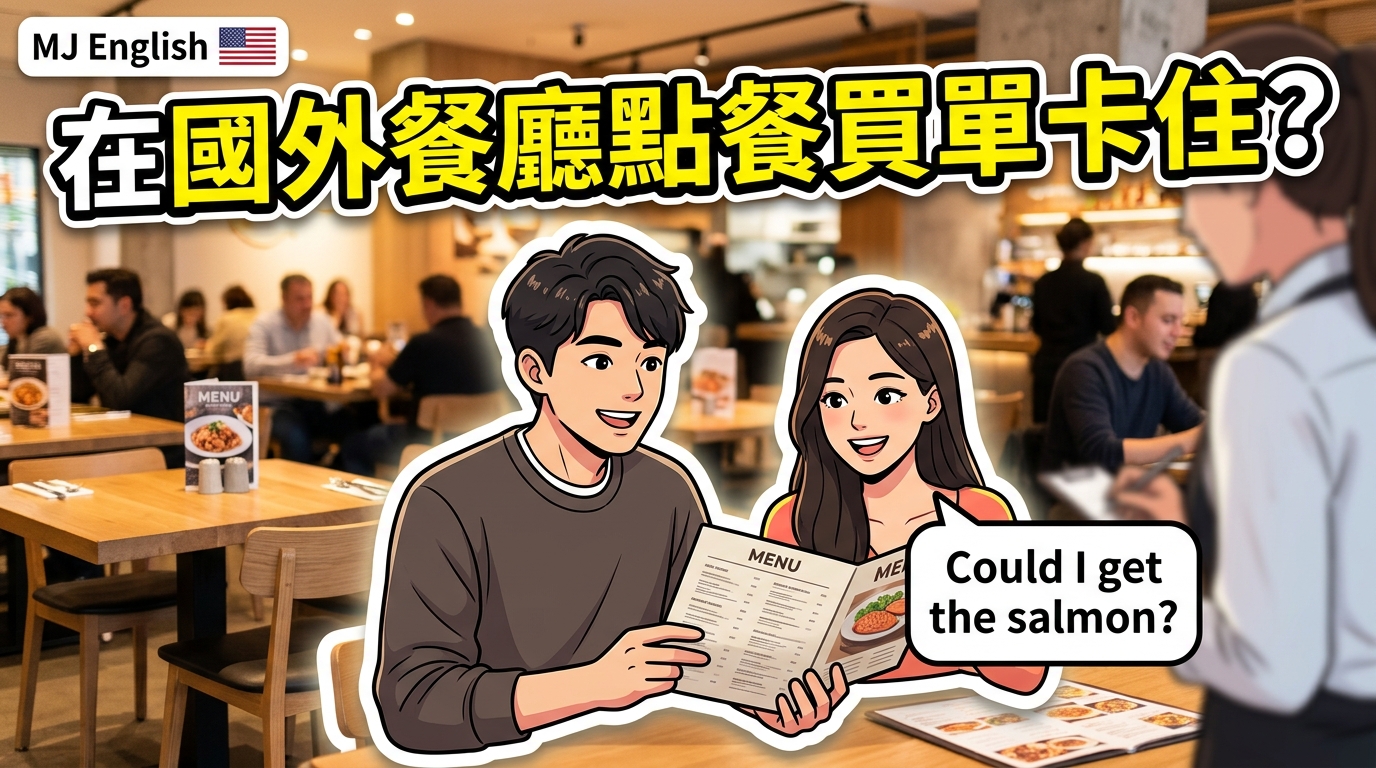
場景:Amy 跟朋友在國外一家餐廳吃飯,從服務生帶位後開始點餐、客製餐點,一路到最後分帳買單。
Server
Hi there, welcome in! Are you ready to order, or do you need a few more minutes?
嗨,歡迎光臨!準備好點餐了嗎,還是需要再幾分鐘?
Amy
I think we’re ready. Could I get the grilled salmon?
我們準備好了。可以給我烤鮭魚嗎(Could I get)?
Server
Great choice. Any sides with that — fries, or a side salad?
很好的選擇。要配菜嗎(sides)——薯條,還是一份沙拉?
Amy
The salad, please. And could you put the dressing on the side?
沙拉,謝謝。然後醬可以另外附嗎(on the side)?
Server
Of course. And anything to drink for the table?
沒問題。那你們要喝點什麼嗎?
Amy
Just water for me. Oh, and could you hold the onions on his burger?
我只要水。喔,還有他的漢堡可以不要加洋蔥嗎(hold)?
Server
No problem at all. Is that for here or to go?
完全沒問題。這是內用還是外帶(for here or to go)?
Amy
For here. Quick question — do you have any recommendations?
內用。順便問一下——你有推薦的嗎(recommendations)?
Server
The lemon tart is amazing. It’s on the house tonight, actually.
檸檬塔超讚。其實今晚是店家招待(on the house)。
Amy
Oh, lovely! We’ll take one. Could we get the check whenever you have a sec?
喔太好了!我們要一份。你有空的時候可以幫我們拿帳單嗎(the check)?
Server
Sure thing. Will that be together or separate?
沒問題。要一起算還是分開算?
Amy
Could we split the bill? And is the tip included?
我們可以分開付嗎(split the bill)?還有小費含在裡面了嗎(tip)?
Server
It’s not, but no pressure at all. I’ll grab everything now.
沒有喔,但完全不用有壓力。我馬上把東西都拿來。
下次這樣說 Next Time
點餐、去料、買單這三關最容易把中文直接搬過來。學會這幾句,從進門到結帳都到位。
① 點餐
I want the salmon.
我要鮭魚。
Could I get the salmon? / I’ll have the salmon.
可以給我鮭魚嗎?/我要點鮭魚。
為什麼:”I want” 文法沒錯,但聽起來像在下命令。”Could I get…” 和 “I’ll have…” 一樣直接,卻多了禮貌,是母語者點餐的標準起手式。
② 客製化去料
Don’t put onions. I don’t want onions.
不要放洋蔥。我不想要洋蔥。
Could you hold the onions?
可以不要加洋蔥嗎?
為什麼:”Don’t put…” 像在指揮人。”hold” 是餐廳專用的「這個不要」——hold the onions、hold the ice,一個字就搞定,乾淨又道地。
③ 買單分帳
I want to pay. Give me the receipt. We pay separately.
我要付錢。給我收據。我們分開付。
Could we get the check? Could we split the bill?
可以幫我們拿帳單嗎?我們可以分開付嗎?
為什麼:買單是請服務生把 “the check”(帳單)拿到桌邊,不是要 receipt(收據),也不是走去櫃台。要各付各的就說 “split the bill”,自然又清楚。
重點單字 Vocabulary Boost
Could I get ~ / Can I have ~/ kʊd aɪ ɡet / phr.
可以給我~嗎(點餐最有禮貌的起手式)。比 “I want” 自然太多,是進餐廳第一句最好用的萬用句。後面直接接餐點名稱即可。
Could I get the grilled salmon? (可以給我烤鮭魚嗎?)
I’ll have ~/ aɪl hæv / phr.
我要點~(母語者點餐最常聽到的講法)。聽起來有自信又友善。指著菜單說 “I’ll have this one” 也完全 OK。
I’ll have the cheeseburger, please. (我要點起司漢堡,謝謝。)
hold ~/ hoʊld / v.
去掉、不要加(某個食材)。餐廳專用的魔法字,比 “Don’t put…” 客氣很多。hold the onions(不要洋蔥)、hold the ice(去冰)、hold the mayo(不要美乃滋)。
Could you hold the onions? (可以不要加洋蔥嗎?)
on the side/ ɑːn ðə saɪd / phr.
(醬料、配菜)另外分開放,不要淋上去。想自己控制醬量、或怕太鹹太油時超實用。”dressing on the side”(沙拉醬另外附)是經典用法。
Could you put the dressing on the side? (醬可以另外附嗎?)
for here or to go/ fɔːr hɪr ɔːr tə ɡoʊ / phr.
內用還是外帶。速食店、咖啡店幾乎每次都問你。for here=內用、to go=外帶(英式常說 takeaway)。答案先想好,回得快又順。
Is that for here or to go? — For here, please. (內用還是外帶?——內用,謝謝。)
recommend / recommendation/ ˌrekəˈmend / v. / n.
推薦/推薦的東西。不知道點什麼,問一句 “Do you have any recommendations?” 馬上顯得輕鬆又懂吃。動詞 recommend、名詞 recommendation。
Do you have any recommendations? (你有推薦的嗎?)
the check/ ðə tʃek / n.
帳單(美式)。要買單就說 “Could we get the check?”。英式則叫 the bill。注意不是 receipt(那是付完後的收據)。
Could we get the check, please? (可以幫我們拿帳單嗎?)
split the bill/ splɪt ðə bɪl / phr.
分帳、各付各的(每人付自己那份)。和朋友吃飯超常用。想平分總額可說 “Let’s split it evenly”;想各付各的也可說 “separate checks”。
Could we split the bill? (我們可以分開付嗎?)
tip/ tɪp / n. / v.
小費(給/付小費)。美國餐廳預設要給,通常餐費的 15–20%,且常沒含在價格裡。問 “Is the tip included?”(小費含了嗎?)最保險。
Is the tip included? (小費含在裡面了嗎?)
on the house/ ɑːn ðə haʊs / idiom
店家招待、免費的(餐廳請客)。house 在這裡指「店家」。聽到 “It’s on the house.” 就是不用錢,微笑說聲謝謝就好。
The dessert is on the house tonight. (今晚甜點是店家招待。)
重點句型 Sentence Patterns
1. Could I get…? / Can I have…? / I’ll have… → 點餐的三種道地起手式
三句都是「我要點~」,禮貌又自然,後面直接接餐點。比直翻的 “I want” 順耳太多,挑順口的用就好。
例:Can I have the chicken pasta? (我可以點雞肉義大利麵嗎?)
例:I’ll have the steak, medium. (我要牛排,五分熟。)
2. Could you hold the…? / … on the side → 客製化:去料 & 醬分開
想改餐點時的兩大法寶。hold=某食材不要加;on the side=醬料或配菜另外放、不要淋上去。
例:Can I get the sauce on the side? (醬可以另外附嗎?)
例:Hold the mayo, and dressing on the side, please. (不要美乃滋,醬另外放,謝謝。)
3. Do you have any recommendations? → 你有推薦的嗎?
不知道點什麼的萬用救星,丟給服務生最自然。也可以說 “What do you recommend?” 或 “What’s good here?”。
例:What do you recommend? (你推薦什麼?)
例:What’s good here? (這裡什麼好吃?)
4. Could we get the check? / Could we split the bill? → 買單與分帳
吃完要結帳的兩句核心。請服務生拿帳單到桌邊,再決定一起算還是各付各的。
例:Could we split the bill? (我們可以分開付嗎?)
例:Can we get separate checks? (可以分開結帳嗎?)
5. Is the tip / service included? → 小費/服務費含了嗎?
結帳前確認小費的關鍵句。美國小費常沒含在價格裡,問一句最保險,才不會帳單嚇一跳。
例:Is service included? (服務費含了嗎?)
例:How much should I tip? (我該給多少小費?)
逐字稿 Transcript
J: Quick question. You’re at a restaurant overseas, the food was great, and you’re ready to pay. What do you actually say to get the bill? If your brain jumps straight to “I want to pay,” or you start scanning the room for a cashier to walk up to — that’s the exact moment a lot of travelers from Taiwan freeze up. The words from the textbook don’t quite match what really happens at the table. I’m Jason, this is MJ English, and today we’re walking through one whole restaurant visit, start to finish — sitting down, ordering, customizing your food, and yes, splitting the bill at the end — so not a single part of it catches you off guard.
J: 快問快答。你在國外餐廳吃完飯,東西超好吃,準備要買單了。你到底要說什麼才能請對方把帳單拿來?如果你腦中第一個冒出來的是 “I want to pay”,或開始東張西望找櫃台想走過去結帳——那一刻,超多台灣旅客就卡住了。課本教的那些,跟餐桌上真正會發生的對不太上。我是 Jason,這裡是 MJ English,今天我們從頭到尾走一遍完整的餐廳流程——入座、點餐、客製餐點,對,還有最後的分帳買單——讓每個環節都不會再嚇到你。
M: I’m Mary. And here’s the thing nobody warns you about: ordering food in English isn’t hard because of the vocabulary — most of those words are easy. It’s hard because the rhythm and the politeness work a little differently from what we’re used to. One culture note first, because it saves a lot of awkwardness. At a lot of sit-down restaurants abroad, a sign or a host means “please wait to be seated” — you don’t just grab any open table like we often do back home; you wait by the door and someone walks you to your seat. Then, in our dialogue, the server opens with, “Are you ready to order, or do you need a few more minutes?” Notice the little gift at the end — the server hands Amy a way out. You’re completely allowed to say, “A few more minutes, please.” Nobody is rushing you.
M: 我是 Mary。有件事沒人會提醒你:用英文點餐難,不是難在單字——那些字大多很簡單。難的是那個節奏跟禮貌的眉角,跟我們習慣的不太一樣。先講一個文化重點,能省掉很多尷尬。很多國外的正式餐廳,門口會有牌子或帶位人員寫著 “please wait to be seated”(請等候帶位)——你不能像在台灣那樣自己挑張空桌就坐,要在門口等,會有人帶你入座。再來,對話裡服務生開口就問 “Are you ready to order, or do you need a few more minutes?”(準備好點餐了嗎,還是需要幾分鐘?)。注意最後那個小貼心——服務生給了 Amy 一個台階下。你完全可以說 “A few more minutes, please.”(再給我幾分鐘,謝謝)。沒有人在催你。
J: So Amy’s ready, and listen closely to how she orders: “Could I get the grilled salmon?” Not “I want the salmon.” This is the number one fix for us. Translated straight from Chinese, “I want” feels natural — but in English it can land a little blunt, almost like you’re barking an order. The smooth, natural openers are “Could I get…,” “Can I have…,” and “I’ll have…” All three are polite and completely standard. Honestly, “I’ll have the salmon” is what you’ll hear most from native speakers — it sounds confident and friendly, and it does the whole job in three little words.
J: 好,Amy 準備好了,仔細聽她怎麼點:”Could I get the grilled salmon?”(可以給我烤鮭魚嗎?)。不是 “I want the salmon.”。這是我們最該改的第一名。從中文直翻,”I want” 對我們很順——但英文裡聽起來有點直、有點兇,幾乎像在下命令。比較滑順、自然的開場是 “Could I get…”、”Can I have…”、還有 “I’ll have…”。三個都很有禮貌、完全標準。老實說,”I’ll have the salmon”(我要烤鮭魚)是你最常從母語者嘴裡聽到的——聽起來有自信又友善,三個字就把事情講完。
M: Next comes the part that quietly trips everyone up: customizing your order. Amy says, “Could you put the dressing on the side?” and a moment later, “Could you hold the onions?” Two golden phrases hiding right there. “On the side” means bring it separately — don’t pour the sauce all over it, leave it next to the plate so you decide how much. And “hold” is the magic restaurant word for “leave this out.” Hold the onions, hold the ice, hold the mayo. The beauty of it is you’re not bluntly saying “don’t put onions,” which can sound a bit harsh — you just say “hold the onions,” and it comes out clean, easy, and completely native.
M: 接下來是大家會默默卡住的地方:客製你的餐點。Amy 說 “Could you put the dressing on the side?”(可以把醬另外附嗎?),過一下又說 “Could you hold the onions?”(可以不要加洋蔥嗎?)。兩個超好用的說法藏在裡面。”On the side”(醬料分開放、另外附)就是「分開拿過來」——不要把醬全淋上去,放盤子旁邊,你自己決定要加多少。而 “hold”(去掉、不要加)是餐廳裡的魔法字,就是「這個不要」。Hold the onions(不要洋蔥)、hold the ice(去冰)、hold the mayo(不要美乃滋)。妙的是,你不是硬邦邦地說 “don’t put onions”,那聽起來有點兇——你只要說 “hold the onions”,就乾淨、輕鬆、又超道地。
J: Now a few small ones that throw people. The server asks, “Is that for here or to go?” “For here” means you’re eating in; “to go” means takeout — in a fast-food place you’ll get this every single time, so keep your answer ready. There’s a drinks trap too: when they ask what you’d like and you just want water, in a lot of places, especially in Europe, they’ll follow up with “Still or sparkling?” “Still” is flat water; “sparkling” is fizzy, and that one usually costs money — so if you want the free kind, say “just tap water, please.” Then Amy pulls a pro move and asks, “Do you have any recommendations?” That one question instantly makes you sound relaxed and curious instead of frozen, and servers love it. She even gets lucky — the lemon tart is “on the house,” which means it’s free, the restaurant’s treat. Hear those three words, and you just smile and say thank you.
J: 再來幾個會讓人措手不及的小地方。服務生問 “Is that for here or to go?”(內用還是外帶?)。”For here”(內用)就是你要在店裡吃;”to go”(外帶)就是帶走——在速食店每次都會問你,所以答案要準備好。喝的也有陷阱:當對方問你要喝什麼、你只想要水時,很多地方、尤其歐洲,會接著問 “Still or sparkling?”(一般水還是氣泡水?)。”Still”(無氣泡的一般水)是平的水;”sparkling”(氣泡水)是有氣的,而且那種通常要錢——所以你想要免費的,就說 “just tap water, please.”(給我自來水就好,謝謝)。然後 Amy 來了一招高手操作,她問 “Do you have any recommendations?”(你有推薦的嗎?)。這一句馬上讓你聽起來輕鬆又有好奇心,不會僵在那邊,服務生超愛。她還走運——那個檸檬塔是 “on the house”(店家招待、免費的),意思是免費、餐廳請客。聽到這三個字,你就微笑說聲謝謝。
M: One more real-life moment the topic promised — what if something’s wrong? Maybe the dish isn’t what you ordered, or the soup’s cold. Please don’t suffer in silence the way we often do back home. The polite, native way is gentle and easy: catch the server and say, “Excuse me, I think there’s been a mix-up — I ordered the salmon, not the steak,” or “Sorry, would you mind warming this up?” If a dish is genuinely wrong, “Could I send this back?” is the normal, totally acceptable phrase — nobody thinks you’re being rude. The trick is to stay friendly and start with “Excuse me” or “Sorry,” and the whole thing gets sorted out in seconds.
M: 還有一個主題答應要講的真實場景——萬一出錯了怎麼辦?可能上錯菜、或湯是冷的。拜託別像我們在台灣常做的那樣默默忍。道地又有禮貌的方式其實很溫和、很簡單:叫住服務生說 “Excuse me, I think there’s been a mix-up — I ordered the salmon, not the steak.”(不好意思,我想是搞錯了——我點的是鮭魚,不是牛排),或是 “Sorry, would you mind warming this up?”(不好意思,可以幫我加熱一下嗎?)。如果一道菜真的送錯,”Could I send this back?”(可以幫我退這道嗎?)是很正常、完全可以接受的說法——沒有人會覺得你沒禮貌。訣竅就是保持友善、用 “Excuse me” 或 “Sorry” 開頭,整件事幾秒鐘就解決了。
J: And then we arrive right back where we started — paying. Amy says, “Could we get the check?” “The check” is the American word for the bill; over in Britain, they just call it “the bill.” Either one works fine. The server replies, “Together or separate?” and Amy says, “Could we split the bill?” “Split the bill” means everyone pays their own share. And then she asks the single smartest question of the whole meal: “Is the tip included?” Here’s the big culture gap. In the United States, tipping is expected — usually fifteen to twenty percent — and it’s often not printed in the price. Back home in Taiwan, we just pay exactly what’s on the menu, so this one catches people every time. Always ask, and you’ll never get a nasty surprise at the bottom of the bill.
J: 然後我們繞回一開始的問題——買單。Amy 說 “Could we get the check?”(可以幫我們拿帳單嗎?)。”The check”(帳單,美式說法)是美國對帳單的講法;在英國,他們就叫 “the bill”。兩個哪裡都通。服務生回 “Together or separate?”(一起算還是分開算?),Amy 說 “Could we split the bill?”(我們可以分開付嗎?)。”Split the bill”(分帳、各付各的)就是每個人付自己的份。然後她問了整餐最聰明的一句:”Is the tip included?”(小費含在裡面了嗎?)。重點來了,文化差超大。在美國,付小費是預設的——通常餐費的一成五到兩成——而且常常沒印在價格裡。在台灣,我們就是付菜單上寫的數字,所以這點每次都讓人踩雷。一定要問,帳單最後才不會給你一個難看的驚喜。
[DIALOGUE REPLAY]
[重播情境對話]
M: Run the whole thing past your ears one more time, and notice how little of it is fancy. There’s no rare vocabulary in that entire conversation — it’s all small, polite building blocks stacked in the right order: “Could I get,” “hold the onions,” “on the side,” “the check,” “split the bill.” That’s the real secret to ordering like a local. You don’t need a bigger dictionary; you need the handful of phrases that come up at every single table, ready to fire without thinking. Lock in those ten, and you can walk into a restaurant in any English-speaking country and run the whole meal on your own.
M: 把整段再從耳朵過一遍,你會發現裡面幾乎沒有什麼華麗的東西。整段對話沒有冷僻單字——全是一些小小的、有禮貌的積木,照對的順序疊起來:”Could I get”、”hold the onions”、”on the side”、”the check”、”split the bill”。這就是像在地人一樣點餐的真正祕訣。你不需要更大的字典;你需要的是那一小把每張餐桌都會用到的句子,不用想就能脫口而出。把這十個記牢,你就能走進任何英語系國家的餐廳,自己從頭搞定整頓飯。
J: So here’s your challenge for the next time you eat out — even right here in Taiwan — run the whole thing through your head in English. Order with “I’ll have…,” customize with “hold the…,” and finish with “Could we get the check?” Say it out loud a few times now, while everything’s calm, and it’ll be sitting on your tongue the moment you actually need it overseas. Everything we covered is written up in the notes below. I’m Jason — go enjoy a great meal, order it with confidence, and we’ll catch you next time on MJ English.
J: 所以這是給你下次出去吃飯的挑戰——就算是在台灣也一樣——在腦中用英文把整套跑一遍。用 “I’ll have…” 點餐,用 “hold the…” 客製,最後用 “Could we get the check?” 收尾。趁現在很輕鬆,先大聲念個幾次,等你真的在國外需要時,它就已經在你舌尖上等著了。今天講的全部都整理在下方連結。我是 Jason——去好好享受一頓飯,點得有自信一點,我們下次 MJ English 再見。
你在國外餐廳,最常卡在哪一關?點餐、客製、還是買單分帳?
留言告訴我們你的「餐廳尷尬時刻」,或用今天學到的句子造一句——我們會挑幾則回覆你。
追蹤 MJ英語 podcast,下次見。