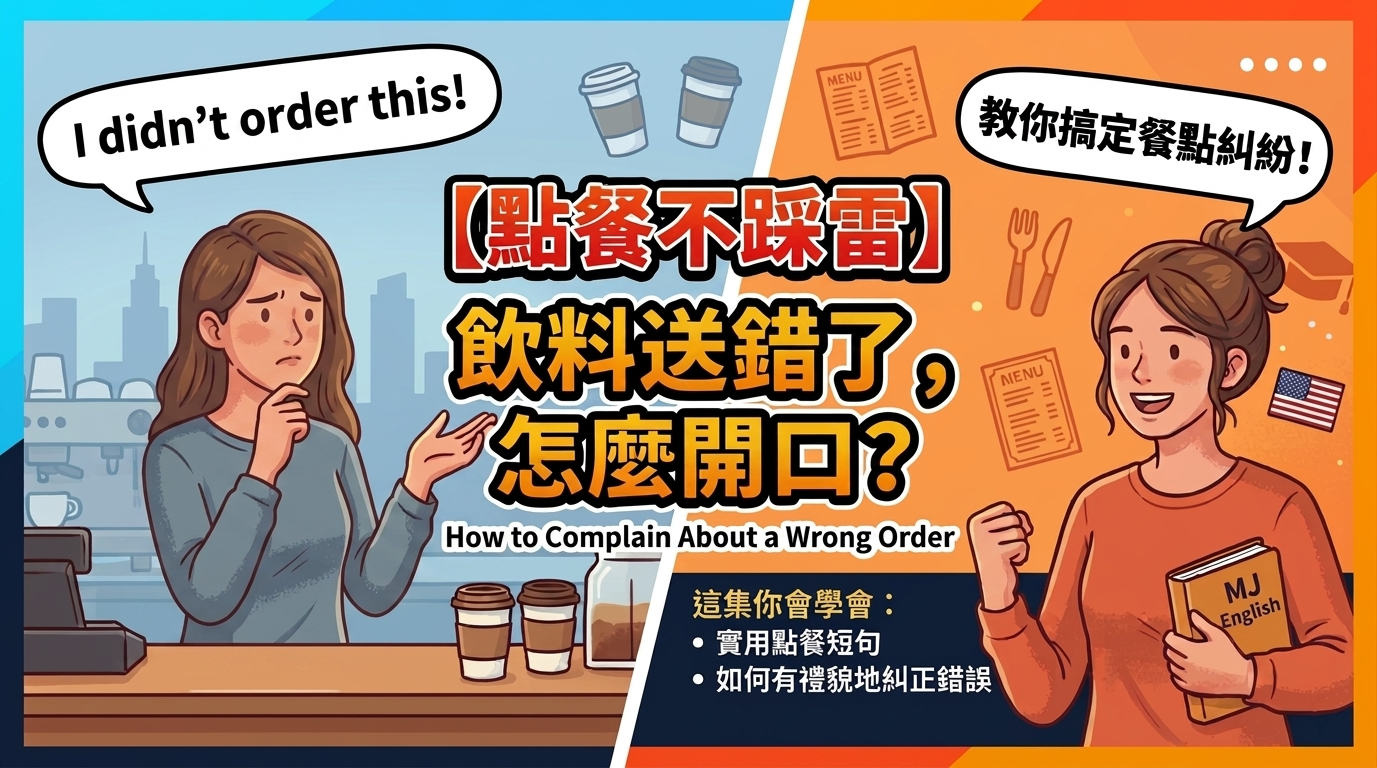
你有沒有這種經驗——在咖啡廳等了好一會兒,飲料終於來了,喝一口…不對啊!This is not what I ordered.
這集要帶你處理咖啡廳點餐出錯的狀況,學會怎麼自然開口說、換到正確的東西,還要確保帳單沒有算錯。
🎧 Apple Podcast | Spotify
情境對話 Dialogue
Amy 在咖啡廳點了焦糖拿鐵,但拿到的卻是一般拿鐵。
她走回櫃台,找店員 Kevin 反應。
English Dialogue
重點單字與片語 重點句型
Amy: Excuse me, I think there’s been a mix-up with my order.
Kevin: Oh, really? I’m sorry about that. What did you order?
Amy: I ordered a caramel latte, but I got a regular latte instead.
Kevin: Let me double-check the ticket… You’re right, that’s our mistake. I’ll swap it out for you right away.
Amy: Thank you so much. Also, could you make sure I’m not charged for the wrong item?
Kevin: Of course. I’ll check your receipt and fix it if needed. Again, really sorry for the inconvenience.
Amy: No worries, it happens! I appreciate you sorting it out.
中文翻譯
Amy:不好意思,我覺得我的點餐好像搞錯了。
Kevin:哦,真的嗎?非常抱歉。你點的是什麼?
Amy:我點的是焦糖拿鐵,但我拿到的是一般拿鐵。
Kevin:讓我確認一下點餐單……你說得對,這是我們的失誤。我馬上幫你換。
Amy:謝謝你。另外,能確認一下我沒有被收到錯誤品項的費用嗎?
Kevin:當然。我來確認你的收據,如果有問題會幫你修正。再次為造成的不便道歉。
Amy:沒關係,這種事常有!感謝你幫我處理好。
重點單字 Vocabulary Boost
- mix-up / ˈmɪks ʌp / n. → 搞混、弄錯的狀況
(無意間的失誤,語氣比 mistake 更口語、不帶責怪;常見搭配:there’s been a mix-up)
There was a mix-up with our reservation — the hotel gave our room away.(訂房記錄搞混了,飯店把我們的房間讓給別人了。) - swap out / swæp aʊt / phrasal v. → 把……換掉、替換
(指把一個東西換成另一個,比 change 更口語;常用在咖啡廳、餐廳點餐替換)
Can you swap out the fries for a salad?(可以幫我把薯條換成沙拉嗎?) - double-check / ˌdʌbəl ˈtʃɛk / v. → 再確認一次
(帶有「謹慎核對」的感覺,要求對方或自己再查一次時好用)
Let me double-check the order before I send it out.(寄出前我再確認一次訂單。) - receipt / rɪˈsiːt / n. → 收據
(注意:p 不發音!正確發音是 rɪˈsiːt,台灣人常讀錯)
Keep your receipt in case you need to return the item.(留著收據,以防之後要退貨。) - inconvenience / ˌɪnkənˈviːniəns / n. → 不便、麻煩
(客服英文常見詞;”Sorry for the inconvenience.” 是道歉的標準句型)
We apologize for any inconvenience this may have caused.(對於可能造成的不便,我們深感抱歉。) - sort out / sɔːrt aʊt / phrasal v. → 把事情處理好、解決
(英式英語特別常見,表示「把一件麻煩的事搞定」;I’ll sort it out. 是很常聽到的承諾句)
Don’t worry, I’ll sort it out for you.(別擔心,我來幫你處理好。) - right away / raɪt əˈweɪ / adv. → 馬上、立刻
(= immediately,但更口語自然;服務業常用來表示立刻行動)
I’ll get you the correct order right away.(我馬上幫你拿正確的東西。) - charged for / tʃɑːrdʒd fɔːr / v. phrase → 被收取……的費用
(確認或質疑帳單時的好用表達;Make sure I’m not charged for X 是禮貌說法)
Make sure you’re not charged for items you didn’t order.(確認你沒有被收到沒有點的東西的費用。) - apologize / əˈpɒlədʒaɪz / v. → 道歉
(比直接說 sorry 更正式、更主動表達責任;服務業道歉語境常用)
Kevin apologized for the mix-up and fixed it immediately.(Kevin 為搞混的事道歉,並立刻幫忙處理好。) - in case / ɪn keɪs / conj. → 以防萬一
(預防某件事發生時用,通常後面接一個可能發生的狀況)
I kept the receipt in case there was a problem with the bill.(我留著收據,以防帳單有問題。)
重點句型 Sentence Patterns
- I think there’s been a mix-up with my ___. → 我覺得我的___好像搞錯了
I think there’s been a mix-up with my order.(我覺得我的點餐好像搞錯了。)| 替換詞:reservation(訂位)/ booking(訂房)/ package(包裹)
💡 用 “I think” 開頭讓語氣更柔和——不是指控,是提出狀況。在英語文化裡,開口反應錯誤完全正常,不需要道歉才說。相比之下,台灣人可能習慣先說「不好意思」,讓對方誤以為自己沒問題。
- I ordered a ___, but I got a ___ instead. → 我點的是___,但我收到的是___
I ordered a caramel latte, but I got a regular latte instead.(我點的是焦糖拿鐵,但我拿到的是一般拿鐵。)| 替換詞:iced Americano / hot one(冰美式/熱的)/ veggie wrap / chicken one(蔬菜捲/雞肉的)
💡 “instead” 放在句尾,清楚表達「我拿到的不是我要的」,語感自然又不生硬。直接說 “You gave me the wrong thing.” 反而聽起來有點衝,這個結構更友善。
- Could you swap this out for ___? → 可以幫我換成___嗎?
Could you swap this out for the right one?(可以幫我換成正確的嗎?)| 替換詞:the correct size(正確的尺寸)/ the one I ordered(我點的那個)/ a decaf version(無咖啡因的版本)
💡 swap out 比 replace 更口語,比 change 更具體,是咖啡廳、餐廳實際會聽到的說法。加上 “Could you” 讓語氣禮貌、不強硬。
- Could you make sure I’m not charged for ___? → 能確認一下我不會被收到___的費用嗎?
Could you make sure I’m not charged for the wrong item?(能確認我沒有被收到錯誤品項的費用嗎?)| 替換詞:the extra item(多算的品項)/ the item I didn’t order(沒有點的東西)
💡 旅遊或海外生活時,確認帳單是完全合理的事。這句語氣禮貌但清楚,讓對方知道你在注意,而不是得過且過。
- No worries, it happens! → 沒關係,這種事常有!
對方道歉後,用這句大方回應,讓互動結束得自然。| 替換詞:These things happen.(這種事難免。)/ Don’t worry about it, it’s totally fine.(沒關係的,完全沒事。)
💡 英語文化裡,反應問題不代表你在生氣或找麻煩——拿到正確的東西後說這句,是展示你大方不計較的好方式,讓雙方都舒服地結束對話。
逐字稿 Transcript
J: Have you ever picked up your drink, taken a sip, and thought — wait, this is completely wrong?
你有沒有拿起飲料喝一口,然後心想——等等,這根本不對?
M: Oh, I have. And the awkward part is figuring out what to say next. Like, do I just go back to the counter? Do I say something? In English?
有啊。然後最尷尬的部分是不知道接下來要說什麼。我要回去找店員嗎?要怎麼說?而且還是英文?
J: I’m Jason.
我是 Jason。
M: And I’m Mary. Welcome back to MJ English — the show where you get the exact words you need for real situations.
我是 Mary。歡迎回到 MJ English——教你在真實情境說對話的節目。
J: Today, we’re tackling something super relatable — getting the wrong order at a café, and how to handle it without stress.
今天我們要聊一個超有共鳴的情境——在咖啡廳拿到錯誤的東西,要怎麼不慌不忙地處理。
M: You just heard Amy do it really well. She walked up to the counter, kept it calm, and got exactly what she needed. Let’s break down how she pulled that off.
你剛才聽到 Amy 處理得很漂亮。她走回去找店員,保持冷靜,最後拿到了正確的東西。我們來拆解她是怎麼做到的。
J: Amy’s opening line was key: “I think there’s been a mix-up with my order.” Notice she didn’t say “You gave me the wrong thing.” That would sound like you’re blaming the staff.
Amy 開口的第一句話很關鍵:「I think there’s been a mix-up with my order.」注意她沒有說「你給錯我了」,那樣聽起來像在指責對方。
M: “I think there’s been a mix-up” is softer. You’re describing the situation, not pointing fingers. And mix-up means an accidental mistake — like things got confused somewhere along the way.
「I think there’s been a mix-up」語氣更柔和。你在陳述狀況,不是在怪對方。Mix-up 指的是意外的失誤——就是某個環節搞混了。
J: You could use mix-up in lots of situations. Like, “There’s been a mix-up with my booking.” Or “I think there was a mix-up at the front desk.”
Mix-up 可以用在很多情境。像是「There’s been a mix-up with my booking.」或是「I think there was a mix-up at the front desk.」
M: Then Amy explained exactly what happened: “I ordered a caramel latte, but I got a regular latte instead.” Simple, clear, and direct. The word “instead” at the end is doing a lot of work there.
然後 Amy 具體說明發生了什麼:「I ordered a caramel latte, but I got a regular latte instead.」簡單、清楚、直接。句尾的 “instead” 扮演重要角色。
J: It signals the contrast — this is what I got, but it should have been something else. You can swap in any items you need. “I ordered an iced Americano, but I got a hot one instead.” Or “I ordered the veggie wrap, but I got the chicken one instead.”
它表示對比——我拿到的是這個,但應該是另一個。你可以換入任何你需要的東西。「I ordered an iced Americano, but I got a hot one instead.」或「I ordered the veggie wrap, but I got the chicken one instead.」
M: After Kevin confirmed the mistake, Amy asked him to swap it out: “Could you swap this out for the right one?” Swap out is such a useful phrase. It basically means “exchange this for the correct one.”
Kevin 確認失誤後,Amy 要求他幫她換:「Could you swap this out for the right one?」Swap out 是個超好用的片語,基本上就是「把這個換成正確的」。
J: It’s more casual than “Could you replace this?” and more specific than “Could you change it?” In cafés and restaurants, swap out is what you’ll actually hear — and use.
它比「Could you replace this?」更口語,也比「Could you change it?」更具體。在咖啡廳和餐廳,swap out 才是你實際會聽到、也會用到的說法。
M: And Amy didn’t stop there. She also said: “Could you make sure I’m not charged for the wrong item?” This is super important — especially when you’re traveling and every receipt matters.
Amy 沒有就此打住。她還說:「Could you make sure I’m not charged for the wrong item?」這個非常重要——尤其是在旅遊的時候,每一張收據都很關鍵。
J: “Charged for” means billed for — being asked to pay for something. So she’s basically saying, “Please check that my receipt is correct.” Polite, but firm. She’s keeping an eye on the bill without making it a big deal.
「Charged for」的意思是被收費——被要求為某件東西付錢。所以她基本上是說「請確認我的帳單是對的」。語氣禮貌但清楚,在注意帳單的同時又不把它搞大。
M: And then — this is my favorite part — Kevin apologized, and Amy said: “No worries, it happens!” That’s such a graceful way to close out the whole interaction.
然後——這是我最喜歡的部分——Kevin 道歉後,Amy 說:「No worries, it happens!」這是結束整個互動非常漂亮的方式。
J: It shows you’re not holding a grudge. The issue’s been sorted out, and you’re ending on a friendly note. “It happens” means “this kind of thing is normal, don’t worry about it.”
這表示你不記恨。問題已經被處理好了,你用友善的方式結尾。「It happens」的意思是「這種事很正常,別放心上」。
M: Other ways to say it: “These things happen.” Or “Don’t worry about it, it’s totally fine.” All three are warm, natural, and show you’re not upset.
其他說法:「These things happen.」或「Don’t worry about it, it’s totally fine.」三句都很自然溫暖,表示你沒有不開心。
J: And in English-speaking culture, pointing something out like this is completely normal. You’re not being rude. You’re not complaining for no reason. You’re just making sure you get what you paid for.
而且在英語文化裡,這樣提出來是完全正常的。你不是在無理取鬧,也不是無故抱怨。你只是在確保拿到你付錢的東西。
M: Alright — want to test yourself? Here’s the challenge: listen one more time, and this time count how many times Amy uses indirect language to keep things friendly. Ready?
好了——想測試自己嗎?挑戰來了:再聽一次,這次計算 Amy 用了幾次間接語氣來保持友善。準備好了嗎?
[DIALOGUE REPLAY]
J: Did you notice? Amy never once sounded frustrated — even though she had every right to be.
你注意到了嗎?Amy 全程聽起來都不沮喪——即使她完全有理由這樣。
M: That’s the magic of “I think there’s been a mix-up.” It gives the staff an out — maybe it’s the system, maybe it’s a miscommunication — without putting blame on anyone directly. And that makes the whole thing go so much smoother.
這就是「I think there’s been a mix-up」的魔力。它給了店員一個出口——也許是系統問題,也許是溝通出錯——不直接指責任何人。整個互動因此流暢得多。
J: The vocabulary and sentence patterns from today are in the link below — grab them before you forget.
今天的單字和句型都在下方連結——趁還記得的時候存起來。
M: Next time you get the wrong coffee, you’ll know exactly what to say. See you next episode — on MJ English.
下次拿到點錯的飲料,你已經知道該說什麼了。下集見。