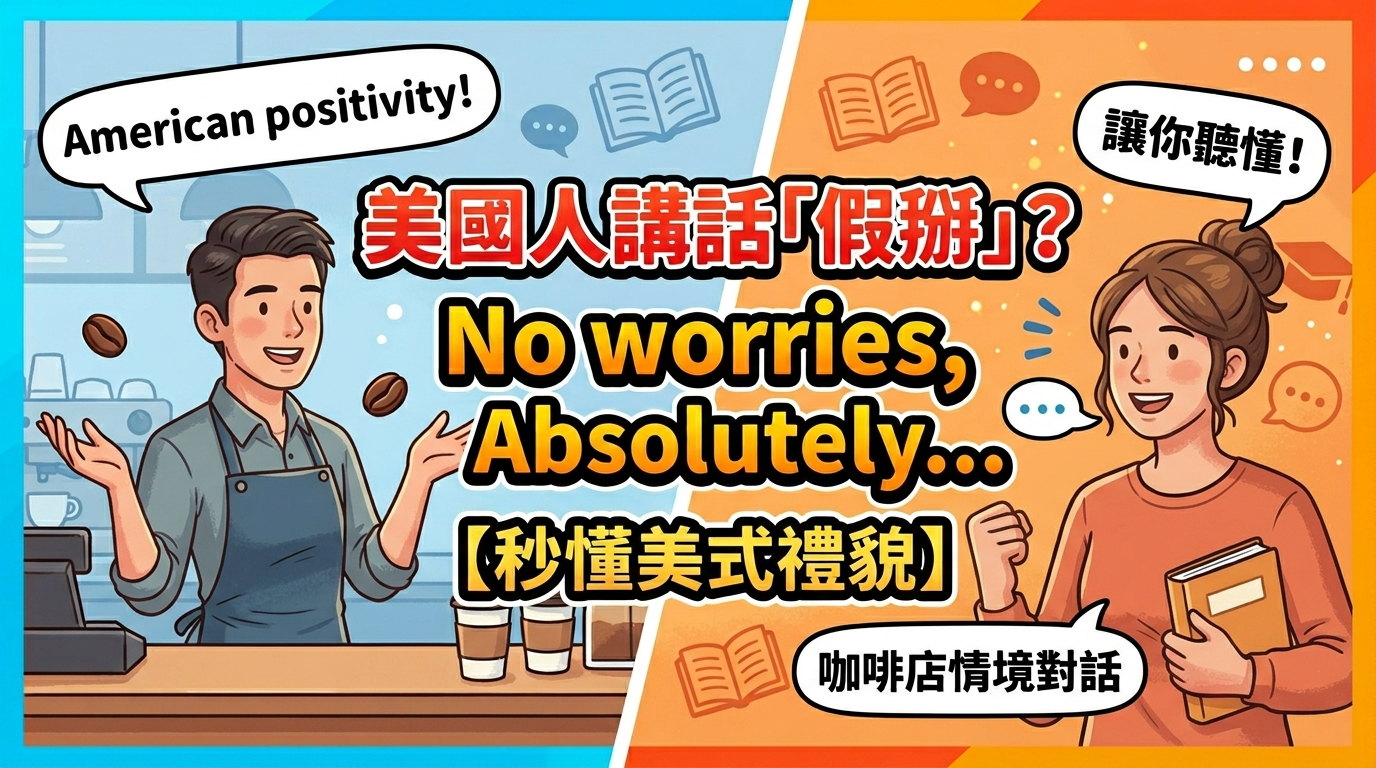
你是不是也覺得美國人動不動就說 No worries、Absolutely、Have a great day 聽起來有點太熱情、太假?今天用情境對話解析 American positivity culture,讓你聽懂美式禮貌語背後真正的意思。
Apple Podcast|Spotify
情境對話 Dialogue
在咖啡店的早晨尖峰時段,Amy 一邊趕著上班,一邊點咖啡。
English Dialogue
Amy: Hi! Can I get a latte, please?
Jake: Absolutely! What size would you like?
Amy: Medium, please. Oh—actually, can I switch to oat milk? Sorry!
Jake: No worries! Happens all the time.
Amy: Thanks for being so patient.
Jake: My pleasure. That’s what I’m here for.
Amy: Do I pick it up here or at the end of the counter?
Jake: You can wait there. You’re all set. We’ll call your name.
Amy: Perfect. I’m kind of in a rush today.
Jake: For sure. We’ll make it quick.
Amy: I really appreciate it.
Jake: Here you go, Amy! One oat milk latte.
Amy: That was fast!
Jake: We try our best. Have a great day!
Amy: Thanks! You too.
Jake: Anytime!
中文翻譯
Amy:嗨!我想點一杯拿鐵。
Jake:當然可以!你要什麼尺寸?
Amy:中杯。喔對了,可以改成燕麥奶嗎?不好意思!
Jake:沒問題!這很常發生。
Amy:謝謝你這麼有耐心。
Jake:我的榮幸,這就是我的工作。
Amy:我要在這裡等,還是去櫃檯另一邊?
Jake:你可以在那邊等,都好了,我們會叫你的名字。
Amy:太好了。我今天有點趕時間。
Jake:沒問題,我們會快一點。
Amy:真的很感謝。
Jake:來囉 Amy!燕麥奶拿鐵一杯。
Amy:也太快了吧!
Jake:我們盡力而為。祝你有美好的一天!
Amy:謝謝!你也是。
Jake:隨時歡迎!
重點單字 Vocabulary Boost
• worry / ˈwɝːi / (v.) ➜ 擔心
• Don’t worry, we’ll take care of it.(別擔心,我們會處理。)
• absolute / ˈæbsəluːt / (adj.) ➜ 絕對的
• That’s an absolute rule here.(這是這裡的絕對規定。)
• pleasure / ˈplɛʒər / (n.) ➜ 榮幸;愉快
• It’s a pleasure to help you.(很高興幫助你。)
• set / sɛt / (adj.) ➜ 準備好的
• Everything is set for you.(一切都為你準備好了。)
• great / ɡreɪt / (adj.) ➜ 很棒的
• Have a great weekend!(祝你週末愉快!)
• sound / saʊnd / (v.) ➜ 聽起來
• That sounds good.(聽起來不錯。)
• sure / ʃʊr / (adj./adv.) ➜ 當然;確定
• I’m sure we can do that.(我確定我們可以。)
• total / ˈtoʊtəl / (adj.) ➜ 完全的
• That was a total surprise.(那真是完全的驚喜。)
• happen / ˈhæpən / (v.) ➜ 發生
• Mistakes happen sometimes.(錯誤有時會發生。)
• pick / pɪk / (v.) ➜ 拿取;挑選
• Please pick up your drink there.(請在那裡取飲料。)
重點句型 Sentence Patterns
• No worries.
中文意思:沒事、別在意
英文例句:No worries, we can change it.
可替換內容:No problem(沒問題)/ It’s okay(沒關係)
• You’re all set.
中文意思:都準備好了
英文例句:You’re all set to go.
可替換內容:ready(準備好)/ good to go(可以出發)
• My pleasure.
中文意思:我的榮幸
英文例句:It’s my pleasure to help.
可替換內容:happy to help(很樂意幫忙)
• Have a great ___.
中文意思:祝你有美好的……
英文例句:Have a great weekend.
可替換內容:day(一天)/ night(夜晚)/ trip(旅程)
• Absolutely!
中文意思:當然可以!
英文例句:Absolutely! I’ll do that.
可替換內容:Of course(當然)/ For sure(沒問題)
逐字稿 Transcript
J: If you’ve ever grabbed a coffee in the U.S., you know exactly how that interaction goes.
J: 如果你曾經在美國買過咖啡,你一定超清楚那整個流程會怎麼進行。
M: Oh yeah. The ultra-cheerful barista is a total classic.
M: 對啊,那種超級熱情的店員,根本經典畫面。
J: And we just listened to a perfect example of that. That tiny coffee shop exchange is actually packed with useful English.
J: 而我們剛剛聽到的,就是一個超標準範例。那段小小的咖啡店對話,其實塞滿了超實用英文。
M: Right. Almost every line in that dialogue wasn’t about emotion. It was about keeping the interaction smooth and stress-free.
M: 沒錯。那段對話幾乎每一句都不是在表達情緒,而是在讓整個互動變得順暢、沒壓力。
J: Let’s start with Amy’s first line: “Can I get a latte, please?”
J: 我們先從 Amy 的第一句開始:「Can I get a latte, please?」
M: This is important. She doesn’t say “Can I have.” In American English, when “ordering food or drinks”, people almost always say “Can I get…”
M: 這個很重要。她不是說「Can I have」。在美式英文裡,點餐幾乎都會用「Can I get…」。**「Can I get…」跟店員點餐時常用,「Can I have」則對誰都能提出要求
J: Then Jake replies, “Absolutely! What size would you like?”
J: 接著 Jake 回:「Absolutely! What size would you like?」
M: The word “absolutely” literally means “completely” or “totally,” but here it doesn’t carry that strong meaning.
M: 「Absolutely」字面是「完全、絕對」的意思,但在這裡其實沒有那麼重。
M: In customer service, “absolutely” really means “I’m very happy to do that for you.”
M: 在服務業裡,「absolutely」其實是在說:「我很樂意幫你處理。」
J: And notice the grammar: “What size would you like?” That’s much more polite than just saying, “What size?”
J: 注意這個句型:「What size would you like?」比直接問「What size?」禮貌非常多。
J: Then Amy changes her order: “Oh—actually, can I switch to oat milk? Sorry!”
J: 接著 Amy 改單:「Oh—actually, can I switch to oat milk? Sorry!」
M: The phrase “switch to” is very useful. It means “change from one thing to another.”
M: 「switch to」很好用,意思是從一個東西換到另一個。
M: And the word “actually” is often used when you suddenly change your mind.
M: 而「actually」很常出現在你臨時改主意的時候。
J: Jake responds with the key phrase: “No worries! Happens all the time.”
J: Jake 回了關鍵句:「No worries! Happens all the time.」
M: “No worries” is a powerful expression. It instantly removes any guilt the customer might feel.
M: 「No worries」超有力量,會瞬間把客人心裡的不好意思拿掉。
M: And “Happens all the time” is actually a shortened sentence. The full form is “It happens all the time.” The subject “it” is dropped because this is very casual spoken English.
M: 「Happens all the time」其實是縮短句,完整是「It happens all the time。」主詞被拿掉,因為這是非常口語的說法。
J: Amy says, “Thanks for being so patient.”
J: Amy 說:「Thanks for being so patient.」
M: This uses the very common pattern “Thanks for + verb-ing.”
M: 這裡用到超常見句型:「Thanks for + 動名詞。」
M: For example: “Thanks for helping,” “Thanks for waiting,” “Thanks for coming.”
M: 像是:「Thanks for helping」、「Thanks for waiting」、「Thanks for coming。」
J: Jake replies, “My pleasure. That’s what I’m here for.”
J: Jake 回:「My pleasure. That’s what I’m here for.」
M: “My pleasure” is a more professional and service-oriented version of “You’re welcome.”
M: 「My pleasure」是比「You’re welcome」更有服務感、更專業的說法。
J: And “That’s what I’m here for” shows that helping the customer is literally his role.
J: 「That’s what I’m here for」就是在說:服務你,本來就是我的工作。
M: Later, Jake says, “You can wait there. You’re all set. We’ll call your name.”
M: 後來 Jake 說:「You can wait there. You’re all set. We’ll call your name.」
J: The phrase “You’re all set” is very interesting. It doesn’t just mean “ready.”
J: 「You’re all set」很有意思,不只是「準備好了」。
M: In this context, it means “Everything is complete. You don’t need to do anything else.”
M: 在這裡意思是:「全部都處理好了,你不用再做任何事。」
J: Amy says, “I’m kind of in a rush today.”
J: Amy 說:「I’m kind of in a rush today.」
M: The phrase “kind of” is a softener. It means “a little” and makes the sentence sound less direct.
M: 「kind of」是語氣緩衝,意思是「有一點」,讓語氣聽起來不會太直接。
J: Jake answers, “For sure. We’ll make it quick.”
J: Jake 回:「For sure. We’ll make it quick.」
M: “For sure” is a very natural way to say “definitely” or “no problem.”
M: 「For sure」就是很自然地在說「當然沒問題」。
J: And the structure “make it + adjective” means “cause something to become that way.” Here, “make it quick” means “prepare it quickly.”
J: 「make it + 形容詞」是讓事情變成那個狀態。這裡就是「我們會幫你做快一點」。
M: When the drink is ready, Jake says, “Here you go, Amy!”
M: 飲料好了,Jake 說:「Here you go, Amy!」
J: “Here you go” is a fixed phrase used when handing something to someone.
J: 「Here you go」是遞東西給別人時的固定說法。
M: At the end, Jake says, “Have a great day!” and Amy replies, “You too.”
M: 最後 Jake 說:「Have a great day!」Amy 回:「You too.」
J: “Have a great ” is a flexible pattern. You can say “Have a great night,” “Have a great trip,” or “Have a great weekend.” J: 「Have a great 」是很好套用的句型,可以換成 night、trip、weekend。
M: Alright, let’s test your ears again. Mentally replay that coffee shop dialogue from the beginning.
M: 好,來再測試一下你的耳朵。請你在腦中把剛剛那段咖啡店對話從頭 replay 一次。
M: This time, listen for those phrases we just talked about. Notice how each one keeps the interaction smooth.
M: 這次請特別去聽我們剛剛講的那些片語,注意它們是怎麼讓整個互動變得很順。
M: So, checking in with you now—did that second listen feel clearer?
M: 現在回來問你一下,第二次聽是不是清楚很多?
M: Did those phrases sound a little less fake and a little more purposeful?
M: 那些句子聽起來,是不是少了一點做作,多了一點「原來是有功能的」感覺?
J: Hopefully, you can now hear them as tools for polite, efficient communication rather than exaggerated emotion.
J: 希望你現在可以把它們聽成是「讓溝通變順的工具」,而不是誇張的情緒表現。
J: All the key vocabulary and sentence patterns from today’s episode are in the link below.
J: 今天所有重點單字和句型,都整理在下面的連結。
M: Thanks for listening to MJ English. See you in the next episode.
M: 感謝你收聽 MJ English,我們下集見。