💡 先搞懂:-ed 形容「你」,-ing 形容「那個東西」
情緒形容詞有兩個版本。-ed 說的是「人的感受」(I’m bored=我覺得無聊);-ing 說的是「引起感受的來源」(The movie is boring=這部電影很無聊)。想多練,英國文化協會 British Council LearnEnglish 有免費文法練習。
記憶法:主詞是「人」多半用 -ed(除非你真的想說這人很無趣);主詞是「事物」用 -ing。
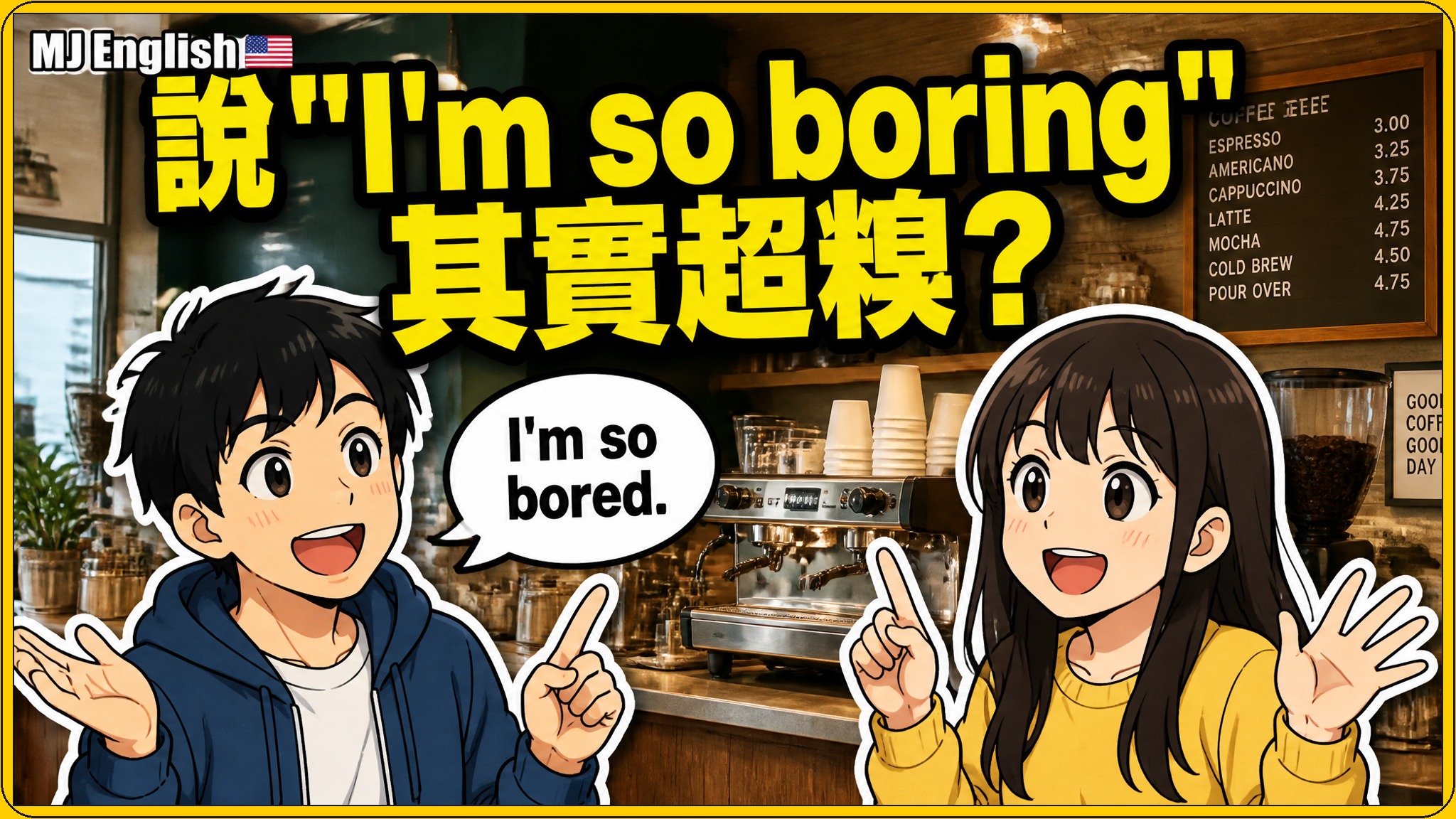
台灣人最容易卡的雷:把 “I’m bored”(我好無聊)說成 “I’m boring”(我是個無趣的人);把 “I’m interested”(我有興趣)說成 “I’m interesting”(我這人很有趣)。差一點,聽起來卻很好笑。
情境對話 Dialogue
場景:Nina 和 David 喝咖啡,聊 Nina 上週末的設計工作坊。
David
Hey Nina! How was the design workshop this weekend?
嗨 Nina!妳這週末的設計工作坊怎麼樣?
Nina
Honestly, the first day was so boring — I almost fell asleep in the back row.
老實說,第一天有夠無聊(boring),我在後排差點睡著。
David
Oh no, so you were bored the whole time?
慘,所以妳整天都很無聊(bored)喔?
Nina
No! Day two was amazing — the teacher was so inspiring, I took ten pages of notes.
才不!第二天超讚——老師超級啟發人(inspiring),我抄了十頁筆記。
David
Nice! So, are you thinking about the advanced class?
讚欸!那妳在考慮進階班嗎?
Nina
Definitely! I’m very interesting in the topic.
當然!我對這個主題非常「interesting」。(Nina 說錯了)
David
You mean “interested”! “I’m interesting” means you think you’re the fascinating one.
妳是說 “interested”(有興趣)啦!”I’m interesting” 是「你這人很有趣」的意思。
Nina
Oops. See? English grammar is so confusing.
糟糕。你看吧,英文文法有夠讓人困惑(confusing)。
David
And you’re confused by it — that’s normal. The -ing describes the thing; the -ed describes you.
而妳被它搞得很困惑(confused)——超正常的。-ing 講那個東西,-ed 講你自己。
Nina
Got it. So the class was exciting, and I was excited.
懂了。所以課程很精彩(exciting),而我很興奮(excited)。
David
Exactly. Though after eight hours straight, you were probably pretty tired by the end.
沒錯。不過連上八小時,妳到最後大概也累壞了(tired)吧。
Nina
So tired! A long but amazing weekend.
有夠累!漫長但超棒的週末。
下次這樣說 Next Time
講自己的心情、表達興趣、形容一件事——這三個地方最容易把 -ed / -ing 說反。學會就到位。
① 說自己的心情
I’m so boring.
我好無聊。(但其實變成「我是個無趣的人」)
I’m so bored.
我好無聊。(我覺得很無聊)
為什麼:-ed 講你的感受。”I’m boring” 文法沒錯,但意思是「我這人很無趣」,很容易鬧笑話。
② 表達有興趣
I’m interesting in cooking.
我對做菜有興趣。
I’m interested in cooking.
我對做菜有興趣。
為什麼:「有興趣」是你的感受,用 interested,而且固定接 in。”I’m interesting” 是「我這人很有趣」。
③ 形容一件事
The trip was so excited.
這趟旅行好興奮。
The trip was so exciting.
這趟旅行好精彩。
為什麼:旅行不會「有感受」,它是「引起感受的來源」,用 -ing。人才用 excited:I was so excited about the trip.
重點單字 Vocabulary Boost
bored / boring/ bɔːrd / ˈbɔːrɪŋ / adj.
bored=(人)覺得無聊;boring=(事物)令人無聊。這組是最經典的地雷,說自己一定用 bored。
The meeting was so boring that I got bored. (會議太無聊,我都無聊了。)
interested / interesting/ ˈɪntrəstɪd / ˈɪntrəstɪŋ / adj.
interested in=(人)對~有興趣;interesting=(事物)有趣。說自己有興趣要用 interested,還要記得接 in。
I’m interested in this interesting topic. (我對這個有趣的主題有興趣。)
excited / exciting/ ɪkˈsaɪtɪd / ɪkˈsaɪtɪŋ / adj.
excited about=(人)興奮、期待;exciting=(事物)刺激、精彩。人 excited、活動 exciting。
I’m so excited about this exciting trip. (我對這趟精彩的旅行超期待。)
confused / confusing/ kənˈfjuːzd / kənˈfjuːzɪŋ / adj.
confused=(人)困惑;confusing=(事物)令人困惑。規則說明看不懂時:The rules are confusing, so I’m confused.
The map was confusing, so I got confused. (地圖很難懂,我搞混了。)
tired / tiring/ ˈtaɪərd / ˈtaɪərɪŋ / adj.
tired=(人)累;tiring=(事)累人。另有 tired of=厭倦(I’m tired of waiting.)別跟「累」搞混。
That tiring hike left me completely tired. (那趟累人的健行讓我累翻了。)
scared / scary/ skerd / ˈskeri / adj.
特例!嚇人的東西用 scary(不是 scaring);(人)害怕用 scared。少數幾個要特別記的不規則。
I’m scared of that scary movie. (我怕那部恐怖片。)
重點句型 Sentence Patterns
1. 人用 -ed,事物用 -ing → 一句話記法
情緒形容詞看主詞:人「有感受」用 -ed;引起感受的人事物用 -ing。想說自己時,幾乎都用 -ed。
例:The movie is boring. (這部電影很無聊)
例:I’m tired; the trip was tiring. (我很累;這趟旅程很累人)
2. -ed 情緒形容詞 + 固定介系詞 → 一起背
-ed 情緒詞後面常固定接某個介系詞,把「形容詞+介系詞」當一組背,講起來才順。
例:I’m excited about the trip. (我很期待這趟旅行)
例:I’m tired of waiting. (我受夠等待了)
3. 絕對別說的三句 → 危險清單
這三句「看起來很像對」,但意思超糗,母語者一聽就知道你把 -ed / -ing 說反了。
例:❌ I’m interesting in it. → ✅ I’m interested in it. (我對它有興趣)
例:❌ I was so exciting. → ✅ I was so excited. (我超興奮)
逐字稿 Transcript
J: There’s one tiny English slip that turns “I’m so bored” into “I’m so boring” — and suddenly you’ve just told everyone you’re a dull person. One letter, completely different meaning. If you’ve ever mixed up bored and boring, or interested and interesting, you are in very good company — it’s one of the most common mistakes learners make. I’m Jason, this is MJ English, and today we’re fixing the -ed and -ing emotion adjectives once and for all.
J: 有一個超小的英文口誤,會把 “I’m so bored”(我好無聊)變成 “I’m so boring”(我是個無趣的人)——一秒告訴全場你這人很無趣。差一個字母,意思完全不同。如果你曾經搞混 bored 和 boring、或 interested 和 interesting,別擔心你不孤單——這是學習者最常犯的錯之一。我是 Jason,這裡是 MJ English,今天我們把 -ed 和 -ing 情緒形容詞一次搞定。
M: I’m Mary, and here’s the good news: there’s just one simple rule underneath all of this. The -ed ending describes how a person feels. The -ing ending describes the thing that causes the feeling. So you are bored, but the movie is boring. You are excited, but the trip is exciting. The person gets -ed; the thing gets -ing. In our chat today, Nina says the first day of her workshop was “so boring” — that’s correct, the workshop caused the feeling. But then she slips and says, “I’m very interesting in the topic.”
M: 我是 Mary。好消息是:這一切底下只有一條簡單規則。-ed 結尾講「人的感受」,-ing 結尾講「引起那感受的東西」。所以你是 bored(覺得無聊),但電影是 boring(很無聊);你是 excited(很興奮),但旅行是 exciting(很精彩)。人用 -ed、東西用 -ing。今天的對話裡,Nina 說工作坊第一天 “so boring”——這是對的,是工作坊引起感受。但接著她口誤說了 “I’m very interesting in the topic.”
J: And that little slip is the whole lesson in one line. When Nina says “I’m interesting,” David can’t help teasing her, because “I’m interesting” means “I am a fascinating person.” What she means is “I’m interested” — the feeling. It’s a super easy mix-up. The fix is a simple habit: when you talk about yourself and your feelings, reach for -ed first. I’m bored, I’m interested, I’m confused, I’m tired, I’m excited.
J: 這個小口誤就是整堂課的重點。當 Nina 說 “I’m interesting”,David 忍不住虧她,因為 “I’m interesting” 是「我是個很有魅力的人」。她要講的是 “I’m interested”——那個感受。這超容易搞混。解法是一個習慣:講自己、講心情時,先想 -ed。I’m bored、I’m interested、I’m confused、I’m tired、I’m excited。
M: Here’s the part that trips up even advanced learners: those -ed feelings usually come with a specific preposition, and you just have to memorize them together. Interested takes in — “I’m interested in art.” Excited takes about — “I’m excited about the trip.” Tired takes of when you mean sick of — “I’m tired of waiting.” Learn the adjective and its little partner as one chunk, and you’ll sound natural instead of pausing to guess.
M: 接下來這點連進階學習者都會卡:這些 -ed 感受詞通常配一個固定介系詞,得一起背。interested 配 in——”I’m interested in art”(我對藝術有興趣)。excited 配 about——”I’m excited about the trip”(我很期待旅行)。tired 配 of 是「厭倦」——”I’m tired of waiting”(我受夠等了)。把形容詞和它的小搭檔當一組背,講起來就自然,不會卡在那邊猜。
J: Now flip it around. The -ing form loves to sit in front of a noun to describe it: a boring meeting, an exciting game, interesting news, an annoying sound. And yes, you can use -ing for a person, but be careful, because it changes the meaning. “He’s boring” is grammatically perfect, but you just called him a dull guy. If you only mean he feels bored right now, say “He looks bored.” So “I’m boring” isn’t broken English — it’s just a slightly sad thing to say about yourself.
J: 現在反過來。-ing 形式很愛放在名詞前面形容它:a boring meeting(無聊的會議)、an exciting game(刺激的比賽)、interesting news(有趣的消息)、an annoying sound(煩人的聲音)。而且對,人也可以用 -ing,但要小心,因為意思會變。”He’s boring” 文法完全正確,但你等於說他這人很無趣。如果你只是想說他現在覺得無聊,要說 “He looks bored”。所以 “I’m boring” 不是壞英文——只是拿來形容自己有點可憐。
M: One more quick one. English grammar itself can be confusing — that’s the thing — which leaves you confused — that’s the feeling. Same simple rule, every single time.
M: 再一個小補充。英文文法本身可以很 confusing(令人困惑)——那是「東西」——它讓你 confused(感到困惑)——那是「感受」。每次都同一條規則。
J: So the whole system fits on a sticky note. People feel things, so use -ed. Things and people cause feelings, so use -ing. Talking about yourself? Start with -ed nearly every single time. Bored, interested, excited, confused, tired, surprised, embarrassed. Say them out loud a few times right now, so the -ed ending becomes your automatic default.
J: 所以整套系統一張便利貼就寫得下。人「有感受」,用 -ed;東西和人「引起感受」,用 -ing。講自己?幾乎每次都先用 -ed。Bored、interested、excited、confused、tired、surprised、embarrassed。現在就大聲念幾次,讓 -ed 結尾變成你的反射預設。
[DIALOGUE REPLAY]
[重播情境對話]
M: Play the chat back and listen for the swap — Nina’s “so boring” for the workshop, her slip on “interesting,” and how David lands every -ed on himself and every -ing on the thing. Once your ear catches that pattern, you’ll never say “I’m so boring” by accident again. Then tell us in the comments: name one thing that’s genuinely boring to you, and a time you were really bored. Use both forms, and tag a friend who always mixes them up.
M: 把對話重播一次,聽那個對調——Nina 用 “so boring” 形容工作坊、她 “interesting” 的口誤、還有 David 怎麼把每個 -ed 放在自己身上、每個 -ing 放在東西上。你的耳朵一抓到這個規律,就再也不會不小心說出 “I’m so boring”。然後留言告訴我們:講一件你覺得真的很 boring 的事,還有一次你很 bored 的時刻。兩種都用用看,再標記一個老是搞混的朋友。
J: That’s a wrap for today — catch you next time on MJ English!
J: 今天就到這——下集 MJ English 再見!
M: Take care, everyone!
M: 大家保重囉!
你曾經把 “I’m so bored” 說成 “I’m so boring” 嗎?還是踩過哪個 -ed / -ing 的雷?
留言用今天學到的說一句,或分享你最尷尬的情緒英文口誤——我們會挑幾則回覆你。
追蹤 MJ英語 podcast,下次見。