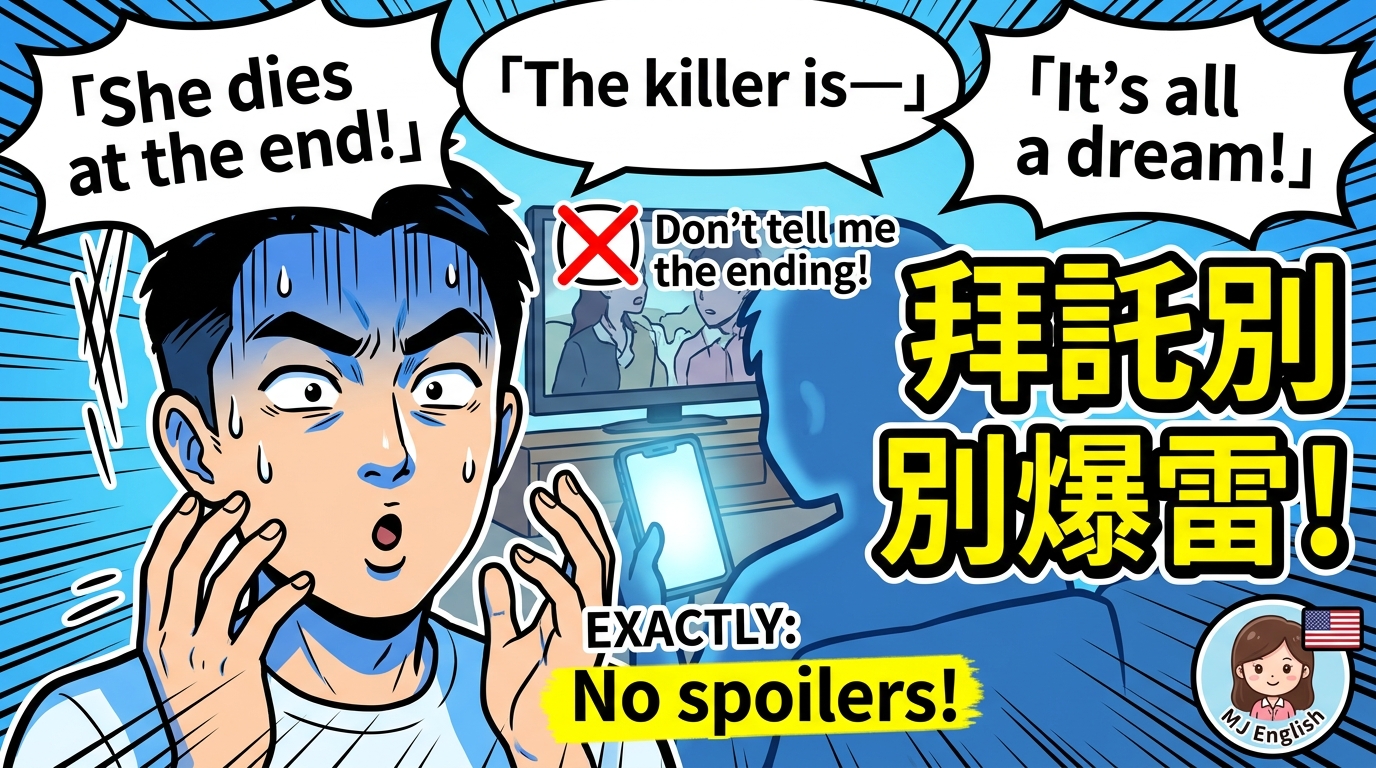
💡 先搞懂:「別暴雷」英文就是 no spoilers
關鍵字是 spoiler(爆雷的內容)——動詞 spoil 原意「破壞、搞砸」,把劇情講出來就是把別人的觀劇樂趣 spoil 掉了。要喊停,直接說 “No spoilers!” 或 “Don’t spoil it!”。在歐美,暴雷是很嚴重的社交地雷,講之前要先說 “Spoiler alert!”(爆雷警告)提醒對方。像 Max(HBO)上的《House of the Dragon》這種全民追的劇,誰先被爆雷誰崩潰。
追劇英文的核心動詞是 binge。binge-watch=一口氣連看好幾集,這是串流時代最高頻的字。形容劇好看到停不下來,用 “I’m hooked”(我上癮了)、”It’s so bingeable”(超適合一次嗑完)。
台灣人最容易卡的雷:把「別爆雷」直譯成 “Don’t say the result” 或 “Don’t tell me the answer”——文法沒錯但老外不這樣講。一句 “No spoilers!” 又短又道地,瞬間到位。
情境對話 Dialogue
場景:午休的茶水間,Rachel 昨晚追完了大家都在瘋的影集,興奮想討論;偏偏 Eric 還落後兩集,死命求她別爆雷。
Rachel
Did you watch the season finale last night? That ending!
你昨晚看了季終集嗎(season finale)?那個結局欸!
Eric
Stop, stop! No spoilers — I’m two episodes behind.
停停停!別爆雷(no spoilers)——我還落後兩集(behind)。
Rachel
Oh, my bad. My lips are sealed. But you have to catch up.
喔,抱歉啦(my bad)。我什麼都不說(my lips are sealed)。但你真的要快點追上(catch up)。
Eric
I know, I know. Work’s been crazy. I haven’t had time.
我知道我知道。最近工作忙翻了,根本沒時間。
Rachel
Just binge it this weekend. The whole season is so bingeable.
這週末一口氣追完就好(binge)。整季超適合一次嗑完(bingeable)。
Eric
Is it, though? The first few episodes felt kind of slow.
真的嗎?前幾集感覺有點慢欸。
Rachel
It’s a slow burn, trust me. Once you hit episode four, you’re hooked.
它是慢熱型的(slow burn),相信我。一到第四集,你就上癮了(hooked)。
Eric
Okay. No spoilers, but — does it end on a cliffhanger?
好吧。不要爆雷,但是——它結尾是吊人胃口的那種嗎(cliffhanger)?
Rachel
I’m not saying a word. You’ll thank me later.
我一個字都不說。你之後會感謝我的。
Eric
Fine. Don’t even react. Just tell me it’s worth it.
好啦。連反應都別給我。只要告訴我值不值得追就好。
Rachel
Totally worth it. Biggest plot twist of the year, hands down.
超值得。今年最大的劇情大反轉(plot twist),絕對是(hands down)。
Eric
Ugh, now I’m dying to know. Weekend plans: cancelled. I’m binging.
唉,我現在超想知道(dying to know)。週末計畫:取消。我要來追了。
下次這樣說 Next Time
聊劇最容易卡的 3 句。學會這幾句,喊停爆雷、催人追劇、給好評都到位。
① 喊停別人爆雷
Don’t say the result! Don’t tell me the answer!
不要說結果!不要告訴我答案!
No spoilers! I’m not caught up yet.
別爆雷!我還沒追上進度。
為什麼:”Don’t say the result” 像在講考試答案、文法對但很怪。聊劇就用 “No spoilers!”,這是英文裡固定、人人秒懂的喊停方式。
② 說自己進度落後
I haven’t watched the new ones. My progress is slow.
我還沒看新的那幾集。我的進度很慢。
I’m two episodes behind. I need to catch up.
我落後兩集,得追上進度。
為什麼:”my progress is slow” 太像工作報告。追劇進度落後就用 “behind”(落後)和 “catch up”(追上),這才是母語者聊劇的講法。
③ 大力推薦一部劇
This show is very good. You should watch it.
這部劇很好。你應該看。
It’s so good — once you start, you’re hooked. Totally bingeable.
超好看——一開追就上癮,完全可以一次嗑完。
為什麼:”very good, you should watch it” 平淡得像罐頭句。”you’re hooked”(上癮)、”bingeable”(適合一次追完)有畫面、有溫度,朋友一聽就想點開。
重點單字 Vocabulary Boost
spoiler/ ˈspɔɪlər / n.
劇透、爆雷的內容。動詞 spoil=破壞、搞砸,把劇情先講出來就 spoil 了別人的樂趣。喊停最常說 “No spoilers!”,要先預告則說 “Spoiler alert!”。
Stop! No spoilers — I’m not caught up. (停!別爆雷——我還沒追上。)
binge-watch/ ˈbɪndʒ wɑtʃ / v.
一口氣連看好幾集、追劇追到停不下來。串流時代最高頻的字,口語常直接縮成 binge:”I binged the whole season.”(我一次追完整季)。
Just binge it this weekend. (這週末一口氣追完就好。)
bingeable/ ˈbɪndʒəbəl / adj.
適合一口氣追完的、好看到停不下來的。形容一部劇節奏抓人、一集接一集捨不得停。推劇神句:”It’s so bingeable.”(超適合一次嗑完)。
The whole season is so bingeable. (整季超適合一次嗑完。)
I’m hooked/ aɪm hʊkt / phr.
我上癮了、被勾住了(hook=魚鉤,被鉤住=離不開)。形容對一部劇、一款遊戲、一件事完全著迷、欲罷不能。
Once you hit episode four, you’re hooked. (一到第四集,你就上癮了。)
slow burn/ sloʊ bɜrn / n.
慢熱(型作品)。指劇情鋪陳慢、前面平、後面越來越精彩。幫一部「開頭悶但後勁強」的劇辯護時超好用:”It’s a slow burn.”(它是慢熱型的)。
It’s a slow burn, trust me. (它是慢熱型的,相信我。)
cliffhanger/ ˈklɪfhæŋər / n.
吊人胃口的結尾(劇情停在最緊張處、讓你苦等下一集)。字面是「掛在懸崖上」。”It ends on a cliffhanger.”(結局吊足胃口)是聊劇必備。
Does it end on a cliffhanger? (它結尾是吊人胃口的那種嗎?)
plot twist/ plɑt twɪst / n.
劇情大反轉(出乎意料的轉折)。plot=劇情,twist=扭轉。看到神展開就喊 “What a plot twist!”(這反轉太神了)。也能用在現實生活的意外轉折。
Biggest plot twist of the year. (今年最大的劇情大反轉。)
catch up/ kætʃ ʌp / phr. v.
追上(進度)、趕上。追劇落後了要 catch up;跟好久不見的朋友敘舊也用 catch up。配 “behind”(落後)一起記:”I’m behind, I need to catch up.”
You have to catch up before Saturday. (你週六前一定要追上進度。)
my lips are sealed/ maɪ lɪps ɑr siːld / phr.
我嘴巴閉緊、什麼都不說(seal=封起來,嘴被封住)。答應幫人保密、絕不爆雷時的可愛說法。比 “I won’t tell” 更生動有畫面。
Don’t worry — my lips are sealed. (別擔心——我什麼都不會說。)
hands down/ hændz daʊn / phr.
毫無疑問、絕對是(強調沒有對手、不用比)。放句尾加強語氣:”Best show of the year, hands down.”(今年最棒的劇,毫無疑問)。下評論超好用。
Biggest plot twist of the year, hands down. (今年最大的反轉,絕對是。)
重點句型 Sentence Patterns
1. No spoilers! / Don’t spoil it! → 別爆雷!
喊停爆雷的固定講法。要先警告對方你接下來要講劇情,就先說 “Spoiler alert!”(爆雷警告)。這組是聊劇的生存必備句。
例:Don’t spoil it for me. (別幫我爆雷。)
例:Spoiler alert — he doesn’t make it. (爆雷警告——他沒能活下來。)
2. I’m ___ episodes behind / I need to catch up → 我落後 ___ 集/我得追上
講進度的兩個關鍵:behind(落後)、catch up(追上)。落後幾集就說 “I’m two episodes behind”,要趕進度就說 “I need to catch up”。
例:I need to catch up this weekend. (我這週末得追上進度。)
例:Are you caught up yet? (你追上了沒?)
3. Once you ___, you’re hooked → 一旦你 ___,就上癮了
推坑神句型。Once=一旦、一…就…,後面接「上鉤點」,再用 “you’re hooked” 收尾。推劇、推遊戲、推任何會上癮的東西都能套。
例:Once you start, you can’t stop. (一開始就停不下來。)
例:Once you try it, you’re hooked. (一試就上癮。)
4. ___, hands down → ___,毫無疑問
放句尾加強語氣,表示「絕對、沒得比」。下評論、表態時超有力:”Best season yet, hands down.”(目前最棒的一季,毫無疑問)。
例:That’s the best episode, hands down. (那絕對是最好的一集。)
例:Hands down the funniest scene. (無庸置疑最好笑的一幕。)
5. I’m dying to ___ → 我超想 ___(等不及了)
誇飾「非常想要、迫不及待」。be dying to + 原形動詞,字面「快死了」其實是「超想」。聊期待的劇、想知道結局時超傳神。
例:I’m dying to watch the finale. (我等不及要看完結篇。)
例:She’s dying to meet you. (她超想見你。)
逐字稿 Transcript
J: Okay, confession time. A few years ago, a coworker walked up to my desk and, in one casual sentence, ruined the ending of a show I’d been watching for two months. Two months! I just stared at him. And the worst part? I didn’t have the English to stop him in time. I said something like “No, don’t say!” — which isn’t even a real phrase. I’m Jason, this is MJ English, and today we’re making sure that never happens to you.
J: 好,告白時間。幾年前,一個同事走到我桌邊,用一句很隨意的話,毀了我追了兩個月的劇的結局。兩個月欸!我整個人就盯著他。而最慘的是?我當下沒有能即時喊停他的英文。我說了類似 “No, don’t say!”(不,別說!)——那根本不是一句通順的話。我是 Jason,這裡是 MJ English,今天我們要確保這種事不會發生在你身上。
M: I’m Mary, and oh, I felt that. The phrase Jason needed is the one everyone in English just knows: “No spoilers.” A spoiler (爆雷的內容) is anything that gives away the plot, and the verb is spoil (破壞) — you spoil the surprise. So when someone starts talking, you throw up your hands and say “No spoilers!” or “Don’t spoil it!” That’s it. Two words can save two months of your life.
M: 我是 Mary,喔,我超有感。Jason 那時需要的,就是英文裡人人都會的那句:”No spoilers.”(別爆雷)。spoiler(爆雷的內容)就是任何會洩漏劇情的東西,動詞是 spoil(破壞)——你 spoil 了那個驚喜。所以當有人開始講,你就把手一舉,說 “No spoilers!”(別爆雷)或 “Don’t spoil it!”(別暴雷)。就這樣。兩個字能救回你兩個月的人生。
J: Let’s listen to our two friends. Rachel just finished the season finale (季終集) — and she’s bursting. She opens with “Did you watch the finale? That ending!” And Eric immediately panics: “Stop, stop! No spoilers — I’m two episodes behind.” Listen to that word, behind (落後). I’m two episodes behind. That’s exactly how you say your progress is lagging. Not “my speed is slow” — behind. And to fix it, you catch up (追上).
J: 我們來聽這兩個朋友。Rachel 剛追完季終集(finale),整個快爆炸。她開口就是 “Did you watch the finale? That ending!”(你看了完結篇嗎?那結局!)。而 Eric 立刻慌了:”Stop, stop! No spoilers — I’m two episodes behind.”(停停停!別爆雷——我落後兩集)。注意那個字,behind(落後)。I’m two episodes behind(我落後兩集)。這就是你要說「進度落後」的講法。不是 “my speed is slow”,是 behind。而要補救,就是 catch up(追上)。
M: And I love Rachel’s response: “Oh, my bad. My lips are sealed.” My bad (我的錯) is the super casual way to say sorry for a small slip. And my lips are sealed (我嘴巴閉緊) — picture your lips zipped shut — is a fun, warm way to promise “I won’t say a thing.” Way more charming than “I won’t tell you.” She’s basically saying: your secret’s safe, but seriously, go catch up.
M: 而我超愛 Rachel 的回應:”Oh, my bad. My lips are sealed.”(喔抱歉啦,我什麼都不說)。My bad(我的錯)是為小失誤道歉超隨意的講法。而 my lips are sealed(我嘴巴閉緊)——想像你的嘴被拉鍊封住——是個有趣又溫暖的方式,表示「我一個字都不會說」。比 “I won’t tell you” 可愛多了。她基本上在說:你的祕密很安全,但說真的,快去追進度。
J: Then comes the recommendation. Rachel says, “Just binge it this weekend. The whole season is so bingeable.” Binge (一口氣追完) is the streaming-era verb — you binge a show when you watch episode after episode without stopping. And bingeable (適合一次嗑完) is the adjective: a show so good you can’t stop. But Eric pushes back — “The first few episodes felt kind of slow.” And Rachel has the perfect comeback: “It’s a slow burn.” A slow burn (慢熱) is a show that starts quiet and gets better and better. It’s the ultimate defense for a show with a slow start.
J: 接著是推薦。Rachel 說:”Just binge it this weekend. The whole season is so bingeable.”(這週末一口氣追完,整季超適合一次嗑完)。Binge(一口氣追完)是串流時代的動詞——你 binge 一部劇,就是一集接一集停不下來地看。而 bingeable(適合一次嗑完)是形容詞:一部好看到讓你停不下來的劇。但 Eric 反駁——”The first few episodes felt kind of slow.”(前幾集感覺有點慢)。而 Rachel 有完美的回擊:”It’s a slow burn.”(它是慢熱型的)。slow burn(慢熱)就是一部開頭安靜、然後越來越精彩的劇。這是幫「開頭慢」的劇辯護的終極說法。
M: And then she nails the hook: “Once you hit episode four, you’re hooked.” I’m hooked (我上癮了) — like a fish on a hook, you’re caught, you can’t get away. It’s the perfect word for “I’m obsessed and I can’t stop.” Notice the pattern too: once you hit episode four, you’re hooked. Once you do this, that happens. And she keeps her promise — Eric asks if it ends on a cliffhanger (吊人胃口的結尾), and Rachel won’t budge: “I’m not saying a word.”
M: 然後她精準地丟出鉤子:”Once you hit episode four, you’re hooked.”(一到第四集,你就上癮了)。I’m hooked(我上癮了)——像魚被鉤住,你被勾住、逃不掉。這是形容「我著迷到停不下來」最完美的字。也注意那個句型:once you hit episode four, you’re hooked(一旦你到第四集,就上癮了)。一旦你做這個,那個就會發生。而她信守承諾——Eric 問結局是不是 cliffhanger(吊人胃口的結尾),Rachel 不為所動:”I’m not saying a word.”(我一個字都不說)。
J: The ending is so us. Eric caves: “Just tell me it’s worth it.” And Rachel gives the one review with zero spoilers: “Totally worth it. Biggest plot twist of the year, hands down.” A plot twist (劇情大反轉) is a surprise turn in the story. And hands down (毫無疑問) means “no competition, absolutely.” She hyped it without giving away a single detail — that’s the whole skill. And Eric? “Now I’m dying to know.” Dying to (超想、等不及) — he’s desperate. Weekend plans: cancelled.
J: 結尾超像我們。Eric 投降了:”Just tell me it’s worth it.”(只要告訴我值不值得追)。而 Rachel 給了一句零暴雷的評論:”Totally worth it. Biggest plot twist of the year, hands down.”(超值得。今年最大的劇情大反轉,絕對是)。plot twist(劇情大反轉)就是故事裡出乎意料的轉折。而 hands down(毫無疑問)意思是「沒得比、絕對」。她沒洩漏任何一個細節就把它捧上天——這就是整個技巧所在。那 Eric 呢?”Now I’m dying to know.”(我現在超想知道)。Dying to(超想、等不及)——他急死了。週末計畫:取消。
[DIALOGUE REPLAY]
[重播情境對話]
M: Hearing it again, notice the dance they’re doing. One person wants to share, the other isn’t caught up — and the whole thing stays friendly because they both know the rules. “No spoilers,” “my lips are sealed,” “I’m not saying a word.” That’s spoiler etiquette, and it’s a real thing in English-speaking culture. With House of the Dragon and Toy Story 5 dropping this month, you’re going to need these lines.
M: 再聽一次,注意他們在跳的那支舞。一個人想分享,另一個還沒追上——而整段之所以還能保持愉快,是因為他們都懂規則。”No spoilers”(別爆雷)、”my lips are sealed”(我什麼都不說)、”I’m not saying a word”(我一個字都不說)。這就是「爆雷禮儀」,在英語文化裡是真的很講究的一件事。這個月《House of the Dragon》和 Toy Story 5 接連上映,你會很需要這幾句。
J: So next time someone runs at you, eyes wide, ready to ruin everything — you won’t freeze like I did. You’ll throw up a hand and go, “No spoilers! I’m not caught up.” And when it’s your turn to recommend something, you’ll know exactly what to say: “It’s a slow burn, but once you start, you’re hooked. Totally bingeable.” Everything’s in the notes below.
J: 所以下次有人衝向你,睜大眼睛、準備毀掉一切——你不會像我當年一樣定格。你會舉起手說:”No spoilers! I’m not caught up.”(別爆雷!我還沒追上)。而當輪到你推薦東西時,你會知道該怎麼說:”It’s a slow burn, but once you start, you’re hooked. Totally bingeable.”(它慢熱,但一開追就上癮,完全可以一次嗑完)。所有內容都在下方連結。
J: That’s a wrap for today. Quick favor before you go — if you’ve got that one friend who spoils everything, forward them this episode. We won’t say it came from you.
J: 今天就到這裡。走之前拜託一件小事——如果你身邊有那種每次都爆雷的朋友,把這集轉給他。我們不會說是你傳的。
M: My lips are sealed. Thanks for hanging out with us today, everyone — and if this helped, leave us a quick review and tell us what you’re watching.
M: 我什麼都不會說。謝謝大家今天陪我們——如果這集有幫到你,幫我們留個評論,順便告訴我們你最近在追什麼。
J: No spoilers, though. Alright, that’s all from me. I’m Jason —
J: 但不要爆雷喔。好啦,我這邊差不多了。我是 Jason——
M: — and I’m Mary. Stay curious, and happy binging.
M: ——我是 Mary。保持好奇,追劇愉快。
J: Take care of yourselves, and we’ll see you next time, right here on MJ English.
J: 大家照顧好自己,我們下次見,一樣在 MJ English。
M: Bye, everyone!
M: 大家掰掰!
你有被爆雷過的慘痛經驗嗎?還是你就是那個會手滑爆雷的人?
留言用今天學的句子分享——你最近在追哪部劇?它是 slow burn 還是一開場就讓你 hooked?
追蹤 MJ英語 podcast,下次見。