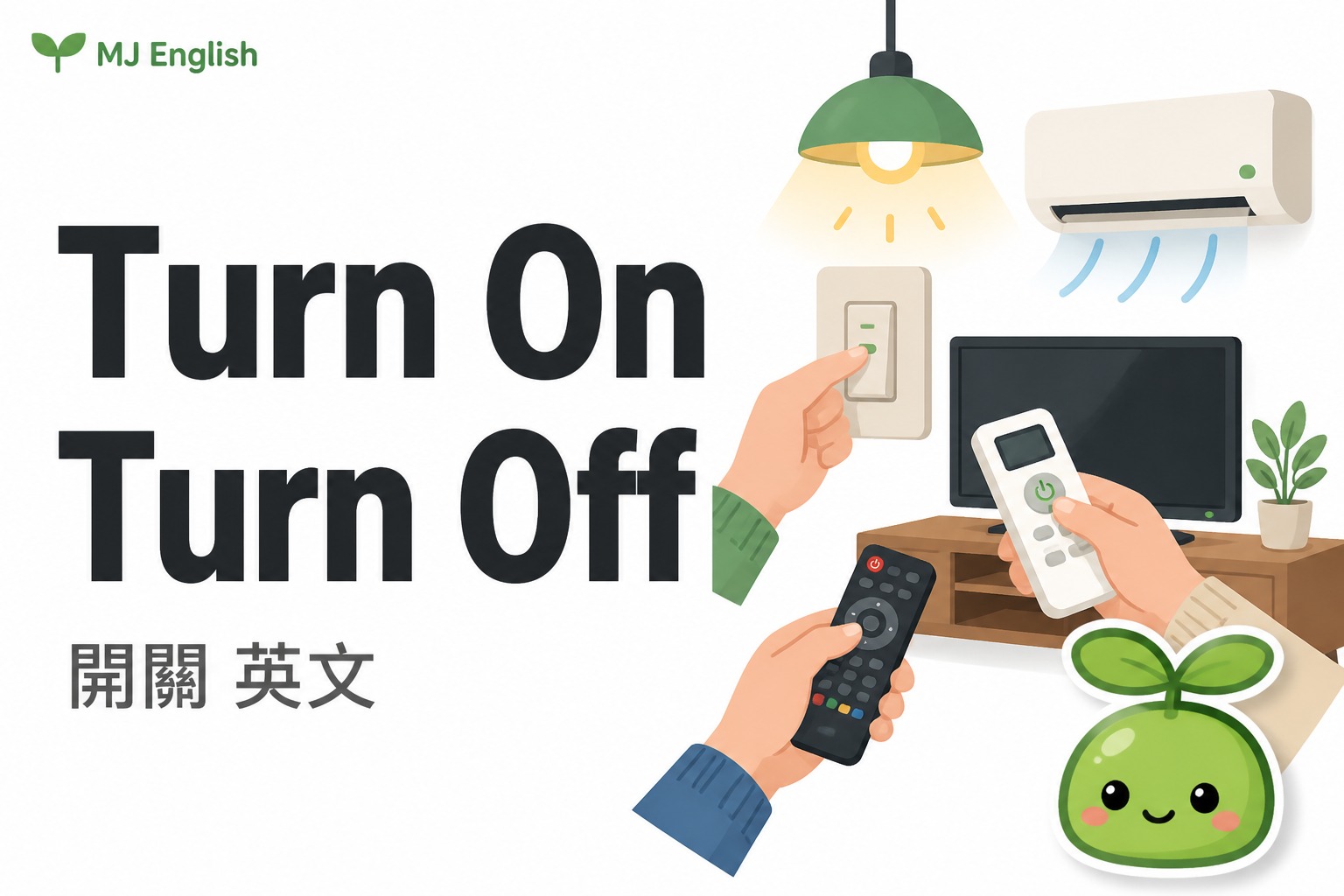
💡 先搞懂:電器的「開關」英文不用 open / close
中文一個「開」字打天下——開燈、開冷氣、開電視,所以我們很自然把它翻成 open。但英文裡 open / close 是給「有蓋子、有門、會打開合起來」的東西用的:open the door(開門)、open the box(開盒子)。燈、冷氣、電視這種「通電才會動」的,要用 turn on / turn off(字面是「轉開/轉關」,源自早期那種要用旋轉的開關)。想省電隨手關燈,連 美國能源部(Energy.gov)都建議 turn off the lights,沒人講 close the lights。
台灣人最容易卡的雷:把「開/關+電器」直接說成 open / close(open the AC、close the TV)。換成 turn on / turn off,再加上 turn up / turn down 調大小,一個 turn 就把整個家電都講順了。
情境對話 Dialogue
場景:Kevin 剛從台灣搬到西雅圖,第一晚住進和 Sarah 合租的公寓。天黑了想開燈、開冷氣、開電視,結果每一句都卡在 open,Sarah 一邊笑一邊幫他改過來。
Kevin
Hey Sarah, it’s getting dark in here — can you open the light?
嘿 Sarah,這裡變暗了——你可以開燈嗎?
Sarah
The light? Oh — you mean turn on the light! The switch is right by the door.
開燈(open the light)?喔——你是說 turn on the light(打開電燈)啦!開關(switch)就在門邊。
Kevin
Turn on… got it. Sorry, my brain still translates straight from Chinese. Found it — whoa, that’s bright. Can I turn it down a bit?
Turn on……懂了。抱歉,我腦袋還是直接從中文翻。找到了——哇,好亮。可以調暗一點(turn it down)嗎?
Sarah
Sure, that one’s a dimmer. Just twist the knob to turn it down.
可以啊,那個是調光開關(dimmer)。轉那個旋鈕就能調暗。
Kevin
Nice. It’s kind of warm in here too — how do I open the AC?
讚。這裡也有點熱——冷氣要怎麼開(open the AC)?
Sarah
Same deal — we say turn on the AC, not “open” it. The remote’s on the couch.
一樣的道理——我們說 turn on the AC(開冷氣),不是 open。遙控器(remote)在沙發上。
Kevin
Okay. And if I want it colder, do I turn it down?
好。那如果我想要更冷,是要 turn it down(往下調)嗎?
Sarah
That’s the tricky part. “Turn it down” means less cold, so warmer. If you want it colder, just say “make it cooler.” Honestly, “warmer” and “cooler” are the safest.
這就是麻煩的地方。turn it down(往下調)是指「冷度變弱」,所以反而變暖。你想要更冷,就直接說 make it cooler(涼一點)。老實說,warmer(暖)跟 cooler(涼)這兩個最保險。
Kevin
Way easier. Last thing — the TV won’t open. I mean… won’t turn on. Nothing happens.
簡單多了。最後一件事——電視打不開(won’t open)。我是說……won’t turn on(打不開)。按了沒反應。
Sarah
Let me see… ah, it’s not plugged in. Plug it into the wall and you’re good.
我看看……啊,它沒插電(not plugged in)。插上牆上插座(plug it in)就行了。
Kevin
Oh no. It wasn’t even plugged in. …There we go — it turned on.
不會吧。原來根本沒插電。……好了——它開了(turned on)。
Sarah
See, you’ve got it. One tip though — turn off the lights when you leave a room. My last roommate left them on all night, every night.
看吧,你抓到了。不過提醒一下——離開房間記得關燈(turn off the lights)。我上一個室友每天整晚都讓燈開著(left them on)。
Kevin
Noted. Turn on, turn off, turn up, turn down — and never “open the light” again.
記住了。turn on、turn off、turn up、turn down——再也不講 open the light 了。
Sarah
Listen to you — sounding like a local already.
聽聽你——已經像在地人了。
下次這樣說 Next Time
這三個場景最容易脫口而出 open / close,學會就再也不卡。
① 開燈、開冷氣、開電視
Can you open the light? I’ll open the AC too.
你可以開燈嗎?我也來開冷氣。
Can you turn on the light? I’ll turn on the AC too.
你可以開燈嗎?我也來開冷氣。
為什麼:open / close 是給門、窗、盒子這種「實體會打開合上」的東西。燈和電器是通電運作,要用 turn on / turn off,這是最常被忽略的中式英文。
② 把音量/冷氣調大調小
Make the volume bigger. Make the AC stronger.
把音量弄大。把冷氣弄強。
Turn it up. / Turn it down.
調大聲一點。/調小聲一點。
為什麼:bigger / stronger 直翻很生硬。音量、亮度、溫度的「調大調小」一律用 turn up / turn down,一句搞定,超萬用。
③ 電器打不開、沒反應
The TV cannot open. It’s broken.
電視不能開。它壞了。
The TV won’t turn on. Maybe it’s not plugged in.
電視打不開。可能是沒插電。
為什麼:cannot open 是中式直譯。機器「就是不肯動」用 won’t turn on 最道地;先別急著說 broken(壞掉),很多時候只是 not plugged in(沒插電)。
重點單字 Vocabulary Boost
turn on/ tɜːrn ɑːn / phr. v.
打開(電源)。燈、電視、冷氣、電腦、水龍頭都用它,取代中式的 open。代名詞要放中間:turn it on。
Can you turn on the light? (你可以開燈嗎?)
turn off/ tɜːrn ɔːf / phr. v.
關掉(電源),取代中式的 close。離開房間關燈、睡前關電視都用它。代名詞放中間:turn it off。
Please turn off the lights when you leave. (離開時請關燈。)
turn up/ tɜːrn ʌp / phr. v.
調大、調強(音量、亮度、暖氣、火力)。”Turn up the music.”(把音樂開大聲)。比 make it louder/bigger 道地。
Can you turn up the volume? (可以把音量調大嗎?)
turn down/ tɜːrn daʊn / phr. v.
調小、調弱(音量、亮度、溫度)。另一個常見意思是「拒絕」(turn down an offer 拒絕一個提議),看上下文。
It’s too loud — turn it down. (太大聲了——調小聲一點。)
plug in/ plʌɡ ɪn / phr. v.
插上插頭、接電源。反義是 unplug(拔插頭)。”It’s not plugged in.”(它沒插電)是電器沒反應時的第一句檢查。
Plug it in and it should work. (插上電應該就會動。)
switch/ swɪtʃ / n.
開關(牆上那個按鈕)。動詞也可以:switch on / switch off 等於 turn on / off(英式更常用)。”the light switch”(電燈開關)。
The switch is right by the door. (開關就在門邊。)
dimmer/ ˈdɪmər / n.
調光開關(可以把燈調亮調暗的旋鈕或滑桿)。dim 當動詞是「把燈調暗」。”dim the lights”(把燈光調暗,常用在浪漫或看電影時)。
That one’s a dimmer — twist it to turn it down. (那個是調光開關——轉它就能調暗。)
remote/ rɪˈmoʊt / n.
遙控器(remote control 的簡稱,日常都直接講 remote)。”Pass me the remote.”(遙控器給我)。台灣人常想不到這個簡稱。
The remote‘s on the couch. (遙控器在沙發上。)
won’t turn on/ woʊnt tɜːrn ɑːn / phr.
打不開、開不了機(won’t=拒絕,擬人化說機器「就是不肯動」)。比 cannot open 道地太多。”My phone won’t turn on.”(我手機開不了機)。
The TV won’t turn on — nothing happens. (電視打不開——按了沒反應。)
make it cooler / warmer/ meɪk ɪt ˈkuːlər / phr.
調涼一點/調暖一點。turn up/down 用在冷氣容易搞混方向,直接講 make it cooler / warmer 最不會出錯,母語者也常這樣講。
Can you make it cooler? It’s stuffy in here. (可以調涼一點嗎?這裡好悶。)
重點句型 Sentence Patterns
1. turn + 受詞 + on / off → 代名詞要放中間(冷區重點!)
這是台灣人最常錯的地方。turn on / off 是「可分離片語動詞」:受詞是名詞時可放前可放後(turn on the light=turn the light on);但受詞是代名詞(it / them)時,一定要放中間,不能放最後。
例:Turn the TV off. ✓ = Turn off the TV. ✓(兩種都對)
例:The lights are on — turn them off. ✓(燈開著——把它們關掉)
2. turn up / turn down → 調大調小(音量、亮度、溫度)
任何「有強弱程度」的東西都用這組:音量、燈光亮度、暖氣、火力。up=調大調強,down=調小調弱。比 make it louder / bigger 自然太多。
例:Can you turn down the TV? It’s too loud. (可以把電視調小聲嗎?太吵了。)
例:It’s freezing — turn up the heat. (好冷——把暖氣調大。)
3. It won’t + 動詞 → 它就是不肯(機器擬人化)
won’t(will not)用在機器上,不是「未來不會」,而是「現在就是不肯動」。形容東西故障、開不了、發不動,比 cannot 生動道地。
例:The car won’t start. (車子發不動。)
例:The door won’t open. (門打不開/卡住了。)
4. plug in / unplug / be plugged in → 插電的三種說法
plug in=插上插頭(動作);unplug=拔插頭;be plugged in=處於「已插電」狀態。電器沒反應時,第一句先確認 Is it plugged in?
例:Unplug the toaster when you’re done. (烤麵包機用完拔插頭。)
例:It’s not working — is it even plugged in? (它沒在運作——它有插電嗎?)
5. leave + 受詞 + on / off → 讓它一直開著/關著
leave 在這裡是「保持某個狀態、放著不管」。leave the lights on=燈開著沒關;leave it off=讓它關著別開。描述「忘了關」「故意開著」超好用。
例:I always leave the AC on when I go out. (我出門都讓冷氣開著。)
例:Just leave it off for now. (現在先讓它關著就好。)
逐字稿 Transcript
J: Quick confession before we start — I’d bet money that you have, at some point in your life, asked someone to “open the light.” It feels so right, doesn’t it? In Chinese, one word — 開 — opens the light, the AC, the TV, everything. So we reach for “open” in English too. And the person just kind of… pauses. I’m Jason, this is MJ English, and today we’re fixing one of the most common pieces of Chinese-English out there.
J: 開始前先快速招供一下——我敢跟你賭錢,你這輩子一定在某個時候叫人家「open the light」(開燈)過。感覺超對,對吧?中文一個「開」字,開燈、開冷氣、開電視,全部通用。所以我們講英文也很自然地伸手抓 open。然後對方就……愣了一下。我是 Jason,這裡是 MJ English,今天我們要修正最常見的中式英文之一。
M: I’m Mary. And the fix is beautifully simple — it all comes down to one verb: turn. Here’s the logic. In English, open and close are for things with a lid or a door — open the box (打開盒子), open the door (開門). But anything that runs on electricity? You turn it on (打開) and turn it off (關掉). Lights, AC, TV, computer — all turn. Watch our two roommates, Kevin and Sarah. Kevin just landed in Seattle, it’s his first night, and he opens with the classic: “Can you open the light?”
M: 我是 Mary。而解法美在它超簡單——關鍵就一個動詞:turn。邏輯是這樣。英文裡 open 和 close 是給有蓋子、有門的東西——open the box(打開盒子)、open the door(開門)。但任何靠電運作的東西?你 turn it on(打開)、turn it off(關掉)。燈、冷氣、電視、電腦——全都用 turn。看我們兩位室友 Kevin 和 Sarah。Kevin 剛降落西雅圖,第一晚,一開口就是經典款:”Can you open the light?”(你可以開燈嗎?)
J: And Sarah’s reaction is so real — “The light? Oh, you mean turn on the light.” That little pause is exactly what happens in real life. She’s not laughing at him, she just had to translate it in her head for a second. Kevin’s honest about it too: “my brain still translates straight from Chinese.” That’s all this is — a translation habit. Once he hears turn on, he gets it instantly. Then the lights come on and they’re too bright, so he asks to turn it down (調暗).
J: 而 Sarah 的反應超真實——”The light? Oh, you mean turn on the light.”(開燈?喔,你是說打開電燈)。那個小停頓正是現實生活會發生的。她不是在笑他,只是腦袋得轉譯一秒。Kevin 也很誠實:”my brain still translates straight from Chinese.”(我腦袋還是直接從中文翻)。就只是這樣——一個翻譯習慣。他一聽到 turn on 馬上就懂。然後燈打開太亮了,所以他問能不能 turn it down(調暗)。
M: And notice how Kevin says it — “Can I turn it down?” Not “turn down it.” This is the grammar gem of the episode. Turn on, turn off, turn up, turn down are separable phrasal verbs. With a noun, you’ve got freedom: turn off the TV or turn the TV off, both fine. But the second you use a pronoun — it, them — it has to go in the middle. Turn it down (調小). Turn them off (把它們關掉). “Turn down it” sounds wrong to every native ear. My little trick: pronoun in the sandwich, always in the middle.
M: 注意 Kevin 怎麼講的——”Can I turn it down?”(我可以調暗嗎?),不是 “turn down it”。這是今天的文法亮點。turn on、turn off、turn up、turn down 是「可分離片語動詞」。接名詞時你很自由:turn off the TV 或 turn the TV off,兩種都對。但你一用代名詞——it、them——它就一定要放中間。Turn it down(調小)。Turn them off(把它們關掉)。”Turn down it” 在每個母語者耳裡都很怪。我的小訣竅:代名詞像三明治夾心,永遠夾中間。
J: Then comes the AC, and Kevin does it again — “how do I open the AC?” Same fix: turn on the AC. But then he hits the genuinely confusing one. He wants it colder, so he asks, “do I turn it down?” And honestly? The AC is the one place even native speakers argue about. To some people, turn down the AC means less cold air — so warmer. To others, it means a lower temperature — so colder. It’s genuinely ambiguous, and that’s why Sarah gives the smartest advice in the whole episode: skip it entirely, just say make it cooler (涼一點) or make it warmer (暖一點). Clear every time.
J: 接著輪到冷氣,Kevin 又犯了——”how do I open the AC?”(冷氣怎麼開?)。一樣的修法:turn on the AC。但接著他碰到真的會搞混的地方。他想要更冷,所以問 “do I turn it down?”(要往下調嗎?)。老實說?冷氣這關連母語者自己都會吵。對某些人來說,turn down the AC 是「冷氣風變弱」——所以變暖。對另一些人,它是「溫度數字調低」——所以變冷。它真的有歧義,這就是為什麼 Sarah 給了全集最聰明的建議:乾脆別用它,直接說 make it cooler(涼一點)或 make it warmer(暖一點)。每次都清楚。
M: And the grand finale — the TV. Kevin says, “the TV won’t open… I mean, won’t turn on.” Two great things here. First, he self-corrects from open to turn on — he’s learning in real time. Second, won’t turn on (打不開) is the perfect phrase for a dead gadget. That won’t isn’t “will not in the future” — it’s the machine refusing to cooperate right now. My phone won’t turn on, the car won’t start — we treat machines like stubborn people. And the punchline? It wasn’t broken. It just wasn’t plugged in (沒插電). Always check that first.
M: 然後是壓軸——電視。Kevin 說 “the TV won’t open… I mean, won’t turn on.”(電視打不開……我是說,開不了)。這裡有兩個亮點。第一,他自己從 open 改成 turn on——他正在即時學習。第二,won’t turn on(打不開)是形容電器掛掉的完美說法。那個 won’t 不是「未來不會」——是機器「現在就是不肯配合」。My phone won’t turn on(我手機開不了機)、the car won’t start(車子發不動)——我們把機器當成很固執的人。而笑點是?它根本沒壞。只是 not plugged in(沒插電)。永遠先檢查這個。
J: Last thing Sarah teaches him is about leaving things on. “Turn off the lights when you leave a room. My last roommate left them on all night.” Notice the difference — turn off is the action, but left them on (一直開著) describes the state, the lights just sitting there glowing. “I left the lights on” is how you confess you forgot — not “I forgot to turn off.” Same scene, two angles, and natives switch between them without thinking.
J: Sarah 教他的最後一件事是關於「讓東西開著」。”Turn off the lights when you leave a room. My last roommate left them on all night.”(離開房間關燈。我上一個室友整晚都開著)。注意差別——turn off 是動作,但 left them on(一直開著)描述的是狀態,燈就那樣亮著。”I left the lights on”(我忘了關燈)是你坦承自己忘了的講法——而不是 “I forgot to turn off”。同一個場景,兩個角度,母語者想都不用想就在兩者間切換。
[DIALOGUE REPLAY]
[重播情境對話]
J: Listen to Kevin’s arc this second time through. He starts with “open the light,” and by the very last line he’s rattling off “turn on, turn off, turn up, turn down” like he’s been saying it for years. That’s the whole journey in one conversation — and it’s not about memorizing a list. It’s about swapping one mental habit: electricity isn’t opened, it’s turned on. Make that one switch in your head and a dozen sentences fix themselves.
J: 這第二次聽,注意 Kevin 的成長線。他從 “open the light” 開始,到最後一句已經像講了好幾年一樣,順口飆出 “turn on, turn off, turn up, turn down”。這就是一段對話裡的完整旅程——而且重點不在背清單。重點在換掉一個思考習慣:電器不是被「打開」,是被 turned on。腦中切換這一個開關,十幾個句子就自己修好了。
M: So here’s your homework — tonight, when you reach for a light switch, say it out loud in English. Turn it on. Turn it off. Tomorrow, the AC, the TV, your laptop. Catch yourself the moment “open” sneaks in, and swap it. Drop a comment and tell us: what’s the one piece of Chinese-English you know you still say? We’ve all got one. I’m Mary, and that’s a wrap on MJ English — go flip some switches.
M: 所以這是你的作業——今晚當你伸手去按電燈開關時,用英文大聲講出來。Turn it on. Turn it off. 明天換冷氣、電視、你的筆電。一抓到 open 偷溜出來,馬上換掉它。留言告訴我們:你自己知道、卻還是會講的那句中式英文是哪句?我們每個人都有一句。我是 Mary,MJ English 今天就到這——去按幾個開關吧。
你也講過 “open the light” 嗎?還是有別句改不掉的中式英文?
留言分享你最常脫口而出的那句——我們一起把它修好。
追蹤 MJ英語 podcast,下次見。