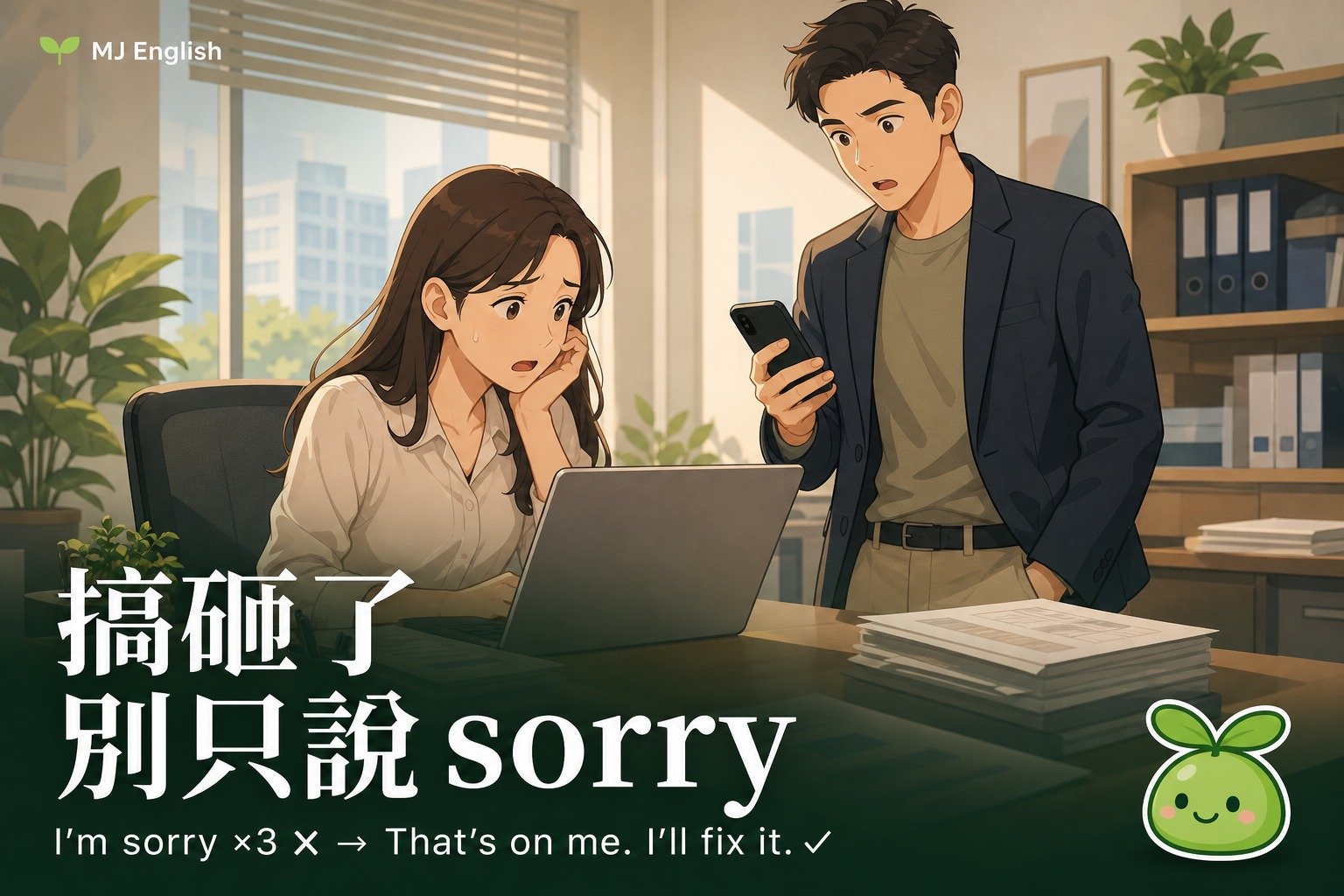
JThree sorries, zero solutions. That’s the whole story of Amy’s Tuesday morning. I’m Jason, and today we’re talking about how to apologize in English when you mess up at the office.三個 sorry,零個解決方案。這就是 Amy 週二早上的故事。我是 Jason,今天要聊的是,在辦公室搞砸的時候,英文到底該怎麼道歉。
MAnd I’m Mary. Three sorries, zero solutions, I love that. When we mess up, a lot of us say “I’m sorry, I’m sorry, I’m really sorry.” In Chinese, that feels sincere. In English, it sounds a little flustered.我是 Mary。三個 sorry、零個解決方案,這個說法我超愛。我們搞砸的時候,很多人會說 “I’m sorry, I’m sorry, I’m really sorry.”。中文聽起來很有誠意,但英文聽起來有點慌張。
JRight. Say Amy sent a client the old price sheet. Her manager, Kevin, walks over and says the client is asking why the prices don’t match. And Amy says, “I’m sorry, I’m so sorry, I’m really sorry.”對。假設 Amy 把舊的價目表寄給了客戶。她的主管 Kevin 走過來說,客戶在問為什麼價格對不上。結果 Amy 說:”I’m sorry, I’m so sorry, I’m really sorry.”
MPoor Amy. Kevin nods, but he still has no idea what happens next. Is it fixed? Is the client angry? All he hears is panic. That’s the real problem with saying sorry again and again.可憐的 Amy。Kevin 點點頭,但他還是不知道接下來會怎樣。問題解決了嗎?客戶生氣了嗎?他只聽到慌張。這就是一直說 sorry 的真正問題。
JSo here’s the first idea. Match your apology to the size of the mistake. Small stuff first, like a typo, or you’re two minutes late. You can just say “My bad.” or “Oops, my mistake.” or “Sorry about that.”所以第一個重點:道歉要配合錯誤的大小。先說小事,像是打錯字,或是晚了兩分鐘。你可以直接說 “My bad.”(我的錯)、”Oops, my mistake.”,或 “Sorry about that.”(抱歉啦)。
MOne warning about “My bad,” though. It’s very casual. It’s fine with a teammate across the desk. But with a client, or when something serious happened, it sounds like you don’t care enough.不過 “My bad” 要小心。它非常口語。跟坐在對面的同事說沒問題,但如果對客戶,或是事情很嚴重,聽起來會像你不夠重視。
JGood point. Now the middle level, real work mistakes. You missed an email, or forgot to follow up. Here you say “That’s on me.” It means this is my responsibility. Simple, and strong.沒錯。再來是中間這一級,真正的工作失誤。你漏回了一封信,或是忘了跟進。這時候就說 “That’s on me.”(這是我的責任)。簡單又有力。
MAnother good one is “I dropped the ball on the follow-up.” To drop the ball means you missed something you were supposed to handle. And you can add “I should’ve double-checked.”另一句也很好用:”I dropped the ball on the follow-up.”(後續跟進我漏掉了)。drop the ball 就是你該處理的事情被你漏掉了。你還可以加一句 “I should’ve double-checked.”(我應該再確認一次的)。
JAnd notice that “I should’ve” is about yourself. That’s you taking responsibility. It’s the opposite of “You should have” aimed at someone else. We did a whole episode on that, so go check it out.注意喔,這裡的 “I should’ve” 是說自己,是你在扛責任。跟對別人說的 “You should have” 完全相反。我們有整集在講這個,可以去聽聽看。
MYes, totally different feeling. Okay, level three is formal. Clients, big impact. Then we say “I apologize for the confusion.” or “I apologize for the delay.” Or in a company email, “Please accept our apologies.”對,感覺完全不同。好,第三級是正式場合,像是客戶、影響很大的事。這時候我們說 “I apologize for the confusion.”(造成困擾很抱歉)或 “I apologize for the delay.”(抱歉延誤了)。公司信件裡也可以寫 “Please accept our apologies.”(請接受我們的歉意)。
JSmall tip. After “apologize for,” use a noun, like “the delay,” or an ing word, like “sending the wrong file.” So that’s half the job, picking the right level. The second half matters even more.小提醒:apologize for 後面接名詞,像 “the delay”,或接動名詞,像 “sending the wrong file”。挑對等級只是一半,另一半其實更重要。
MAlways follow the apology with the fix. Say what you’ll do, and when. “I’ll fix it right now.” Or “I’ll send the corrected quote by noon.” Or “I’ll copy you on the email.”道歉之後一定要接補救。說清楚你要做什麼、什麼時候做。”I’ll fix it right now.”(我現在馬上修)。或 “I’ll send the corrected quote by noon.”(我中午前寄修正版報價單)。或 “I’ll copy you on the email.”(我寄信時會 cc 給你)。
JCopy you on the email means you put that person in cc, so they see it too. Great for managers. And if you can’t fix it right away, say “I’m on it.” That alone makes people relax.copy you on the email 就是把對方放進副本,讓他也看得到。對主管特別好用。如果沒辦法馬上修好,就說 “I’m on it.”(我在處理了)。光這一句就能讓人放心。
MThat’s what Kevin really wants. In our story, Kevin says, “Take a breath. What happened?” And Amy finally says, “That’s on me. I used last month’s price sheet by mistake.”這才是 Kevin 真正想聽的。故事裡 Kevin 說:”Take a breath. What happened?”(先深呼吸,發生什麼事?)然後 Amy 終於說:”That’s on me. I used last month’s price sheet by mistake.”(這是我的責任,我不小心用了上個月的價目表。)
JNice order there. She owns it first, then gives a short reason. By mistake just means you did it without meaning to. Then comes the fix: “I’ll send the corrected quote by noon and copy you on it.”順序很漂亮。她先認錯,再給一句簡短的原因。by mistake 就是不是故意、不小心的。然後是補救:”I’ll send the corrected quote by noon and copy you on it.”
MCorrected just means fixed, the right version. And then she writes to the client, “I apologize for the confusion, please see the updated version attached.” Short, formal, and calm.corrected 就是改正過、正確的版本。接著她寫信給客戶:”I apologize for the confusion, please see the updated version attached.”(造成困擾很抱歉,請見附件更新版。)簡短、正式,又冷靜。
JRight. So the order is: own it, give the fix, and keep the reason to one short line at the end. Reason last, never first. Which brings us to the three traps.對。所以順序就是:先認錯,再給補救,原因留到最後、一句話就好。原因放最後,絕對不要放最前面。接下來就是三個常見的雷。
MTrap one is the one we started with. Three sorries in a row. Try “That’s on me. I’ll fix it right now.” Same feeling, but now there’s a plan.第一個雷就是我們一開始說的,連說三次 sorry。改成 “That’s on me. I’ll fix it right now.”,一樣有誠意,但現在多了一個方案。
JTrap two is “Sorry for my mistake.” It comes straight from Chinese, and it sounds stiff. Native speakers say “Sorry about that. That was my mistake.” Two short sentences, and much more natural.第二個雷是 “Sorry for my mistake.”。它是中文直翻過來的,聽起來很生硬。母語者會說 “Sorry about that. That was my mistake.”,兩個短句,自然多了。
MTrap three is starting with the excuse. “Because the system was slow…” Your manager hears someone dodging. Instead say, “That’s on me. The system was slow, but I should’ve double-checked.”第三個雷是一開口就找藉口,”Because the system was slow…”。主管聽起來會覺得你在閃躲。改成 “That’s on me. The system was slow, but I should’ve double-checked.”(這是我的責任,系統是慢,但我應該再確認的。)
JOne last piece is the ending. You can add some reassurance, but only if you can keep it. “It won’t happen again.” Even better, something real, like “I’ve set a reminder so I don’t miss it next time.”最後一塊是收尾。你可以補一句讓人放心的話,但前提是你做得到。”It won’t happen again.”(不會再發生了。)更好的是說具體的做法,像 “I’ve set a reminder so I don’t miss it next time.”(我設了提醒,下次不會漏。)
MAnd “Thanks for being understanding” is a lovely way to close with a manager or a client. Warm, not dramatic. At the end of our story, Kevin tells Amy she handled it way better than the three sorries.“Thanks for being understanding.”(謝謝你的體諒。)也很適合拿來跟主管或客戶收尾,溫暖但不浮誇。故事最後,Kevin 跟 Amy 說她處理得比那三個 sorry 好太多了。
JAnd Amy laughs, “Ha, my bad. Old habit. It won’t happen again.” Old habit is a nice phrase for little things we keep doing. And “my bad” works here because it’s a light, friendly moment with Kevin, not an email to the client.Amy 笑著說:”Ha, my bad. Old habit. It won’t happen again.”(哈,我的錯,老習慣了,不會再發生了。)old habit 很適合形容那些我們一直改不掉的小毛病。而且這裡用 “my bad” 剛好,因為這是跟 Kevin 之間輕鬆的小插曲,不是寫給客戶的信。
MA perfect example of matching the level. Quick recap. Level one, “My bad.” Level two, “That’s on me” or “I dropped the ball.” Level three, “I apologize for.” And then, always, the fix.剛好是配合等級的完美示範。快速複習:第一級 “My bad.”;第二級 “That’s on me” 或 “I dropped the ball.”;第三級 “I apologize for.”。然後,永遠都要接補救。
JNow listen to the whole conversation again. Watch how Amy goes from panic to plan, and see if you can catch each level as it comes up.現在再聽一次完整對話。看看 Amy 怎麼從慌張變成有方案,也試試看能不能聽出每一個等級。
MAnd pay attention to what comes right after each apology. That’s the part that makes you sound calm. Here we go.也注意每次道歉後面緊接著什麼。那一句就是讓你聽起來冷靜的關鍵。開始囉。
🔁 [DIALOGUE REPLAY] 重播情境對話
JSo remember: own it, fix it, keep the reason short. One clear apology plus one clear fix beats three sorries every time.記住:先認錯、再補救、原因講短一點。一句清楚的道歉加一句清楚的補救,每次都勝過三個 sorry。
MTell us in the comments: what’s your most memorable mess-up at work? Share what happened, and we’ll help you find the perfect English apology for it.留言告訴我們:你在工作上最難忘的一次搞砸是什麼?說說發生了什麼事,我們幫你配一句最適合的英文道歉。
JIt won’t happen again, unless you miss the next episode.不會再發生了,除非你錯過下一集。
MOwn it, fix it, move on. That’s MJ English!認錯、補救、往前走。這裡是 MJ英語!