
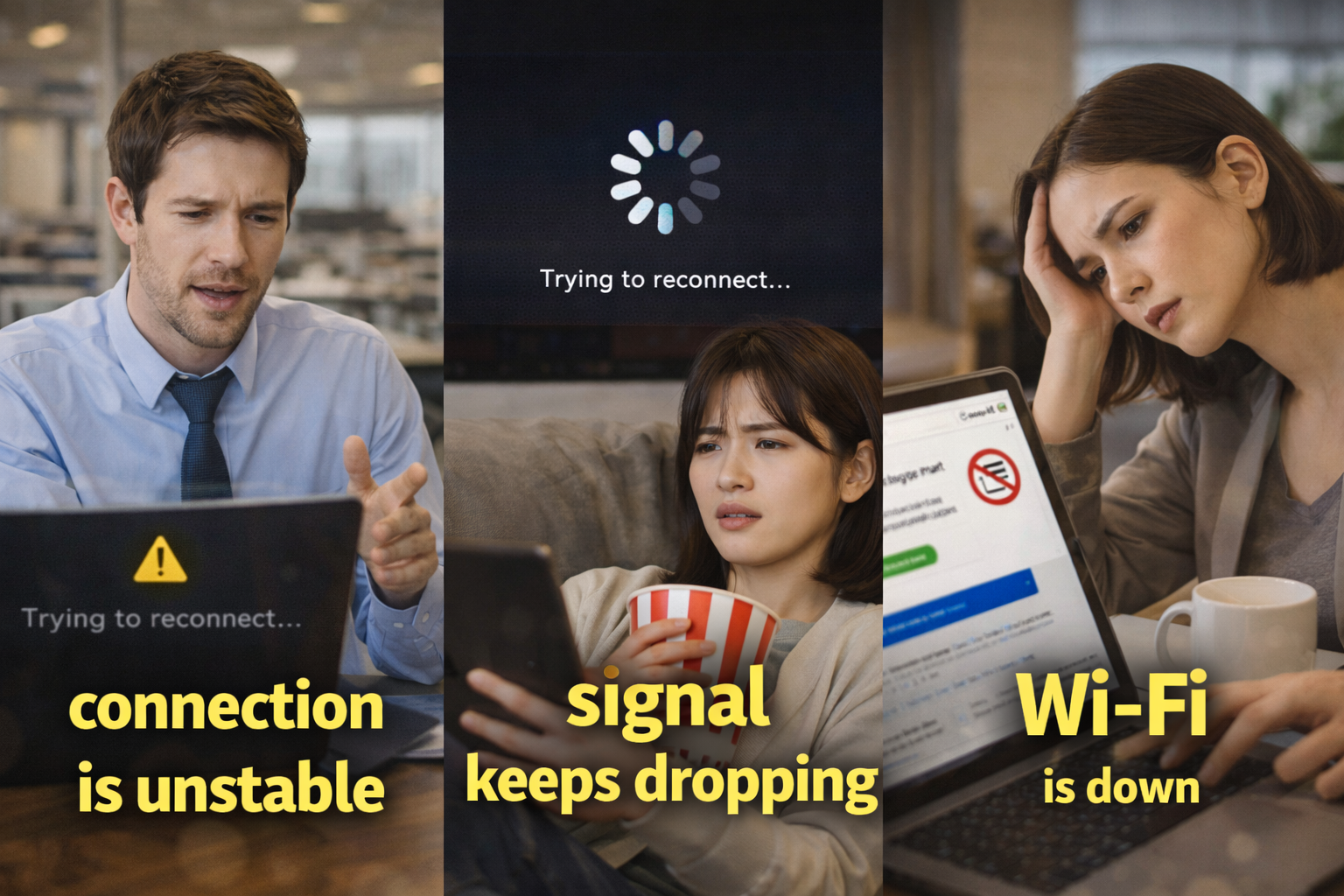
你一定遇過這種狀況:
👉 Zoom 會議快開始
👉 Netflix 正追到一半
👉 老闆剛剛丟來 Google Meet 連結
結果… Wi-Fi 直接斷線 😭
但你知道 daily conversation English 中,
母語人士其實很少說 No Internet 嗎?
像是:
👉 The connection is unstable.
👉 My signal keeps dropping.
這些才是真正生活中常用的英文表達!
🎧Apple Podcast|Spotify
💬 Dialogue 情境對話
📍場景設定
Kevin 和 Emma 在咖啡廳準備遠距開會,但 Kevin 的筆電一直連不上網路。
English Dialogue
Emma: Are you able to join the meeting now?
Kevin: Not yet. My laptop won’t connect to the Wi-Fi.
Emma: That’s strange. Did you enter the password correctly?
Kevin: Yeah, but the signal seems really weak here.
Emma: Maybe try switching to another network.
Kevin: I already did, but it keeps disconnecting.
Emma: That’s annoying. Do you have mobile data?
Kevin: I do, but the speed isn’t very stable.
Emma: You might need to restart your device.
Kevin: Let me give that a try.
Emma: Hopefully that fixes the issue.
Kevin: Yeah, I don’t want to miss the meeting.
中文翻譯
Emma:你現在可以進會議了嗎?
Kevin:還沒,我筆電連不上 Wi-Fi。
Emma:奇怪,你密碼有打對嗎?
Kevin:有,但這裡訊號好像很弱。
Emma:你可以試著換另一個網路。
Kevin:我試過了,但一直斷線。
Emma:真煩,你有開行動數據嗎?
Kevin:有,但速度不太穩定。
Emma:你可能要重開機。
Kevin:我試試看。
Emma:希望這樣能解決問題。
Kevin:對啊,我不想錯過會議。
📚 Vocabulary Boost 重點單字
| 單字 | 詞性 | 中文意思 | 英文例句 | 中文翻譯 |
|---|---|---|---|---|
| connect | verb | 連接 | I can’t connect to the Wi-Fi. | 我連不上 Wi-Fi |
| signal | noun | 訊號 | The signal is weak. | 訊號很弱 |
| network | noun | 網路 | This network is slow. | 這個網路很慢 |
| disconnect | verb | 斷線 | It keeps disconnecting. | 它一直斷線 |
| stable | adj. | 穩定的 | The internet is not stable. | 網路不穩 |
| restart | verb | 重開機 | Please restart your laptop. | 請重開筆電 |
| device | noun | 裝置 | Turn off your device. | 關掉你的裝置 |
| speed | noun | 速度 | The speed is slow. | 速度很慢 |
| password | noun | 密碼 | Enter the password. | 輸入密碼 |
| issue | noun | 問題 | There is an issue. | 有個問題 |
🔍 Sentence Patterns 重點句型
| 句型結構 | 中文意思 | 英文例句 | 中文翻譯 |
|---|---|---|---|
| won’t + V | 無法 | It won’t connect. | 它連不上 |
| seems + adj. | 看起來 | It seems slow. | 看起來很慢 |
| keep + V-ing | 持續 | It keeps dropping. | 它一直掉線 |
| try + V-ing | 試著 | Try restarting it. | 試著重開 |
| You might need to + V | 你可能需要 | You might need to wait. | 你可能要等 |
📖 Transcript 逐字稿
M: You know that… um… that very specific kind of panic, right?
M:你知道那種……嗯……非常特定、會讓人瞬間恐慌的情況吧?
J: Oh no. What happened this time?
J:喔不,這次又發生什麼事了?
M: Well, I was literally two minutes away from starting a video call with a client yesterday.
M:昨天我真的只差兩分鐘就要跟客戶開始視訊會議了。
M: I had my coffee ready, I looked super professional, and then…
M:我咖啡都準備好了,看起來也超級專業,然後……
J: Oh, let me guess. The connection dropped.
J:喔,我猜,是不是連線斷掉了?
M: Boom. The screen just completely froze. My face was stuck in this really weird, unflattering grimace.
M:砰的一聲,畫面整個卡住,我的臉還停在一個超奇怪、超不上相的表情上。
J: That is literally the absolute worst timing.
J:那真的是時機最糟糕的時候。
M: Right. And usually the only thing we know how to say in that moment is just a frantic, “Uh, no internet!”.
M:對,而且通常那一刻我們唯一會說的就只有很慌張的一句:「呃,沒有網路!」
J: So, welcome to MJ English. Today we are going to upgrade your tech vocabulary.
J:歡迎來到 MJ English,今天我們要升級你的科技相關英文詞彙。
M: So you can sound calm and professional, even when your technology is totally betraying you.
M:讓你就算在科技設備完全背叛你的時候,聽起來依然冷靜又專業。
J: To start, we’re going to listen to a really quick conversation between Kevin and Emma.
J:首先,我們要來聽一段 Kevin 跟 Emma 之間非常簡短的對話。
M: Right, they’re at a café trying to get ready for a remote meeting.
M:沒錯,他們在咖啡廳準備要參加一場遠距會議。
J: But Kevin is having a bit of a meltdown. Let’s listen to how they handle it.
J:不過 Kevin 有點小崩潰,我們來聽聽看他們是怎麼處理的。
Kevin 和 Emma 在咖啡廳準備遠距開會,但 Kevin 的筆電一直連不上網路。
English Dialogue
Emma: Are you able to join the meeting now?
Kevin: Not yet. My laptop won’t connect to the Wi-Fi.
Emma: That’s strange. Did you enter the password correctly?
Kevin: Yeah, but the signal seems really weak here.
Emma: Maybe try switching to another network.
Kevin: I already did, but it keeps disconnecting.
Emma: That’s annoying. Do you have mobile data?
Kevin: I do, but the speed isn’t very stable.
Emma: You might need to restart your device.
Kevin: Let me give that a try.
Emma: Hopefully that fixes the issue.
Kevin: Yeah, I don’t want to miss the meeting.
中文翻譯
Emma:你現在可以進會議了嗎?
Kevin:還沒,我筆電連不上 Wi-Fi。
Emma:奇怪,你密碼有打對嗎?
Kevin:有,但這裡訊號好像很弱。
Emma:你可以試著換另一個網路。
Kevin:我試過了,但一直斷線。
Emma:真煩,你有開行動數據嗎?
Kevin:有,但速度不太穩定。
Emma:你可能要重開機。
Kevin:我試試看。
Emma:希望這樣能解決問題。
Kevin:對啊,我不想錯過會議。
J: Okay, poor Kevin.
J:好啦,可憐的 Kevin。
M: Yeah, I think we have all been there, right?
M:對,我想大家都有過這種經驗吧?
J: Oh, definitely. But… um… did you notice the very first thing he said?
J:喔,絕對有。不過……嗯……你有注意到他一開始說的話嗎?
M: “My laptop won’t connect”.
M:「我的筆電連不上。」
J: Yeah. That is such an interesting choice of words.
J:對,這真的是一個很有意思的用詞選擇。
M: How so?
M:怎麼說?
J: Well, grammatically, “won’t” is usually for the future, right? But here he’s using it to talk about refusal.
J:在文法上,「won’t」通常是用在未來式,但這裡他用來表達一種「拒絕」。
M: Right, like the laptop has a personality or something.
M:對,就好像這台筆電有自己的個性一樣。
J: Like it’s just stubbornly refusing to do its job. It “won’t” connect.
J:就像它很固執地拒絕做好它的工作,就是「不肯」連線。
M: It’s a great way to shift the blame, actually. It’s not that Kevin is bad at technology…
M:其實這也是一種很棒的轉移責任方式,不是 Kevin 技術能力不好……
J: Right, it’s that the machine is on strike.
J:對,是機器在罷工。
M: Yeah, like “my car won’t start” or “the file won’t open”.
M:就像是「我的車發不動」或「檔案打不開」。
J: It paints the device as the villain.
J:這會把裝置描繪成反派。
M: Then he gets a bit more specific. He doesn’t just say “the internet is bad”.
M:接著他講得更具體了,他沒有只說「網路很差」。
J: He talks about the signal. He says: “The signal seems really weak.”
J:他提到的是訊號,他說:「訊號好像很弱。」
M: Signal is that specific word for connection strength. But I really like that he used the word “seems” there.
M:「Signal」是指連線強度的專門用字,而且我很喜歡他用了「seems」。
J: “It seems weak.” Yeah. Why do that though? Why not just say “it is weak”?
J:「看起來很弱」,那為什麼要這樣說,而不是直接說「就是很弱」?
M: It’s a social thing, I think. He’s not a network engineer running a diagnostic test.
M:我覺得這是一種社交上的用法,畢竟他不是在做診斷測試的網路工程師。
M: So using “seems” makes it an observation rather than a hard fact.
M:所以用「seems」會讓它變成一種觀察,而不是斷定的事實。
J: It sounds a bit softer.
J:聽起來比較委婉。
M: Yeah, less complaining.
M:對,比較不像在抱怨。
J: That makes total sense. But then he describes that super annoying thing where the internet works for a second and then dies.
J:這很合理,但接著他描述那種超煩的情況,就是網路一下可以用一下又掛掉。
M: Oh, I hate that.
M:我超討厭那種情況。
J: And then it works again. He says: “It keeps disconnecting.”
J:然後又恢復,他說:「它一直在斷線。」
M: That pattern is gold. Keep + an -ing verb.
M:這個句型超好用,「Keep + 動名詞」。
J: “Keep disconnecting.” , it perfectly captures that frustration of something happening again and again.
J:「一直斷線」,這真的完美表達出一再發生的那種挫折感。
M: Like, “the video keeps buffering”.
M:像是「影片一直在緩衝」。
J: or “my app keeps crashing”.
J:或是「我的 App 一直閃退」。
M: It implies it’s not a one-time thing, it’s a recurring nightmare.
M:這表示它不是只發生一次,而是一場反覆出現的惡夢。
J: And then, when Emma asks about a backup plan, Kevin says his mobile data “isn’t stable”.
J:接著 Emma 問他備案時,Kevin 說他的行動數據「不穩定」。
M: “Isn’t stable”. That sounds so much more professional than saying “it’s up and down”.
M:「不穩定」,這聽起來比說「忽快忽慢」專業多了。
J: Or “wonky”. “Stable” implies reliability.
J:或是說「怪怪的」,「Stable」代表可靠性。
M: And in a business context, reliability is everything.
M:在商務情境中,可靠性就是一切。
J: If your connection isn’t stable, you aren’t stable.
J:如果你的連線不穩定,你看起來也不專業。
M: So Emma gives him the universal fix for all technology problems ever.
M:所以 Emma 給了他一個萬用的科技問題解法。
J: The classic restart. She says: “You might need to restart your device.”
J:經典的重新啟動,她說:「你可能需要重新啟動你的裝置。」
M: But notice she didn’t just order him to do it. She used a really polite structure there. “You might need to…”.
M:但注意她不是直接命令,而是用了很禮貌的句型:「你可能需要……」
J: Yeah, it’s a suggestion, not a command. And earlier she said, “Try switching”.
J:對,那是建議不是命令,而且她剛剛還說「Try switching」。
M: Try + -ing. That pattern is the friendliest way to offer tech support. “Try restarting.”
M:「Try + 動名詞」,這是提供技術建議最友善的方式,例如「試著重新啟動」。
M: “Try moving closer to the router.”
M:「試著靠近路由器一點。」
M: So instead of just shouting “bad internet”, using words like “connect”, “signal”, “stable”, and “disconnect”…
M:所以與其只喊「網路很爛」,用像是「connect」、「signal」、「stable」、「disconnect」這些字……
J: It makes you sound like you know exactly what the problem is.
J:會讓你聽起來很清楚問題出在哪裡。
M: And it buys you a little extra time while you frantically try to get back online.
M:也能在你拼命想重新上線的同時,幫你多爭取一點時間。
J: Saves the meeting… and your reputation.
J:拯救會議……也拯救你的專業形象。
M: Want the full transcript, key vocabulary, and useful sentence patterns organized for you? Just click the link below.
M:想要完整逐字稿、重點單字和實用句型整理嗎?點擊下方連結即可取得。
J: It’s really useful stuff to have ready. Thanks for listening.
J:這些內容非常實用,謝謝你的收聽。
M: Catch you next time.
M:我們下次見。