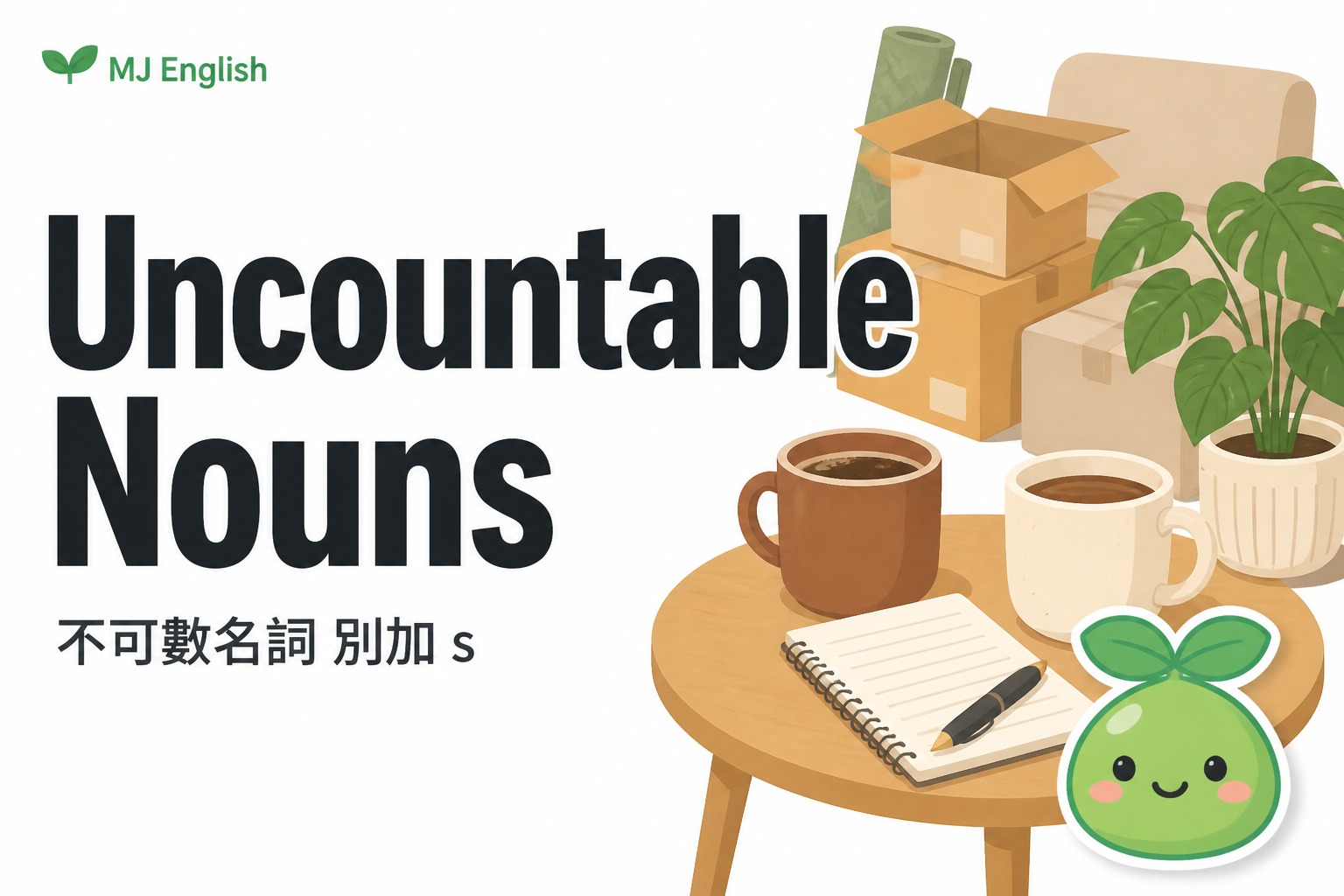
台灣人最常犯的英文錯誤 | 不可數名詞別加s!

2026 07 22 en uncountable nouns Daily English | 生活英語

跟朋友分享搬新家的心情,你脫口而出 “I need to buy some furnitures”——但這句話文法上根本不存在,因為 furniture 這個字,永遠不能加 s。

搞懂 不可數名詞 加s 的規則:information、advice、furniture 這類字不加 s、不用 a/an、也不能說 many,要用 much/some/a lot of/a piece of 才對。

💡 先搞懂:中文什麼都能加「幾個」,英文卻分「可數」跟「不可數」

中文說「兩個建議」「很多資訊」完全沒問題,但 information、advice、furniture 這些字在英文文法裡被鎖成不可數名詞,天生沒有複數形,也不能直接用 a/an 修飾;可以參考 BBC Learning English 的文法教學,就整理了完整的可數/不可數名詞清單。

台灣人最容易卡的雷:想到「有很多」就直覺加 s 或用 many,但不可數名詞要靠 much、a lot of,或「一份」的量詞說法,像 a piece of advice、a loaf of bread。


🎧 邊聽邊學

完整 podcast 已上架,挑你習慣的平台播

Apple Podcasts
Spotify

情境對話 Dialogue

場景:Chloe 剛搬進新公寓,Brian 陪她喝咖啡聊近況,她講什麼都想加 s,被 Brian 笑著一一糾正。


Chloe

I just moved into my new apartment — I need to buy some furnitures.

我剛搬進新公寓,需要買一些傢俱(furniture)。

Brian

Furniture doesn’t take an s — it’s always singular, even for a lot of it.

傢俱這個字不加 s,就算要買很多件也一樣,永遠是單數。

Chloe

Really? I also need some advices on where to shop cheap.

真的假的?我也需要一些建議(advice),哪裡買比較便宜。

Brian

Advice is the same — no s, but you can say “a piece of advice.”

advice 也一樣不加 s,但你可以說「a piece of advice」,一個建議。

Chloe

Okay, one piece of advice then — where’s a good cheap store?

好,那先給我一個建議——哪裡有便宜好買的店?

Brian

Try IKEA — their furniture is affordable and pretty easy to build.

去 IKEA 吧,他們的傢俱很平價,也很好組裝。

Chloe

Good idea. Also, my new job gave me too many homeworks for training.

好主意。對了,我新工作的訓練還出了一堆功課(homework)。

Brian

Homework’s uncountable too — just say “too much homework,” not “many.”

homework 也是不可數,要說「too much homework」,不能講 many。

Chloe

Ugh, English hates plurals. I don’t have many money for shopping anyway.

唉,英文的複數規則有夠煩。而且我現在也沒剩多少錢(money)能逛街。

Brian

Say “not much money” or “a lot of money” — never “many money.”

要說「not much money」或「a lot of money」,千萬別說「many money」。

Chloe

So no s, no “a,” and no “many” for these words?

所以這種字不能加 s、不能加 a,也不能用 many?

Brian

Exactly. Use much, some, or a lot of instead — those always work.

沒錯。改用 much、some 或 a lot of,這幾個都安全。

Chloe

Got it. Thanks for all the advice — I mean, all this advice!

懂了。謝謝你給我一堆建議——真的超多的啦!

Brian

Now you’re getting it. Let’s go furniture shopping this weekend.

你現在抓到訣竅了。這週末一起去買傢俱吧。


下次這樣說 Next Time

這三個場景最容易把不可數名詞加上 s,記起來就到位。

① 跟朋友要建議

❌ 中文腦會說

Can you give me some advices?

可以給我一些建議嗎?(advices 是中式錯法,這個字不存在)

✅ 該這樣說

Can you give me some advice? / a piece of advice

可以給我一些建議嗎?/給我一個建議。

為什麼:advice 是不可數名詞,永遠不加 s,一個建議要說 a piece of advice。

② 搬新家買傢俱

❌ 中文腦會說

I need to buy some furnitures.

我需要買一些傢俱。(furnitures 這種寫法文法上不存在)

✅ 該這樣說

I need to buy some furniture. / a few pieces of furniture

我需要買一些傢俱。/我需要買幾件傢俱。

為什麼:furniture 不可數不加 s,想講「幾件」要用 a few pieces of furniture。

③ 抱怨功課、資訊太多

❌ 中文腦會說

I have too many homeworks and informations to handle.

我有太多功課跟資訊要處理。(homeworks、informations 都是常見中式錯誤)

✅ 該這樣說

I have too much homework and a lot of information to handle.

我有太多功課跟資訊要處理。

為什麼:homework、information 都不可數,形容「多」要用 much 或 a lot of,不是 many 加 s。


重點單字 Vocabulary Boost

information/ˌɪn.fɚˈmeɪ.ʃən/ 名詞

——資訊,不可數,不加 s,一則消息可說 a piece of information。

I need some information about the bus schedule.(我需要一些巴士時刻表的資訊。)

advice/ədˈvaɪs/ 名詞

——建議,不可數,一個建議要說 a piece of advice,不能說 an advice。

Can you give me some advice?(你可以給我一些建議嗎?)

furniture/ˈfɝː.nɪ.tʃɚ/ 名詞

——傢俱,不可數,就算好幾件也不加 s,單件用 a piece of furniture。

We still need more furniture for the living room.(客廳還需要更多傢俱。)

news/nuːz/ 名詞

——新聞、消息,字尾雖有 s,文法上卻是單數不可數,動詞要用 is。

That’s great news!(那真是個好消息!)

homework/ˈhoʊm.wɝːk/ 名詞

——功課、作業,不可數,要說 too much homework,不能說 homeworks。

I have too much homework this week.(我這禮拜功課太多了。)

luggage/ˈlʌɡ.ɪdʒ/ 名詞

——行李,不可數,一件行李要說 a piece of luggage。

How much luggage can I check in?(我可以托運多少行李?)

equipment/ɪˈkwɪp.mənt/ 名詞

——設備、器材,不可數,就算好多台機器也不加 s。

The gym has new equipment.(這間健身房有新設備。)

money/ˈmʌn.i/ 名詞

——錢,不可數,別說 many money,要說 much money 或 a lot of money。

I don’t have much money right now.(我現在沒有很多錢。)

bread/brɛd/ 名詞

——麵包,不可數,一條用 a loaf of bread,一片用 a slice of bread。

Could you buy a loaf of bread?(可以幫我買一條麵包嗎?)

staff/stæf/ 名詞

——員工、職員(集合名詞),整體不加 s,指某個人要說 a staff member。

Our staff is very friendly.(我們的員工都很親切。)

🎯 30 秒快速複習

不可數名詞不加 s、不用 a/an、不用 many,量詞用 much/some/a lot of/a piece of。

information 資訊(不可數)
advice 建議(一個=a piece of advice)
furniture 傢俱(一件=a piece of furniture)
homework 功課(too much homework,不是 homeworks)
money 錢(much/a lot of money,不是 many money)
❌ many → ✅ much(不可數名詞用 much)
a lot of 可數不可數都能用,不確定就選它
a piece of / a slice of / a loaf of 不可數名詞的「一份」量詞

重點句型 Sentence Patterns

1. 不可數名詞不加 s,也不用 a/an → 規則核心

information、advice、furniture 這類字本身就是「整體概念」,沒有單複數差別,字典裡不會列出複數形,用 a/an 修飾也不合文法。

例:I need some information, not “informations.”(我需要一些資訊,不是 informations。)
例:She gave me good advice, not “a good advice.”(她給了我不錯的建議,不是 a good advice。)
例:This apartment needs more furniture, not “more furnitures.”(這間公寓需要更多傢俱,不是 more furnitures。)
記不住的話先背這三個台灣人最愛講錯的字:information、advice、furniture,看到它們絕對別加 s。

2. a piece of / a bit of / a slice of → 幫不可數名詞算「一份」

不可數名詞沒有複數形,想指「一個、一份、一件」時要靠這些量詞單位,advice/news/furniture/luggage 常用 piece,bread 用 slice 或 loaf。

例:Here’s a piece of advice for you.(給你一個建議。)
例:I heard an interesting piece of news today.(我今天聽到一則有趣的消息。)
例:Could I get a slice of bread?(可以給我一片麵包嗎?)
想講「一個」不可數名詞時,先想它適合用哪個量詞單位,而不是直接加 s。

3. much(不可數)vs many(可數)→ 別再 many money、many homework

many 只能修飾可數名詞複數(many books),修飾不可數名詞要用 much,如 much money、much homework、much information。

例:I don’t have much time today.(我今天沒有很多時間。)
例:How much luggage do you have?(你有多少行李?)
例:There isn’t much furniture in this room.(這間房間沒有很多傢俱。)
看到 money、homework、furniture、time 這類不可數名詞,直接把 many 換成 much 就對了。

4. some / any + 不可數名詞 → 肯定用 some、疑問否定用 any

some 和 any 都能修飾可數與不可數名詞,肯定句用 some,疑問句、否定句常用 any,不必糾結單複數。

例:Can you give me some advice?(可以給我一些建議嗎?)
例:I don’t have any furniture yet.(我還沒有任何傢俱。)
例:Do you need any information?(你需要任何資訊嗎?)
some/any 不用管名詞可不可數,這點反而比中文直覺,不用另外背規則。

5. a lot of → 可數不可數都安全的萬用量詞

不確定該用 many 還是 much 時,a lot of 兩種名詞都能套用,是最安全的保底選項。

例:I have a lot of homework this week.(我這禮拜功課很多。)
例:There’s a lot of information online.(網路上有很多資訊。)
例:We bought a lot of furniture.(我們買了很多傢俱。)
真的不確定該用 many 還是 much,就直接用 a lot of,永遠不會錯。

逐字稿 Transcript

J
I used to say “informations” out loud all the time until a coworker quietly fixed it for me.我以前老是把 information(資訊)多講一個 s,講成 informations,直到一個同事小小聲糾正我。I felt my face go red.我整張臉都紅了。I’m Jason, and today we’re breaking one habit almost every Mandarin speaker carries into English.我是 Jason,今天要來破解一個幾乎每個講中文的人都會帶進英文裡的老習慣。
M
I’m Mary.我是 Mary。And honestly, it’s such a sneaky mistake, because in Chinese you can put a number in front of almost anything — two informations, three advices, it just sounds normal.老實說這個錯超容易犯,因為中文什麼都能加數字——兩個資訊、三個建議,聽起來完全正常。
J
Right — that’s the exact trap.對——這就是最典型的陷阱。English quietly splits nouns into two camps: countable, like books and chairs, and uncountable, like information and furniture.英文把名詞悄悄分成兩派:countable(可數)像 books、chairs,跟 uncountable(不可數)像 information、furniture(傢俱)。Uncountable nouns never take an s, no matter how much of them you have.不可數名詞永遠不加 s,不管你有多少都一樣。
M
And our conversation shows it perfectly.我們這段對話就示範得超清楚。Chloe just moved into a new apartment, and within one sentence she says, “I need to buy some furnitures.”Chloe 剛搬進新公寓,才一句話就說:「我需要買一些 furnitures。」
J
And Brian catches it right away: “Furniture doesn’t take an s — it’s always singular, even for a lot of it.”Brian 馬上就抓到:「傢俱不加 s,就算要買很多件也一樣,它永遠是單數。」One word, corrected on the spot.一個字,當場就被糾正。
M
You can almost hear Chloe’s brain glitch for a second there.你幾乎可以聽到 Chloe 的腦袋當機那一秒。She just found a new apartment, she’s excited, and suddenly grammar trips her up mid-sentence.她才剛找到新公寓,正興奮著,結果文法突然在句子中間絆倒她。
J
That’s the real fix, though — not memorizing lists, but learning the quantifier that replaces the s.但真正的解法不是死背單字表,而是學會用量詞取代 s。For furniture, that’s “a piece of furniture,” or “a few pieces of furniture” for several.傢俱的話,就是「a piece of furniture」(一件傢俱),好幾件就用「a few pieces of furniture」。
M
Chloe keeps going, too.Chloe 還沒停。She asks Brian, “I also need some advices on where to shop cheap” — and there it is again, that automatic little s.她問 Brian:「我也需要一些 advices,哪裡買比較便宜」——那個自動加上的小 s 又出現了。
J
Advice works exactly like furniture.advice(建議)的規則跟 furniture 一模一樣。It’s uncountable, so no s, ever.它是不可數,所以永遠不加 s。Brian tells her, “Advice is the same — no s, but you can say a piece of advice.”Brian 告訴她:「advice 也一樣不加 s,但你可以說 a piece of advice。」
M
And that’s such a useful little phrase — “a piece of advice.”「a piece of advice」(一個建議)這個小片語超好用。You can drop it into almost any sentence when you want to sound natural instead of stiff and formal.幾乎任何句子都能塞進去,想講得自然一點、不要太生硬的時候特別好用。
J
Here’s the deeper reason this trips up Mandarin speakers so often.這就是講中文的人常常在這裡絆倒的更深層原因。In Chinese, you can put a number in front of almost any noun, and the grammar never blocks you.中文幾乎可以在任何名詞前面加數字,文法上完全不會擋你。
M
English just doesn’t work that way.但英文完全不是這樣運作的。A whole set of nouns got locked as uncountable long ago, and native speakers never even think twice about it.一整批名詞老早就被鎖定成不可數,母語者甚至根本不會多想。
J
Then Chloe brings up work.接著 Chloe 聊到工作。She says her new job gave her, quote, “too many homeworks for training” — and homework is a classic one, because school made it feel countable.她說新工作的訓練讓她「too many homeworks」——homework(功課)是經典錯誤,因為學校生活讓人覺得它好像可以數。
M
Brian corrects that one fast, too: “Homework’s uncountable too — just say too much homework, not many.”Brian 也馬上糾正:「homework 也是不可數,要說 too much homework,不能用 many。」Much, not many — that’s the real swap to remember.much 不是 many——這個替換才是要記住的重點。
J
And that’s the second rule worth locking in.這是第二條要記牢的規則。Many only pairs with countable plurals, like many books or many friends.many 只能搭配可數名詞的複數,像 many books、many friends。Uncountable nouns always pair with much instead.不可數名詞永遠要搭 much。
M
Wait — so even native speakers instinctively know money is uncountable?等等——所以連母語者也是靠直覺就知道 money(錢)是不可數?Nobody ever taught them a rule, they just grew up hearing much money, never many money.沒人教過他們規則,他們只是從小聽到的都是 much money,從來不是 many money。
J
Exactly.沒錯。And Chloe hits that exact wall next.Chloe 接下來就撞上這面牆。She admits she doesn’t have many money for shopping — and Brian jumps straight in to fix it.她說自己沒有 many money 可以買東西——Brian 馬上跳出來糾正。
M
He says, “Say not much money or a lot of money — never many money.”他說:「要說 not much money 或 a lot of money,絕對不要說 many money。」And a lot of is honestly the easiest fix in this whole lesson.老實說,a lot of 是這整堂課裡最簡單的解法。
J
That’s because a lot of works for both categories, countable and uncountable, without you having to choose.因為 a lot of 可數不可數都通用,不用你費心選邊站。When you’re not sure, a lot of is always the safe pick.不確定的時候,用 a lot of 永遠是安全牌。
M
Same with some and any, actually — both work on any noun, countable or not.some 跟 any 其實也一樣——不管可不可數都能用。Say “some advice,” “some furniture,” “any information,” and you’re always safe.說「some advice」、「some furniture」、「any information」都不會出錯。
J
By the end, Chloe basically summarizes the whole rule herself: no s, no a, no many for these words.到最後,Chloe 幾乎自己把規則講完了:不加 s、不用 a、不用 many。That’s exactly the checklist to keep in your head.這正是你腦中要記住的檢查清單。
M
There’s one sneaky exception worth flagging, too: news.還有一個很陰險的例外要特別提:news(新聞)。It ends in an s, so it looks plural, but it’s actually singular and uncountable — you always say “the news is,” never “the news are.”它字尾雖然有 s、看起來像複數,但其實是單數不可數——要說「the news is」,不能說「the news are」。A friend once told me “the news are shocking,” and I had to explain the s is just a trap.我一個朋友有次說「the news are shocking」,我還得跟他解釋那個 s 根本是個陷阱。
J
Travel gives you two more classics — luggage and equipment.旅行話題還會給你兩個經典字——luggage(行李)跟 equipment(設備)。Neither takes an s, no matter how many suitcases or machines you’re actually talking about.不管你講的是幾件行李箱、幾台機器,這兩個字都不加 s。So at the airport, you ask “how much luggage do you have,” not “how many luggages,” and a gym has “new equipment,” never “new equipments.”所以機場會問「how much luggage do you have」,不會說「how many luggages」;健身房有「new equipment」,不會說「new equipments」。
M
Bread’s another one, and it comes with its own set of units — a loaf of bread for the whole thing, a slice of bread for just one piece.bread(麵包)也是一個,它有自己專屬的量詞——一整條用 a loaf of bread,一片用 a slice of bread。
J
And staff is a fun one, because it’s a collective noun.staff(員工)也很有趣,因為它是集合名詞。You say “our staff is friendly,” talking about the whole team as one unit, not each person.你會說「our staff is friendly」,指的是整個團隊、當成一個整體,不是在講某一個人。If you mean just one person, you’d say “a staff member,” not “a staff” — same trick as furniture.如果只想講一個人,要說「a staff member」,不能說「a staff」——跟 furniture 的邏輯一樣。
M
Ten words, one shared rule.十個字,一條共同規則。Information, advice, furniture, homework, money, news, luggage, equipment, bread, staff — none of them ever want that little s.information、advice、furniture、homework、money、news、luggage、equipment、bread、staff——沒有一個想要那個小小的 s。
J
Okay — before you hear the whole thing again, do this once through: every time you hear Chloe or Brian mention one of these tricky nouns, check whether an s snuck on or not.好——在你再聽一次完整對話之前,先做這件事:每次聽到 Chloe 或 Brian 提到這些難搞的名詞,馬上檢查有沒有偷加 s。
🔁 [DIALOGUE REPLAY] 重播情境對話
M
So — catch it this time?那——這次抓到了嗎?Furniture, advice, homework, money — not one of them picked up an s anywhere in that whole conversation, on purpose.furniture、advice、homework、money——整段對話裡沒有一個字被加上 s,這是故意的。
J
And notice something else — Brian never lectures her.還有一件事也值得注意——Brian 從來沒有說教。He just quietly swaps the wrong word for the right one, mid-conversation, and moves right on.他只是在對話中間,悄悄把錯的字換成對的,然後就繼續聊下去。
M
So here’s your challenge: next time you want to say informations or advices, pause for one second and swap in much, some, or a piece of instead.給你的挑戰是:下次差點要說 informations 或 advices 的時候,先停一秒,改用 much、some,或 a piece of 代替。
J
Thanks so much for hanging out with us today — go count your uncountable nouns, and let us know which one you always trip on!超級謝謝你今天陪我們這一集——去數數你身邊的不可數名詞,留言告訴我們你最常在哪一個踩雷!
M
See you next time on MJ English!下次 MJ English 見!
J
Bye, everyone!大家掰掰!

延伸學習 Keep Going

同樣是台灣人最容易搞混的英文,一起補起來。


你是不是也曾經脫口而出 “informations” 或 “advices”?

留言告訴我們,這 10 個不可數名詞裡,你最常在哪一個踩雷!

追蹤 MJ英語 podcast,下次見。
標題和URL已復制