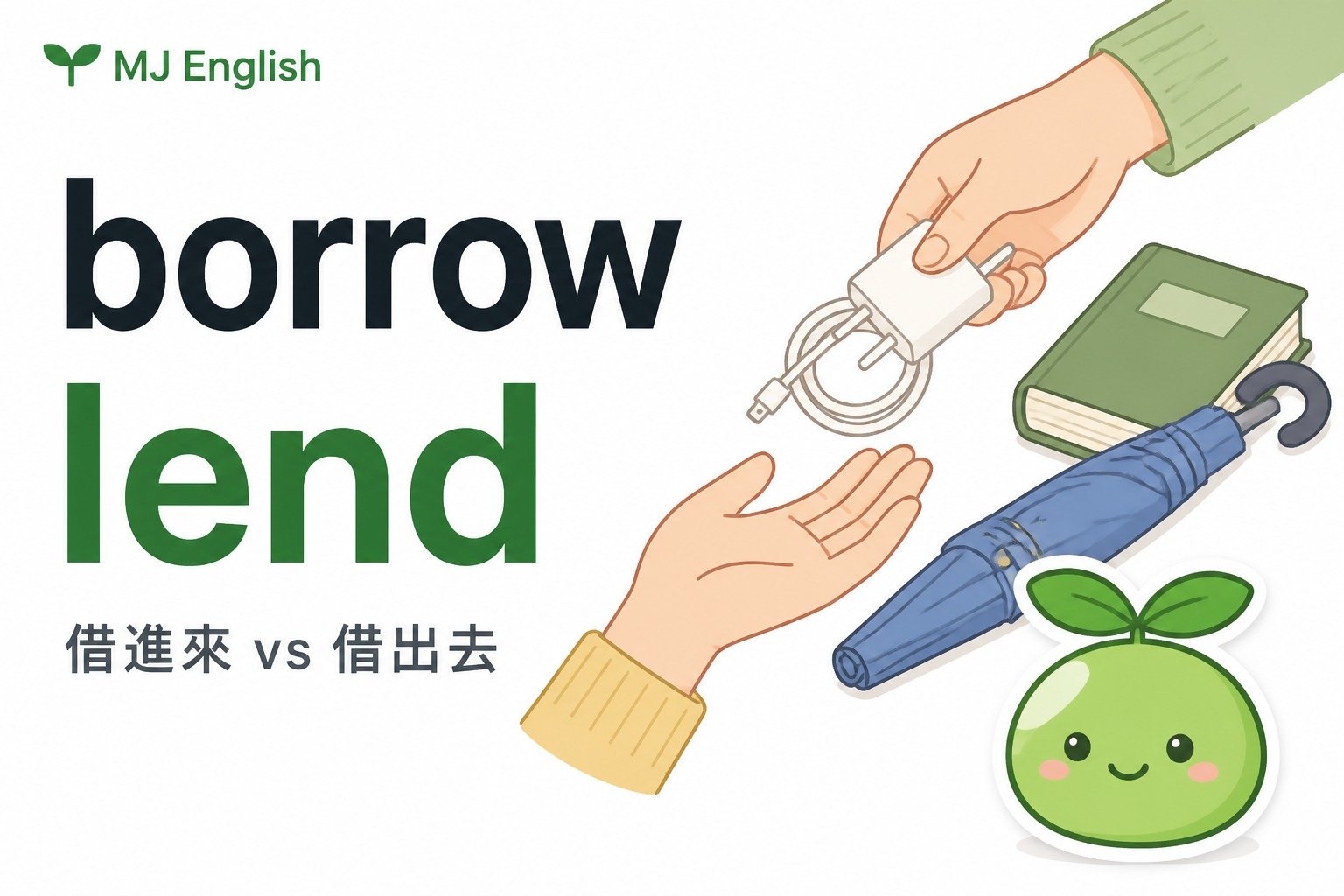
「borrow me」是錯的!借進來、借出去中文都叫「借」,英文怎麼分 borrow 和 lend?

2026 07 14 en borrow vs lend Daily English | 生活英語

手機快沒電,你脫口一句 “Can you borrow me a charger?”——老外一秒皺眉。借進來、借出去,中文都叫「借」,英文卻是兩個相反方向的字。

搞懂 borrow vs lend 差別borrow=你「拿進來」(向別人借),lend=你「給出去」(借給別人)。

🎧

Podcast 製作中

完整 podcast 版本準備上架。先訂閱節目,新集數第一時間通知。

訂閱 Apple Podcasts 訂閱 Spotify

💡 先搞懂:中文一個「借」,英文分方向

關鍵不是背單字,是看「方向」:borrow=東西「往你這邊來」(你拿進來,常搭 from);lend=東西「從你這邊出去」(你給別人,常搭 to)。像去 圖書館 borrow a book,是書從圖書館到你手上。

台灣人最容易卡的雷:想請別人借你東西,別說「Can you borrow me…」——你要對方「給出去」,用 lend:Can you lend me…?


情境對話 Dialogue

場景:Chloe 手機快沒電,跟 Ryan 借充電器,順便還借了書和雨傘——今天什麼都跟人借。


Chloe

Hey, could you lend me your charger? My phone’s about to die.

欸,可以借我你的充電器嗎?我手機快沒電了。

Ryan

Sure, here you go. Just give it back before you leave, okay?

好啊,拿去。你走之前記得還我喔?

Chloe

Of course. You’re a lifesaver — I always forget mine.

當然。你真是救星——我老是忘記帶自己的。

Ryan

Ha, no worries. Didn’t you borrow one from Mia last week too?

哈,沒事。你上禮拜不是也跟 Mia 借了一個?

Chloe

I did! I’m the worst. I borrow stuff from everyone and never remember.

有啦!我最糟了。我跟每個人借東西,然後都不記得。

Ryan

As long as you return it. So, are you lending me that book you finished?

你有還就好。話說,你看完的那本書要借我嗎?

Chloe

Oh right, the novel! Yeah, you can borrow it whenever.

喔對,那本小說!好啊,你隨時可以借去看。

Ryan

Nice. I’ll grab it Friday. Don’t lend it to anyone else first!

讚。我禮拜五去拿。別先借給別人喔!

Chloe

It’s all yours. Oh, can I also borrow your umbrella? It’s pouring.

都是你的了。喔對,我也可以跟你借雨傘嗎?外面在下大雨。

Ryan

Wow, you’re borrowing everything today. Take it — just don’t lose it.

哇,你今天什麼都在借。拿去吧——別弄丟就好。

Chloe

I promise. I’ll lend you my whole apartment to make up for this.

我保證。我把整間公寓借你,補償你這一切。

Ryan

Deal. I’m holding you to that.

一言為定。我可記住你這句話了。


下次這樣說 Next Time

這三個場景最容易把 borrow 和 lend 用反,記起來就到位。

① 請對方借你東西

❌ 中文腦會說

Can you borrow me your charger?

可以借我你的充電器嗎?(borrow me 方向反了)

✅ 該這樣說

Can you lend me your charger?

可以借我你的充電器嗎?

為什麼:你要對方把東西「給出去」給你,用 lend;borrow 是「拿進來」,不能 borrow 某人東西。

② 向某人借

❌ 中文腦會說

I lent a pen from Mia.

我跟 Mia 借了一支筆。(lend 是給出去,不能 from)

✅ 該這樣說

I borrowed a pen from Mia.

我跟 Mia 借了一支筆。

為什麼:東西從 Mia 到你手上(拿進來),用 borrow … from;lend 是往外給,不會配 from。

③ 你想借用別人的

❌ 中文腦會說

I want to lend your car.

我想借你的車(來開)。(想借用是拿進來,不是 lend)

✅ 該這樣說

I want to borrow your car.

我想借你的車(來開)。

為什麼:你要把車「拿來用」=borrow;lend your car 會變成「我要把你的車借給別人」,意思整個跑掉。


重點單字 Vocabulary Boost

borrow/ˈbɑr.oʊ/ 動詞

借(進來)——你向別人借、把東西拿來用;常搭 borrow … from。

Can I borrow your umbrella?(我可以跟你借雨傘嗎?)

lend/lɛnd/ 動詞

借(出去)——你把東西借給別人;lend sb sth 或 lend sth to sb。過去式 lent。

Could you lend me your charger?(可以借我你的充電器嗎?)

lend me/lɛnd mi/ 片語

借我(=借給我)。請人借你東西的正解,不是 borrow me。

Can you lend me ten bucks?(可以借我十塊嗎?)

borrow from/ˈbɑr.oʊ frəm/ 片語

向…借。borrow 幾乎一定搭 from(東西從對方來)。

I borrowed it from Mia.(我跟 Mia 借的。)

give back/ɡɪv bæk/ 片語

歸還、還回去。正式一點用 return。

Just give it back before you leave.(走之前還我就好。)

lifesaver/ˈlaɪfˌseɪ.vɚ/ 名詞

救星、幫大忙的人(誇張感謝用)。

Thanks, you’re a lifesaver!(謝啦,你真是救星!)

lend a hand/lɛnd ə hænd/ 片語

幫忙(把「一隻手」借出去給人)。同樣是 lend=往外給。

Can you lend me a hand with this?(可以幫我一下嗎?)

grab/ɡræb/ 動詞

(順手)去拿、抓。口語很常用。

I’ll grab it on Friday.(我禮拜五去拿。)

pouring/ˈpɔr.ɪŋ/ 動詞

下傾盆大雨。It’s pouring.=雨下超大。

Take an umbrella — it’s pouring.(帶把傘,外面下超大。)

hold you to that/hoʊld ju tu ðæt/ 片語

我要你說到做到、記住你這句話(半開玩笑)。

Okay, I’m holding you to that!(好,我可記住你這句了!)

🎯 30 秒快速複習

borrow = 你「拿進來」(向人借,+from);lend = 你「給出去」(借給人,+to)。看方向就對了。

borrow from ~ 向~借(拿進來)
lend … to ~ 借給~(給出去)
Can you lend me ~? 可以借我~嗎
Can I borrow ~? 我可以借~嗎
lend a hand 幫忙
give it back 還回去
❌ borrow me ~ → ✅ lend me ~
❌ lend from ~ → ✅ borrow from ~

重點句型 Sentence Patterns

1. lend + 人 + 物 → 借給某人(給出去)

東西從你這往外給,用 lend;lend sb sth 或 lend sth to sb 都行。

例:Can you lend me your pen?(可以借我你的筆嗎?)
例:I lent my car to my brother.(我把車借給我弟。)
例:She never lends her books to anyone.(她從不把書借給任何人。)
請別人借你東西,永遠用 lend me,不是 borrow me。

2. borrow + 物 + from + 人 → 向某人借(拿進來)

東西往你這來,用 borrow;後面幾乎一定接 from + 來源。

例:I borrowed this book from the library.(這本書我跟圖書館借的。)
例:Can I borrow your charger?(我可以跟你借充電器嗎?)
例:He borrowed money from his friend.(他跟朋友借了錢。)
看到 from 就想到 borrow(東西從那邊過來);lend 不會配 from。

3. Can you lend me ~? ↔ Can I borrow ~? → 兩種問法

同一件事,兩種角度:請對方「給」用 lend、說自己要「拿」用 borrow。

例:Can you lend me your umbrella?(你可以借我雨傘嗎?)
例:Can I borrow your umbrella?(我可以跟你借雨傘嗎?)
例:Could I borrow this for a second?(這個我可以借一下嗎?)
兩句都對、都很自然,挑一個順口的用就好,別把兩個字混成 borrow me。

4. 方向記憶法:borrow 拿進來/lend 給出去

不用背,想像東西的移動方向:往你來=borrow,離開你=lend。

例:I borrow it, you lend it.(我借進來,你借出去。)
例:The owner lends; the user borrows.(擁有的人借出、使用的人借入。)
例:You can’t borrow me anything.(你沒辦法「borrow 我」東西。)
誰是「拿」的人就 borrow,誰是「給」的人就 lend,同一件東西兩個字。

5. lend a hand → 幫忙(延伸用法)

把「一隻手」借出去=幫忙;一樣是 lend=往外給的邏輯。

例:Can you lend me a hand?(可以幫我一下嗎?)
例:Everyone lent a hand with the move.(大家都來幫忙搬家。)
例:I’m happy to lend a hand anytime.(我隨時樂意幫忙。)
「借一隻手」給人=幫忙,超道地;不會說 borrow a hand。

逐字稿 Transcript

J
Someone holds out their hand, phone dying, and says, “hey, can you borrow me a charger?”有人伸出手、手機快沒電,說:「欸,can you borrow me a charger(可以「borrow 我」充電器嗎)?」And somewhere, an English teacher quietly flinches.而某個角落,一位英文老師默默抽了一下。It’s one of the most common little slips Taiwanese speakers make, and honestly it’s the easiest one in the world to fix once you see the trick.這是台灣人最常犯的小失誤之一,但老實說,一旦看懂訣竅,它是全世界最好修的。I’m Jason, and today we’re sorting out borrow and lend for good.我是 Jason,今天要把 borrow 和 lend 一次徹底搞定。
M
I’m Mary, and I love this pair because it’s not really about vocabulary — it’s about direction.我是 Mary,我超愛這一組,因為它其實不是在考單字——是在考「方向」。Both words are about the same object moving between two people, but they point in opposite directions.兩個字講的都是同一個東西在兩個人之間移動,但方向剛好相反。In our conversation, Chloe is having a very needy day and borrows basically everything, so she’s the perfect person to learn from.在我們的對話裡,Chloe 今天超需要人幫、幾乎什麼都跟人借,正好是最好的學習範例。
J
Let’s start with what she gets right.先從她講對的地方開始。She opens with, “could you lend me your charger?”她開口就說:「could you lend me your charger(可以借我充電器嗎)?」That’s perfect.這句完美。Lend is when something goes OUT from you to someone else.lend 是東西「從你這往外」給別人。You have it, and you hand it over.東西在你手上,你把它交出去。Ryan owns the charger, so Ryan lends it. The owner lends.充電器是 Ryan 的,所以是 Ryan lend 出去。擁有的人 lend。
M
And here’s the exact moment learners trip.而這正是學習者絆倒的那一刻。The instinct is to say “can you borrow me your charger?” But that’s backwards.直覺會說「can you borrow me your charger」,但方向反了。Borrow is when something comes IN to you — you’re the one receiving it.borrow 是東西「往你這裡來」——你是收下的那一方。So you can’t “borrow someone” anything; you borrow it FROM them, or you ask them to LEND it to you.所以你不能「borrow 某人」東西;你是向他 borrow … from,或請他 lend 給你。
J
Think of it as a direction of travel.把它想成一個移動方向。Lend goes away from you, like lending your hand out.lend 是離開你、往外去,像把手伸出去借人。Borrow comes toward you, into your bag.borrow 是往你這來、進到你的包包裡。Same charger, same two people — the word just depends on who’s giving and who’s taking.同一個充電器、同樣兩個人——用哪個字只看誰在給、誰在拿。
M
Chloe actually nails the other side a second later.Chloe 其實過一秒就把另一邊也用得很準。She says, “didn’t you borrow one from Mia last week?” and “I borrow stuff from everyone.”她說:「你上禮拜不是也跟 Mia 借了一個?」還有「我跟每個人借東西」。Notice the little word riding along: FROM.注意那個跟著的小字:from。Borrow almost always travels with “from” — you borrow something from a person.borrow 幾乎一定帶著 from——你向某人 borrow 某樣東西。That “from” is your clue that the thing is coming toward you.那個 from 就是提示:東西正往你這邊來。
J
And lend travels with “to,” or with a person straight after it.而 lend 帶的是 to,或後面直接接人。You lend something TO someone, or you just “lend me the book,” “lend her the car.”你 lend 某樣東西 to 某人,或直接「lend me the book」「lend her the car」。So Ryan asks, “are you lending me that book?” — the book goes out from Chloe to Ryan.所以 Ryan 問「are you lending me that book(那本書要借我嗎)?」——書從 Chloe 往外給 Ryan。And Chloe answers, “you can borrow it whenever” — same book, but now from Ryan’s point of view, it’s coming toward him.而 Chloe 回「you can borrow it whenever(你隨時可以借去)」——同一本書,但換成 Ryan 的角度,是往他那邊來。
M
That flip in one exchange is the whole lesson in miniature.一來一往之間那個翻轉,就是整堂課的縮影。One object, one hand-off, two speakers — and each person naturally picks the word that matches their direction.一個東西、一次交接、兩個說話者——每個人都自然挑到符合自己方向的字。The giver lends; the taker borrows.給的人 lend、拿的人 borrow。
J
There’s a great warning line too.還有一句很棒的警告句。Ryan says, “don’t lend it to anyone else first.”Ryan 說:「don’t lend it to anyone else first(別先借給別人喔)。」Perfect use — he’s telling Chloe not to give it out to a third person.用得完美——他在叫 Chloe 別把書轉借給第三個人。If he’d said “don’t borrow it to anyone,” that would make no sense, because borrow only ever comes toward you, never out.如果他說「don’t borrow it to anyone」就不通了,因為 borrow 永遠是往你來、不會往外。
M
And near the end, Chloe piles it on: “can I also borrow your umbrella?”接近尾聲,Chloe 又加碼:「can I also borrow your umbrella(我也可以跟你借雨傘嗎)?」Coming toward her.往她這邊來。Then she jokes, “I’ll lend you my whole apartment to make up for this” — going out from her.然後她開玩笑:「I’ll lend you my whole apartment(我把整間公寓借你)補償你」——從她往外給。She switches between the two four or five times without thinking, purely by feeling the direction.她想都沒想就在兩個字之間切換了四五次,純粹靠感覺方向。That’s exactly the instinct we want you to build.這正是我們希望你養成的直覺。
J
One quick bonus that’s not in the chat: there’s a lovely idiom, “lend a hand,” which just means to help.補一個對話裡沒有的:有個很棒的慣用語「lend a hand」,就是「幫忙」。“Can you lend me a hand?” is asking someone to give their help to you.「Can you lend me a hand?」就是請人把幫忙「給」你。It follows the same logic — help going out from them, toward you.邏輯一模一樣——幫忙從他們那往外、朝你來。
M
So before we let you go, do yourself a favor and play that whole conversation one more time.所以在結束前,幫自己一個忙,把整段對話再聽一次。This round, listen for two things: every time something is coming TOWARD the speaker — that’s borrow — and every time something is going OUT from the speaker to someone else — that’s lend.這一輪留意聽兩件事:每次東西「往說話者這邊來」——那是 borrow;每次東西「從說話者往外給別人」——那是 lend。Watch the direction, not the object.看方向,別看東西本身。
🔁 [DIALOGUE REPLAY] 重播情境對話
J
So — now that you’ve listened again, did you catch it?那——再聽一次之後,你抓到了嗎?Every time Chloe was taking something in, she said “borrow,” usually with a little “from.”每次 Chloe 把東西拿進來,她說的是 borrow,通常還帶個小小的 from。Every time someone was handing something over, they said “lend,” with a “to” or a person right after.每次有人把東西交出去,說的是 lend,後面接 to 或直接接人。Not once did anyone say “borrow me.”沒有一次有人說「borrow me」。That’s the whole trick: borrow comes toward you, lend goes away from you.整個訣竅就這樣:borrow 往你來、lend 從你出去。
M
And you don’t need to memorize a grammar chart.而且你不用去背什麼文法表。Just picture the object moving.只要想像那個東西在移動。If it’s coming into your hands, you’re borrowing it. If it’s leaving your hands for someone else, you’re lending it.如果它進到你手裡,你是在 borrow;如果它離開你的手去別人那,你是在 lend。Feel the direction, and the right word shows up on its own.感受方向,對的字自己就會冒出來。
J
So here’s your challenge: next time you need to ask for something, catch yourself before you say “can you borrow me that.”所以這是你的挑戰:下次你要跟人開口借東西,在說出「can you borrow me that」前先攔住自己。Flip it: “can you lend me that,” or “can I borrow that from you?”翻過來:「can you lend me that」,或「can I borrow that from you?」Get that one reflex right and you’re basically done.把那個反射練對,你基本上就搞定了。That’s all from us today.今天就到這裡。
M
Thanks for hanging out with us — go lend someone a hand today, and try not to borrow too much!謝謝你陪我們這一集——今天去幫個人的忙(lend a hand),然後盡量別借太多東西啦!
J
See you next time on MJ English — bye, everyone!下次 MJ English 見——大家掰掰!

延伸學習 Keep Going

同樣是台灣人最容易搞混、用反的英文,一起補起來。


你以前是不是也說過 “borrow me”?

留言用今天學的 borrow/lend 造一句,看看你有沒有抓到方向!

追蹤 MJ英語 podcast,下次見。
標題和URL已復制