「請慢用」別說 Eat slowly!感恩節晚餐英文這樣說

「請慢用」英文怎麼說?感恩節作客英文 Thanks for having me | MJ英語 Daily English | 生活英語

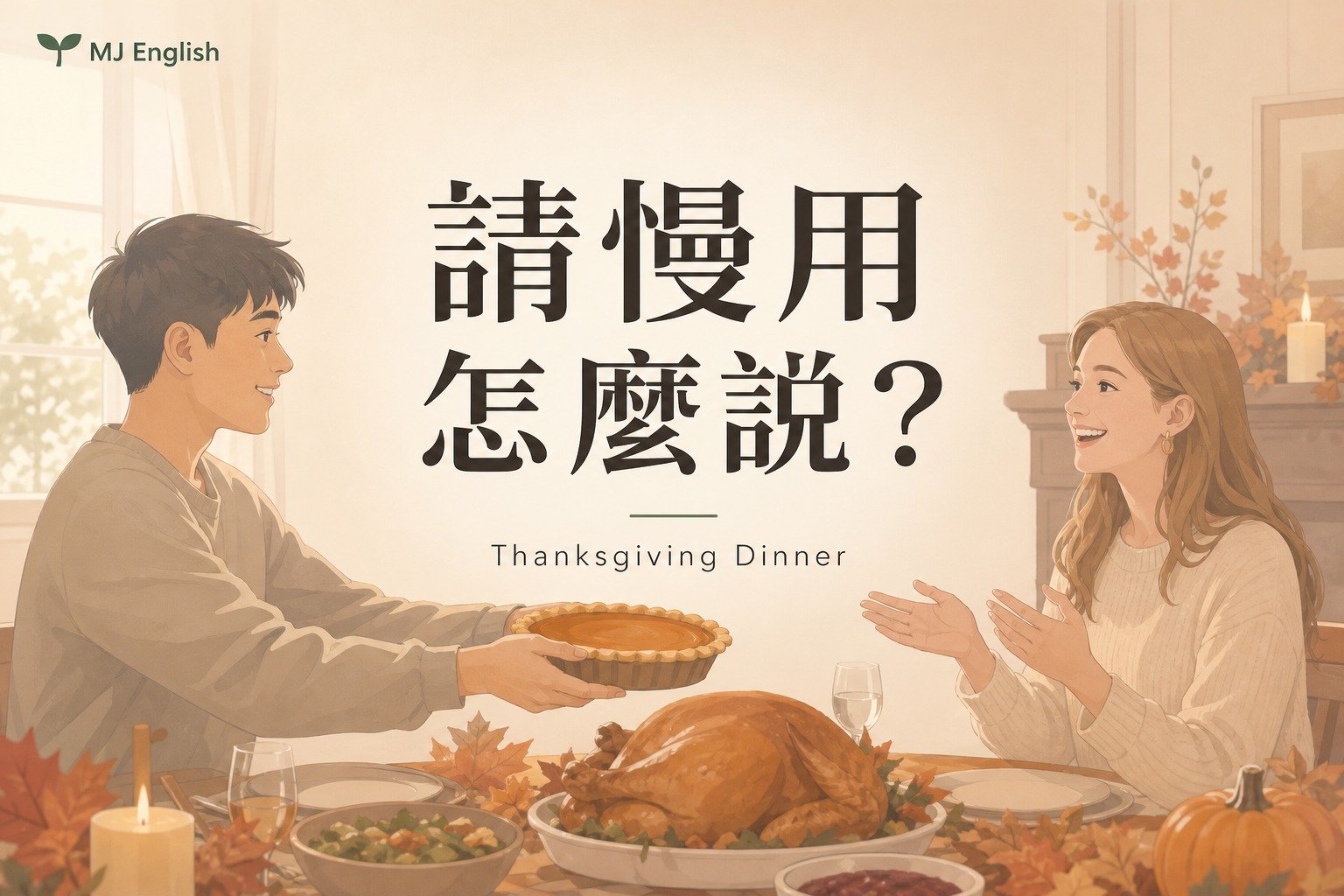
第一次去美國同事家過感恩節,你端出自己帶的派,熱情地說 “Please eat slowly.”——大家愣了一下:要慢慢吃?怕我們噎到嗎?

「請慢用」英文直接說 Enjoy! 或 Dig in!(開動吧)。進門道謝說 Thanks for having me!,想幫忙說 Can I give you a hand?

💡 先搞懂:作客的客套話,別直翻中文

中文的「謝謝邀請」「我可以幫忙嗎」「請慢用」,直翻成英文不是文法錯,就是意思跑掉。英文作客有一套固定說法:進門說 Thanks for having me!,想幫忙說 Can I give you a hand?,請大家吃說 Enjoy! 或 Dig in!,吃飽了說 I’m stuffed.

台灣人最容易卡的雷:① Thank you to invite me. → Thanks for having me!;② Can I help you? → Can I give you a hand?;③ Please eat slowly. → Enjoy!


情境對話 Dialogue

邊聽邊學

這一集完整音檔就在這裡,也可以到 Apple 或 Spotify 收聽

立即播放約 8 分

場景:感恩節晚上,在芝加哥工作的 Kevin 第一次到同事 Sarah 家作客,手上拿著一個南瓜派。


Sarah

Kevin, you made it! Happy Thanksgiving! Come on in.

Kevin,你來啦!感恩節快樂!快進來。

Kevin

Happy Thanksgiving, Sarah! Thank you to invite me.

感恩節快樂,Sarah!謝謝你邀請我。(要說 Thanks for having me!)

Sarah

Of course! We’re so happy to have you. Oh, is that a pumpkin pie?

當然!很高興你來。喔,那是南瓜派嗎?

Kevin

Yes, I bought it at a bakery. Can I help you?

對,我在麵包店買的。我可以幫你嗎?(像店員,要說 Can I give you a hand?)

Sarah

Aw, thanks! Could you give me a hand with the plates? They’re on the counter.

哇,謝啦!可以幫我拿一下盤子嗎?在流理台上。

Kevin

Sure. Wow, the turkey looks amazing!

沒問題。哇,火雞看起來好棒!

Sarah

Thanks! Okay, everyone, dinner’s ready. Help yourself!

謝謝!好,各位,晚餐好了。自己拿喔!

Kevin

This is so good. I think I ate too much. I’m stuffed.

這太好吃了。我好像吃太多了,好撐。

Sarah

Ha, that’s the Thanksgiving spirit! Is there room for pie?

哈,這就是感恩節的精神!還吃得下派嗎?

Kevin

Always! Here’s the pie, everyone. Please eat slowly.

當然!各位,派來了。請慢慢吃。(像怕人噎到,要說 Enjoy!)

Sarah

Ha, don’t worry, we will! You mean, enjoy! Okay, everybody, dig in!

哈,放心,我們會慢慢吃的!你是說 enjoy 吧!好,大家開動!

Kevin

Right, enjoy! Thanks for having me, Sarah. This was my first real Thanksgiving.

對,請享用!謝謝你招待我,Sarah。這是我第一次過真正的感恩節。

🎯 30 秒快速複習

謝謝招待=Thanks for having me/想幫忙=Can I give you a hand?/請慢用=Enjoy!/吃好撐=I’m stuffed

①謝謝招待=Thanks for having me!
②謝謝邀請=Thanks for inviting me!
③要我幫忙嗎=Can I give you a hand?
④要我帶什麼嗎=What can I bring?
⑤請慢用=Enjoy!
⑥大家開動=Dig in!
⑦自己拿別客氣=Help yourself!
⑧我吃好撐=I’m stuffed.

下次這樣說 Next Time

去美國人家作客,台灣人最常直翻的三句。

① 謝謝邀請

❌ 中文腦會說

Thank you to invite me.

thank you 後面不接 to

✅ 該這樣說

Thanks for having me!

謝謝招待/謝謝邀請

為什麼:thank you 後面接 for,不接 to。作客最常說 Thanks for having me,離開時最常用,進門也可以。

② 我可以幫忙嗎

❌ 中文腦會說

Can I help you?

像店員招呼客人

✅ 該這樣說

Can I give you a hand?

要我幫忙嗎?

為什麼:Can I help you? 是店員問客人要買什麼。在朋友家想幫忙,說 give you a hand 比較自然。

③ 請慢用

❌ 中文腦會說

Please eat slowly.

像提醒別噎到

✅ 該這樣說

Enjoy!

請享用

為什麼:英文沒有「慢用」的客套話,eat slowly 聽起來是真的叫人慢慢吃。說 Enjoy! 或 Dig in! 就好。


重點單字 Vocabulary Boost

Thanksgiving/ˌθæŋksˈɡɪvɪŋ/ n.

感恩節(美國是十一月第四個星期四)。

Happy Thanksgiving!(感恩節快樂!)

having me/ˈhævɪŋ mi/ phr.

邀請我、招待我(Thanks for having me)。

Thanks for having me!(謝謝招待!)

give you a hand/ɡɪv ju ə hænd/ phr.

幫你一把。

Can I give you a hand?(要我幫忙嗎?)

help yourself/hɛlp jɚˈsɛlf/ phr.

自己拿、別客氣。

Dinner’s ready. Help yourself!(晚餐好了,自己拿喔!)

dig in/dɪɡ ɪn/ phr.

開動、大口吃吧。

Okay, everybody, dig in!(好,大家開動!)

stuffed/stʌft/ adj.

吃得好撐。

I ate too much. I’m stuffed.(我吃太多了,好撐。)

pumpkin pie/ˈpʌmpkɪn paɪ/ n.

南瓜派,感恩節必備甜點。

Is that a pumpkin pie?(那是南瓜派嗎?)

turkey/ˈtɝki/ n.

火雞(感恩節大餐主菜)。

The turkey looks amazing!(火雞看起來好棒!)


重點句型 Sentence Patterns

1. 謝謝邀請 → Thanks for having me!

thank you 後面接 for(+V-ing 或名詞),不接 to。

例:”Thanks for having me!”(「謝謝招待!」)
例:”Thanks for inviting me.”(「謝謝你邀請我。」)
例:”Thank you for dinner. It was amazing.”(「謝謝你的晚餐,太好吃了。」)
離開前跟主人說 Thanks for having me 最道地,進門時說也很自然,主人會覺得你很有禮貌。

2. 想幫忙 → Can I give you a hand?

Can I help you? 是店員招呼客人,在朋友家聽起來怪怪的。

例:”Can I give you a hand?”(「要我幫忙嗎?」)
例:”Is there anything I can do?”(「有什麼我能做的嗎?」)
例:”Let me help with the dishes.”(「我來幫忙洗碗。」)
Can I help you? 是店員招呼客人,在朋友家聽起來怪怪的。

3. 請慢用 → Enjoy! / Dig in!

英文沒有「慢用」這種客套話,eat slowly 會被當成真的要你慢慢吃。

例:”Here’s the pie, everyone. Enjoy!”(「派來了,大家請享用!」)
例:”Okay, everybody, dig in!”(「好,大家開動!」)
例:”Help yourself!”(「自己拿,別客氣!」)
Dig in 比較輕鬆,適合朋友家;正式一點就說 Enjoy!

4. 出發前先問 → What can I bring?

美國人作客習慣帶一道菜、甜點或飲料,先問主人最保險。

例:”What can I bring?”(「我要帶什麼過去?」)
例:”Should I bring a dessert?”(「我帶個甜點好嗎?」)
例:”Just bring yourself!”(「人來就好!」)
美國人作客習慣帶一道菜、甜點或飲料,先問主人最保險。

5. 吃飽了 → I’m stuffed.

比 I’m full 更生動,感恩節大家都會這樣說。

例:”I’m stuffed.”(「我好撐。」)
例:”I couldn’t eat another bite.”(「我一口都吃不下了。」)
例:”Is there room for pie?”(「還吃得下派嗎?」)
比 I’m full 更生動,感恩節大家都會這樣說。

逐字稿 Transcript

J
Picture this. The smell of roasted turkey fills the house. The kitchen is warm and crowded, and the doorbell just rang. Hi, I’m Jason, and welcome to MJ English. Today, we’re going to a first Thanksgiving dinner at a coworker’s home.想像一下。烤火雞的香味飄滿整個屋子,廚房又暖又擠,門鈴剛響起來。嗨,我是 Jason,歡迎來到 MJ English。今天我們要去同事家,參加第一次的感恩節晚餐。
M
And I’m Mary! Okay, so our guy is Kevin. He’s from Taiwan, he works in Chicago, and his coworker Sarah invited him over. He’s excited, but he makes three small mistakes. They all come from translating Chinese word for word.我是 Mary!好,我們的主角是 Kevin。他是台灣人,在芝加哥工作,同事 Sarah 邀他到家裡吃飯。他很期待,但犯了三個小錯,全都是把中文一個字一個字翻成英文造成的。
J
Quick background first. Thanksgiving is on the fourth Thursday of November. The big dinner is turkey, mashed potatoes, and pumpkin pie. It’s a family day, so getting invited to someone’s home is a really nice thing.先講一下背景。感恩節是十一月的第四個星期四。大餐有火雞、馬鈴薯泥,還有南瓜派。這是家人團聚的日子,所以被邀請去別人家,代表對方真的把你當朋友。
M
Okay, mistake number one. Kevin walks in and says, “Thank you to invite me.” We understand him, but it sounds off. In English, after “thank you,” we don’t use “to.” We use “for.”好,第一個錯。Kevin 一進門就說 Thank you to invite me. 我們聽得懂,但聽起來怪怪的。英文裡 thank you 後面不接 to,要接 for。
J
So the natural way is, “Thanks for having me!” The rule is simple: thank you, plus for, plus a verb with i-n-g. So “Thanks for inviting me” works too. Both sound warm and friendly at the door.所以自然的說法是 Thanks for having me! 規則很簡單:thank you 加 for,再加動詞 ing。所以 Thanks for inviting me. 也可以。在門口講都很親切。
M
Here’s a nice little tip. Say it again when you leave. “Thanks for having me” at the door, and again at the end of the night. The host will remember that. It’s polite, and it’s not hard at all.有個小撇步:離開的時候再說一次。進門說一次 Thanks for having me,晚上結束時再說一次。主人會記得的。這樣很有禮貌,而且一點都不難。
J
Before the dinner, you can also ask, “What can I bring?” In the U.S., guests usually bring a dish, a dessert, or some drinks. Kevin brought a pumpkin pie from a bakery. That’s a perfect choice for Thanksgiving.晚餐前,你也可以先問 What can I bring? 在美國,客人通常會帶一道菜、一份甜點,或是飲料。Kevin 從麵包店買了一個南瓜派,這個選擇對感恩節來說剛剛好。
M
And sometimes the host says, “Just bring yourself!” That means, you don’t need to bring anything. But honestly, I still bring something small. A bottle of juice or some cookies. It just feels nicer.有時候主人會說 Just bring yourself! 意思是什麼都不用帶,人來就好。不過老實說,我還是會帶點小東西,像是果汁或餅乾,感覺比較貼心。
J
Mistake number two. Sarah is busy in the kitchen, so Kevin says, “Can I help you?” In his head, it’s a kind offer. But that’s what a shop clerk says to a customer walking in.第二個錯。Sarah 在廚房忙,所以 Kevin 說 Can I help you? 他心裡是想好意幫忙,但這句其實是店員對走進店裡的客人說的話。
M
Right, so it sounds like he’s working at her house! The better way is, “Can I give you a hand?” You can also say, “Is there anything I can do?” And Sarah says, “Could you give me a hand with the plates?”對,聽起來就像他在人家家裡打工一樣!比較好的說法是 Can I give you a hand? 你也可以說 Is there anything I can do? 然後 Sarah 說:Could you give me a hand with the plates?
J
Then dinner is ready. Sarah says, “Help yourself!” That means, take the food you want, no need to wait for me. It’s a very common thing hosts say, and it makes everybody relax.接著晚餐好了。Sarah 說 Help yourself! 意思是想吃什麼自己拿,不用等我。這是主人很常說的一句話,會讓大家都放鬆下來。
M
Kevin eats a lot, and later he says, “I’m stuffed.” That means very, very full. It’s more fun than “I’m full.” Then Sarah asks, “Is there room for pie?” It’s a joke, because everyone always finds room for pie.Kevin 吃了很多,後來他說 I’m stuffed. 意思是超級撐。比 I’m full 更生動。然後 Sarah 問 Is there room for pie? 這是個玩笑,因為大家永遠都吃得下派。
J
Now the third mistake, and it’s the big one. Kevin brings out the pie and says, “Please eat slowly.” In Chinese, that’s a really polite thing to say to your guests. So he thinks it works the same way in English.現在是第三個錯,也是最大的一個。Kevin 把派端出來說 Please eat slowly. 中文的「請慢用」是很禮貌的客套話,所以他以為英文也一樣。
M
But in English, it sounds like a warning. Like, “Be careful, don’t choke!” It’s what you’d say to a little kid. English doesn’t really have a polite phrase like that for eating. We say something happier instead.但在英文裡,聽起來像警告,好像在說「小心點,不要噎到!」那是對小孩子才會說的話。英文裡其實沒有這種吃飯時的客套話,我們會用比較開心的說法。
J
Here’s the fix. Just say, “Enjoy!” And in the story, Sarah says, “You mean, enjoy! Okay, everybody, dig in!” “Dig in” means start eating. It’s casual, and it sounds very warm.修正方法是直接說 Enjoy! 故事裡 Sarah 說:You mean, enjoy! Okay, everybody, dig in! Dig in 就是開動的意思,很口語,聽起來很溫暖。
M
So which one should you use? “Enjoy!” works almost anywhere, even at a nice dinner. “Dig in!” is better with friends and family. At my friend’s house, everyone says “Dig in!” and then it gets loud and happy right away.那該用哪一個?Enjoy! 幾乎到處都能用,連比較正式的晚餐也可以。Dig in! 比較適合朋友和家人。在我朋友家,大家都說 Dig in!,然後馬上就熱鬧起來了。
J
I remember my first time at an American friend’s table. I was so nervous, I said almost nothing. Then he said “Help yourself!” and I just stood there. Now I know I should smile, grab a plate, and say thanks.我記得第一次坐在美國朋友的餐桌上,我緊張到幾乎沒說話。他說 Help yourself! 我就站在那裡不動。現在我知道應該笑一笑、拿個盤子,然後說聲謝謝。
M
That’s so real. And honestly, nobody expects perfect English at the table. If you say a warm, simple sentence with a smile, people will like you. That matters more than a long, fancy sentence.這好真實。而且說真的,沒人期待你在餐桌上講完美的英文。帶著微笑說一句溫暖又簡單的話,大家就會喜歡你,這比一長串華麗的句子重要多了。
J
Let’s do a quick recap. Arriving? “Thanks for having me!” Want to help? “Can I give you a hand?” Time to eat? “Enjoy!” or “Dig in!” And later, when you’re full, “I’m stuffed.”我們來快速整理一下。剛到?Thanks for having me! 想幫忙?Can I give you a hand? 要吃飯了?Enjoy! 或 Dig in! 之後吃飽了,就說 I’m stuffed.
M
And don’t forget the bonus ones. “What can I bring?” before you go, and “Help yourself!” when you’re the host. If you remember just these few phrases, your first Thanksgiving will go smoothly. We promise.加碼的那幾句也別忘了。出發前問 What can I bring?,自己當主人的時候就說 Help yourself! 只要記得這幾句,你的第一次感恩節就會很順利。我們保證。
J
Okay, now let’s see how it sounds when everything goes right. Kevin and Sarah’s whole evening is coming up, from the doorbell to the last slice of pie. Listen to how natural each phrase feels.好,現在來聽聽一切順利的時候是什麼感覺。Kevin 和 Sarah 整個晚上的對話要來了,從門鈴響起,到最後一片派。聽聽每一句有多自然。
M
Let’s hear the whole conversation one more time. This time, try to catch all the phrases we talked about today, and see how many you can spot. Here we go!我們把整段對話再聽一次。這次請試著抓出今天聊到的所有說法,看看你能找到幾個。開始囉!
🔁 [DIALOGUE REPLAY] 重播情境對話
J
The second time through, you can hear how short and easy these phrases are. Listen for “Thanks for having me,” “give you a hand,” and “dig in.” You’ll catch them much faster now.第二次聽,你可以發現這些說法有多短、多簡單。注意聽 Thanks for having me、give you a hand,還有 dig in。現在你會更快抓到它們。
M
Now it’s your turn! Leave a comment with one English sentence about your best meal with friends or family. Like, “I’m stuffed after my first Thanksgiving dinner.” And follow MJ English so you don’t miss the next episode.換你囉!留言用一句英文,說說你和朋友或家人吃過最棒的一餐,例如 I’m stuffed after my first Thanksgiving dinner. 也記得追蹤 MJ English,才不會錯過下一集。
J
Happy Thanksgiving, and save me a slice of pie!感恩節快樂,也幫我留一塊派喔!
M
And may your plate stay full. See you next time!也祝你的盤子永遠是滿的。下次見!

延伸學習 Keep Going

節日跟作客的英文,這幾集一起看。

你吃過最難忘的一頓節日大餐是什麼?用英文留言一句,例如 I’m stuffed after my first Thanksgiving dinner.,我們幫你看說得對不對!

留言你作客最常卡住的英文,我們排進之後的節目。

追蹤 MJ英語 podcast,下次見。

標題和URL已復制