
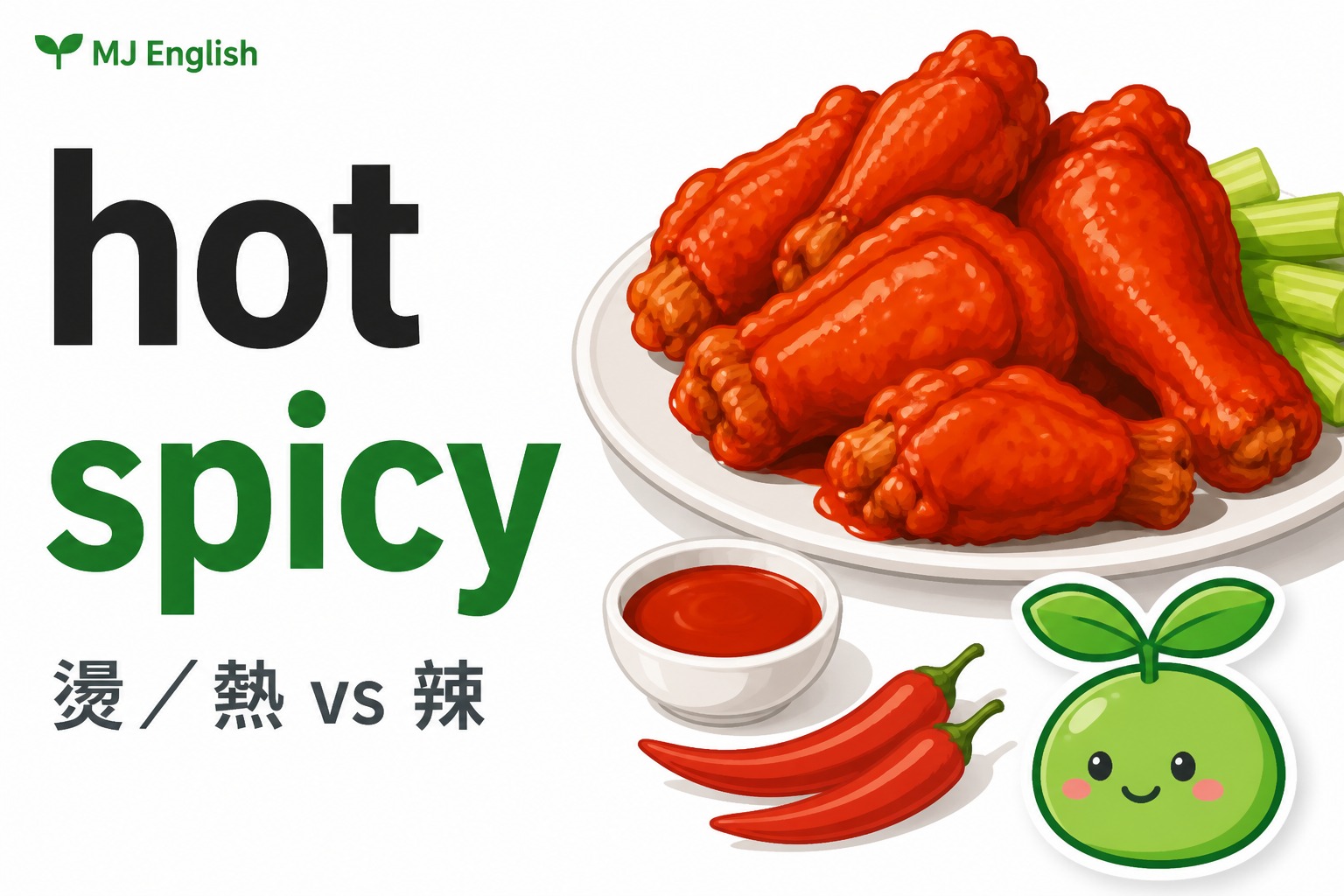
老外聽了會皺眉!台灣人最愛講反的 hot/spicy 差別

2026 07 21 en hot vs spicy 3 Daily English | 生活英語

咬一口美式辣雞翅,你脫口而出 “This is so hot!”——老外卻只聽懂「很燙」,還叫你先放涼,完全不知道你在說辣。中文一句「好辣」「好燙」好像都能講 hot,英文卻是兩碼子事。

搞懂 hot spicy 差別spicy=辣(辣椒的刺激),hot=燙/熱(溫度),別再一個字用到底。

🎧

Podcast 製作中

完整 podcast 版本準備上架。先訂閱節目,新集數第一時間通知。

訂閱 Apple Podcasts 訂閱 Spotify

💡 先搞懂:中文的「辣」感覺像「燙」,英文卻是兩個字

辣椒素刺激的其實是舌頭的熱痛覺受器,跟真正的高溫路徑很像,難怪中文常把「辣」講得像「燙」;但英文早就把兩種感覺拆開,一個字都不能混著用。

在美國吃辣度較高的料理,服務生常會直接問你的 spice level,菜單也常標出 mild/medium/hot 這種辣度分級;連老美熟悉的辣醬品牌 Tabasco 都會用 Scoville 辣度來標示各款的嗆勁。

台灣人最容易卡的雷:想說「好辣」,別直接講 hot——先想清楚你要形容的是辣度還是溫度,講辣度一律用 spicy 才不會讓對方誤會。


情境對話 Dialogue

場景:Amy 和美國朋友 Kevin 在運動酒吧邊看比賽邊吃,點了一大盤 buffalo wings(辣雞翅),她咬一口就把辣說成了 hot。


Amy

I just bit into a buffalo wing — wow, it’s so hot!

我剛咬了一口辣雞翅——哇,好辣!

Kevin

Hot? Maybe let the plate cool down for a bit.

很燙?那盤子要不要先放涼一點?

Amy

No, I mean it’s really spicy, not burning hot.

不是啦,我是說很辣,不是很燙。

Kevin

Oh, got it. I thought the wings were too hot to touch.

喔,了解。我還以為你是說雞翅燙到不能碰。

Amy

In Chinese, spicy just feels like a kind of hot to us.

中文裡,辣本來就給人一種「燙」的感覺。

Kevin

That explains so much. English keeps those two completely separate.

難怪。英文把這兩種感覺分得很清楚。

Amy

So spicy is about the chili kick, not the temperature?

所以 spicy 是辣度,跟溫度沒關係?

Kevin

Exactly. Hot just describes how warm something feels.

沒錯。hot 單純是在講溫度高低。

Amy

Got it. These wings are spicy, but they aren’t actually hot.

了解了。這些雞翅是辣,但其實沒有很燙。

Kevin

That sauce looks incredibly spicy. Can you even handle it?

那個醬看起來超辣的。你吃得了嗎?

Amy

I can handle mild spicy, but this looks extra spicy.

微辣我還可以,但這個看起來是特辣。

Kevin

Let’s just ask the server for the mild ones instead.

那我們直接跟服務生換微辣的好了。

Amy

Good call. I don’t want to sweat through the whole game.

好主意。我可不想看整場比賽都滿頭大汗。

Kevin

Same here. Mild sounds perfect for a spicy newbie like you.

我也是。微辣對你這種辣度新手剛剛好。

Amy

Deal. Next time, I’ll say spicy from the start.

成交。下次我一開始就會說 spicy。

Kevin

Perfect. Now let’s enjoy these mild wings and the game.

太好了。那我們就好好享受這些微辣雞翅和比賽吧。


下次這樣說 Next Time

這三個場景最容易把 hot 和 spicy 用反,記起來就到位。

① 形容食物很辣

❌ 中文腦會說

These wings are so hot.

這些雞翅好辣。(老外聽了會以為是在說很燙)

✅ 該這樣說

These wings are so spicy.

這些雞翅好辣。

為什麼:hot 在食物脈絡容易被聽成溫度很高,講辣度一律用 spicy,才不會讓對方誤會。

② 點餐想少辣一點

❌ 中文腦會說

I don’t want it too hot.

我不要太辣。(服務生可能以為你是怕燙)

✅ 該這樣說

Can I get it mild, or not too spicy?

可以幫我做微辣,或不要太辣嗎?

為什麼:調整辣度要用 spicy/mild 這套系統,不是 hot,服務生才聽得懂你要降辣不是降溫。

③ 把「燙」跟「辣」分清楚

❌ 中文腦會說

It’s so hot, I can’t eat it!

好辣/好燙,我沒辦法吃!(到底是哪一種完全聽不出來)

✅ 該這樣說

It’s so spicy, I can’t handle it!

好辣,我沒辦法吃!

為什麼:spicy 講的是辣度、hot 講的是溫度,同一句 hot 可能會讓對方誤會成燙口,先確定你要形容哪一種感覺再選字。


重點單字 Vocabulary Boost

spicy/ˈspaɪ.si/ 形容詞

辣——因辣椒產生的刺激感,形容食物辣度的正解字。

These wings are really spicy.(這些雞翅真的很辣。)

hot/hɑt/ 形容詞

燙/熱——原意是溫度高;食物脈絡也可指辣,但容易讓外國人誤會成燙口。

Be careful, the pan is hot.(小心,鍋子很燙。)

mild/maɪld/ 形容詞

不辣/溫和——辣度低或幾乎不辣,點餐降辣度必備字。

Can I get this mild, please?(可以幫我做微辣的嗎?)

numbing/ˈnʌm.ɪŋ/ 形容詞

麻——超辣的東西(如鬼椒醬)帶來的舌頭發麻感。

That ghost pepper sauce has a numbing kick.(那款鬼椒醬帶有麻麻的口感。)

bland/blænd/ 形容詞

無味/清淡——味道太淡、不夠有層次,跟 spicy 相反的一種評價。

Without any spice, it tastes pretty bland.(沒加辣的話,吃起來滿清淡的。)

kick/kɪk/ 名詞

嗆勁——食物或飲料帶來的強烈刺激感,常搭 spicy kick。

This sauce has a nice spicy kick.(這醬料有股不錯的嗆辣勁。)

tongue-tingling/tʌŋ ˈtɪŋ.ə.lɪŋ/ 形容詞

舌頭發麻刺痛的——生動描述吃辣椒/花椒後嘴巴的刺激感。

The hot sauce left a tongue-tingling sensation.(這辣醬讓舌頭留下一陣刺麻感。)

sweat/swɛt/ 動詞

冒汗——吃很辣的東西常見的生理反應。

I always sweat when I eat spicy food.(我吃辣的東西總是會冒汗。)

handle/ˈhæn.dəl/ 動詞

承受得了、吃得消——can’t handle the heat 常用來說某人不能吃辣。

I can’t handle anything too spicy.(我沒辦法吃太辣的東西。)

authentic/ɔːˈθɛn.tɪk/ 形容詞

道地的——強調食物或做法是原汁原味、正宗的。

These are the most authentic buffalo wings I’ve had.(這是我吃過最道地的美式辣雞翅。)

🎯 30 秒快速複習

spicy=辣、hot=燙/熱、mild=不辣,先把這三個字分清楚,其他都好記。

spicy
hot 燙/熱(食物脈絡易被誤會成辣,其實是溫度)
mild 不辣/微辣
too spicy for me 對我來說太辣
can’t handle the heat 受不了這麼辣
How spicy is it? 這個有多辣?
numbing 麻(花椒的麻)
❌ so hot → ✅ so spicy(形容辣度時)

重點句型 Sentence Patterns

1. spicier / the spiciest → 辣度的比較級與最高級

形容詞字尾 -y 結尾,比較級去 y 加 ier,最高級加 iest,不用背不規則變化。

例:This dish is spicier than that one.(這道菜比那道辣。)
例:It’s the spiciest thing on the menu.(這是菜單上最辣的東西。)
例:Can you make it a little spicier?(可以幫我弄辣一點嗎?)
點餐想調整辣度,直接用 spicier/less spicy 溝通最直覺,不用整句重講。

2. too spicy for me → 超出我能接受的辣度

too + 形容詞 + for + 人,表示超出某人能接受的程度,比直接說「我不喜歡」更精準。

例:This is too spicy for me.(這對我來說太辣了。)
例:It’s too hot to eat right now.(現在太燙了不能吃。)
例:That was too spicy for a beginner.(對辣度新手來說那太辣了。)
too spicy for me 直接點出「超出我的接受範圍」,比 I don’t like it 更好用。

3. can/can’t handle (the heat) → 承受得住/受不了辣度

handle 這裡指「應付、承受得住」,heat 在辣度話題裡幾乎等於辣度本身,不是溫度。

例:I can’t handle the heat.(我受不了這麼辣。)
例:She can handle really spicy food.(她可以吃很辣的東西。)
例:Can you handle ghost pepper wings?(你吃得了鬼椒辣雞翅嗎?)
看到 the heat 出現在食物話題裡,先想成辣度,別誤會成溫度。

4. How spicy is it? / on a scale of… → 詢問辣度

點餐前確認辣度,可以直接問,或請對方用數字分級回答。

例:How spicy is it?(這個有多辣?)
例:On a scale of one to ten, how spicy is this?(一到十分,這個有多辣?)
例:Is it spicy at all?(這個會辣嗎?)
美式餐廳很習慣用 1–10 分描述辣度,直接問清楚比自己憑感覺猜安全。

5. mild / medium / extra spicy → 點餐辣度分級用語

點辣度就像點咖啡濃度一樣,有固定的三段分級詞可以直接用。

例:I’ll take it mild, please.(我要微辣,謝謝。)
例:Medium spicy is perfect for me.(中辣對我剛剛好。)
例:Extra spicy, if you can handle it.(如果你受得了,可以點特辣。)
菜單上沒寫分級時,直接用這三個詞跟服務生溝通最快。

逐字稿 Transcript

J
Picture this: a plate of buffalo wings hits the table, sauce glowing bright orange, and your friend bites in and goes, “Oh my gosh, this is so hot.”想像一下:一盤 buffalo wings(辣雞翅)端上桌,橘紅色辣醬亮晶晶,你朋友咬一口就說:「天啊,這個好 hot 喔。」But nothing on that table actually got any warmer.但這桌上根本沒有一樣東西變得比較燙。I’m Jason, and that one little word trips up almost every Mandarin speaker.我是 Jason,而這個小小的字,幾乎每個講中文的人都會踩雷。
M
I’m Mary.我是 Mary。And it’s such an easy slip, because it makes real physical sense.而這種搞混超容易發生,因為它在生理上完全講得通。Chili has capsaicin, and capsaicin fires the exact same nerve receptors your body uses to feel real heat.辣椒含有辣椒素,而辣椒素刺激的神經受器,跟你身體感覺真正高溫用的是同一組。So your mouth honestly can’t tell a spicy bite from a hot one.所以你的嘴巴其實分不出「辣」跟「燙」。
J
Right — that burn is technically the same signal your brain gets off a hot stove, so no wonder they feel identical.對——那灼燒感其實跟你摸到熱爐子時大腦收到的訊號一樣,難怪兩個感覺一模一樣。In Chinese, spicy basically feels like a flavor of hot, and honestly that’s totally fair.在中文裡,辣感覺就像是「燙」的一種,老實說這樣講完全合理。But English drew a hard line between those two words a long time ago, and it never let them blur back together.但英文老早就把這兩個字劃清界線,而且從此沒讓它們再混回去過。
M
And our conversation nails it.我們這段對話就示範得超完美。Amy and Kevin are at a sports bar, watching a game over a plate of wings, and within one bite, Amy walks straight into the trap.Amy 和 Kevin 在運動酒吧邊看比賽邊配一盤雞翅,結果 Amy 才咬一口就直接踩進陷阱。She takes a bite and says, “I just bit into a buffalo wing — wow, it’s so hot!”她咬了一口說:「我剛咬了一口辣雞翅——哇,好 hot!」
J
And Kevin takes it completely literally — I mean, why wouldn’t he?而 Kevin 完全照字面理解——你想想,他哪有理由不這樣想?He goes, “Hot? Maybe let the plate cool down for a bit.”他說:「很燙?那盤子要不要先放涼一點?」To him, hot can only ever mean one thing, and that’s the temperature.對他來說,hot 就只可能有一個意思,那就是溫度。
M
Wait — so he genuinely thinks she’s saying the wings are too warm to eat?等等——所以他是真的以為她在說雞翅太燙、還沒辦法吃?
J
Exactly — no reason to guess chili.沒錯——他沒理由猜到是辣。Then you hear Amy catch herself.接著你就聽到 Amy 自己發現講錯了。She backs up fast: “No, I mean it’s really spicy, not burning hot.”她馬上改口:「不是啦,我是說很辣,不是很燙。」And that one line is the whole lesson.而這一句,就是整堂課的重點。
M
Right.對。Spicy is the kick and sting chili gives your tongue — it’s about flavor and irritation, not temperature at all.spicy 是辣椒在舌頭上那種又衝又刺的感覺——講的是味道和刺激,跟溫度完全無關。Hot, on the other hand, is just how warm something physically is: a coffee, a stove burner, a plate fresh out of the kitchen.而 hot 純粹是東西實際多燙:一杯咖啡、一個爐火、一個剛從廚房端出來的盤子。
J
And Kevin gets it instantly: “Oh, got it. I thought the wings were too hot to touch.”Kevin 秒懂:「喔,了解,我還以為你是說雞翅燙到不能碰。」One tiny word, and the whole picture in his head flips.只差一個小字,他腦中的畫面就整個翻過來。
M
And that’s the exact trap so many Taiwanese speakers fall into.而這正是超多台灣人會掉進去的陷阱。It’s honestly not about vocabulary at all — it’s about instinct.老實說這根本不是單字量的問題——是直覺的問題。Spicy food really does burn your mouth, so translating that feeling straight into “hot” feels completely natural in the moment.辣的東西真的會燒嘴,所以當下把那種感覺直接翻成 hot,感覺再自然不過。
J
But native speakers keep the two in totally separate boxes.但母語者把這兩個字放在完全不同的抽屜裡。Say a dish is hot, and most people just assume it came off the grill or out of the fryer — not for a second that it’s drenched in fiery sauce.你說一道菜 hot,大部分人只會以為它剛從烤架或炸鍋端出來——完全不會想到它其實淋滿了嗆辣醬。
M
Now, a quick honest disclaimer — English does sometimes use hot for spice.這邊要老實補一句——英文有時候真的會用 hot 來講辣。Think hot sauce, hot wings, even hot pot.像 hot sauce(辣醬)、hot wings(辣雞翅),甚至 hot pot(火鍋)。And American wing places rank their sauces from mild all the way up to a scorching “extra hot.”而美國的雞翅店把辣度從 mild 一路排到超辣的「extra hot」。
J
So it’s not totally off-limits — a fun exception to keep in your pocket.所以這個字不是完全不能用——算是一個可以偷偷記著的有趣例外。But in casual talk, with no menu or label for context, hot means temperature first.但在一般聊天、沒有菜單或標籤給你脈絡時,hot 就是先指溫度。Spicy, though?那 spicy 呢?Never ambiguous — it always means chili.完全不會有歧義——它永遠是在講辣。So whenever you’re unsure, spicy wins.所以只要你不確定,選 spicy 就對了。
M
Once they’re on the same page, it gets specific.等他們對上頻率之後,話題就變得更具體了。Kevin asks, “That sauce looks incredibly spicy. Can you even handle it?”Kevin 問:「那個醬看起來超辣的,你吃得了嗎?」And “handle” there just means tolerate — can you cope with that much heat?這裡的 handle 就是「受得了」——你招架得住那麼辣嗎?
J
It’s the natural way to check someone’s spice tolerance before they dig in.這是很自然地在對方開動前確認辣度接受度。And the really extreme stuff — ghost pepper, Carolina Reaper sauce — brings a numbing, tongue-tingling burn that can leave you sweating long after the first bite is gone.而那種真的很極端的——鬼椒、卡羅萊納死神辣椒醬——會帶來一種麻、舌頭刺痛的灼燒感,讓你早就吃完第一口之後還在冒汗。
M
Amy plays it safe, though: “I can handle mild spicy, but this looks extra spicy.”不過 Amy 選擇保守一點:「微辣我還可以,但這個看起來是特辣。」And mild, medium, extra spicy are the standard tiers everywhere — learn those three and you can order with real confidence.而 mild(微辣)、medium(中辣)、extra spicy(特辣)到哪都是標準分級——學會這三個,你點餐就很有底氣。
J
And if it’s hotter than you bargained for, there’s a ready-made line: too, plus an adjective, plus “for me.”如果它辣到超出你預期,有一句現成的可以用:too 加形容詞加 for me。“This is too spicy for me” works for anything — too salty for me, too much for me.「This is too spicy for me」什麼都能套——太鹹、太多,都一樣。
M
You’ll also run into comparatives constantly.你也會很常用到比較級。“This is spicier than that one,” or “it’s the spiciest thing on the menu” — just drop the y and add er or est.「This is spicier than that one」或「it’s the spiciest thing on the menu」——把字尾 y 去掉、加 er 或 est 就好。Nice and simple, with no irregular forms to memorize.又簡單、又完全沒有不規則變化要背。
J
And before ordering something new, just ask outright: “How spicy is it?”而點沒吃過的東西之前,直接問就好:「How spicy is it(這個有多辣)?」Or even, “On a scale of one to ten, how spicy is this?”甚至可以問:「On a scale of one to ten, how spicy is this(一到十分,這個有多辣)?」Servers at any good wing joint hear it all day, so never feel shy about asking.隨便一間像樣的雞翅店,服務生一整天都在被問這句,所以別不好意思開口。
M
Especially from people who don’t want one overpowering wing to make the whole basket taste bland by comparison.尤其是那種不想因為一支太搶戲的辣雞翅,害整籃其他雞翅相比之下都變得像沒味道的人。Even a simple “not too spicy, please” at the counter can save your entire meal.就算只在櫃檯講一句「not too spicy, please(不要太辣)」,也能救你整頓飯。
J
Okay — before you hear the whole thing again, do me one quick favor this round.好——在你再聽一次完整對話之前,這一輪幫我一個小忙。Every time Amy or Kevin says “hot,” decide instantly: the chili, or the temperature?每次 Amy 或 Kevin 說到 hot,馬上判斷:是辣椒,還是溫度?
🔁 [DIALOGUE REPLAY] 重播情境對話
M
So — now that you’ve heard it twice, did you catch it?那——再聽一次之後,你抓到了嗎?Every single “hot” in there pointed straight at temperature, and every “spicy” pointed straight at the chili.裡面每一次的 hot 都是指溫度,每一次的 spicy 都是指辣椒。Not one single overlap between them.兩者之間完全沒有一次重疊。
J
And you don’t have to memorize a thing.而且你完全不用背任何東西。Just picture it — is it the burn from chili, or actual heat?只要想像一下——這感覺是辣椒來的,還是真的很燙?If the pepper’s doing the work, it’s spicy; if the temperature is, it’s hot.辣椒在作用就是 spicy,溫度在作用就是 hot。
M
So here’s your challenge: next time you’re about to say “this is so hot” about food, catch yourself and swap in spicy instead — then just ask for it mild if it’s genuinely too much for you.給你的挑戰是:下次你差點要用「this is so hot」形容食物時,攔住自己、改成 spicy——然後如果真的太辣,就直接請他們做微辣。Thanks so much for hanging out with us today!超級謝謝你今天陪我們這一集!
J
Go order some properly spicy wings, and see you next time on MJ English — bye, everyone!去點一份夠辣的雞翅,下次 MJ English 見——大家掰掰!

延伸學習 Keep Going

同樣是台灣人最容易搞混的英文,一起補起來。


你是不是也曾經對外國朋友說過 “This is so hot”?

留言用今天學的 spicy/hot/mild 造一句,分享你最辣的一次踩雷經驗!

追蹤 MJ英語 podcast,下次見。

標題和URL已復制