
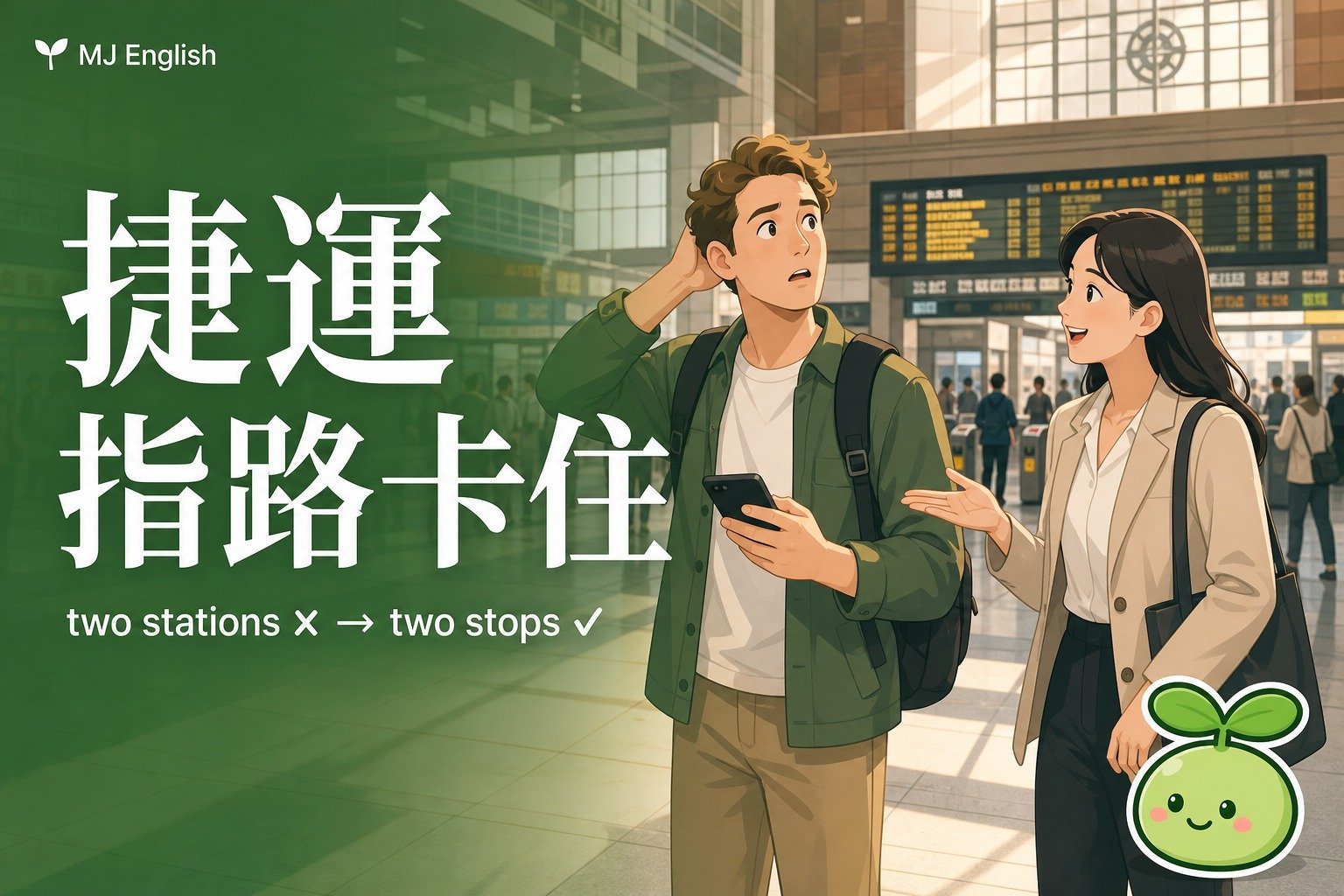
外國人問捷運怎麼走,你卡在哪一句?四句指路英文一次學會

捷運指路英文:換線、幾號出口、幾站怎麼說一次學會 | MJ英語 Daily English | 生活英語

台北車站,外國人舉著手機問你怎麼去士林夜市。你腦中有畫面、嘴巴卻卡住:換線怎麼說?幾號出口怎麼說?最後只擠出 “Go go, that way.”

四句就夠:Transfer to the Red Line.(換紅線)→ It’s five stops from here.(五站)→ Get off at Jiantan and take Exit 1.(在劍潭下車走一號出口)→ It’s about fifteen minutes. 注意:下車是站、出口是 take,別說 get off at Exit 1。

💡 先搞懂:捷運指路,台灣人最常卡的四個地方

①換線:中文的「轉車、換線」英文最常用 transfer——Transfer to the Red Line at Taipei Main Station。②幾號出口:出口不是下車的地方,所以不是 get off at Exit 1,要說 take Exit 1 或 use Exit 1;下車才用 get off at + 站名。③幾站:中文說「兩站」,英文母語者說 two stops,不是 two stations(station 是那棟車站,stop 是「停幾次」)。④方向:月台要講去哪個方向——toward Tamsui(往淡水方向),走錯邊就說 the platform on the other side。最後補一句時間 It’s about fifteen minutes,對方會很感謝你。

台灣人最容易卡的雷:① Get off at Exit 1.(出口不是下車點)→ Get off at Jiantan and take Exit 1.;② two stations → two stops;③ Take MRT.(漏 the)→ Take the MRT.


情境對話 Dialogue

邊聽邊學

這一集完整音檔就在這裡,也可以到 Apple 或 Spotify 收聽

立即播放約 7 分

場景:台北車站大廳,外國旅客 Mark 拿著手機四處張望;上班族 Jenny 正要去搭車,看他一臉迷路就開口幫忙。


Mark

Excuse me, sorry. Do you know how to get to Shilin Night Market?

不好意思打擾了。你知道怎麼去士林夜市嗎?

Jenny

Sure. You take MRT here, then five stations, get off at Exit one.

好啊。你在這裡搭捷運,然後五站,在一號出口下車。(三個地方都卡:漏 the、two stations、出口不能當下車點)

Mark

Sorry, exit one? Is that a station?

抱歉,一號出口?那是一個站嗎?

Jenny

Ah, no, sorry. Let me start over. Take the Red Line toward Tamsui. It’s five stops from here.

啊,不是,抱歉。我重講一次。搭紅線往淡水方向,從這裡過去五站。

Mark

Okay, Red Line, toward Tamsui, five stops. Got it.

好,紅線、往淡水方向、五站。懂了。

Jenny

Then get off at Jiantan Station and take Exit one. The night market is right across the street.

然後在劍潭站下車,走一號出口。夜市就在對面。

Mark

Perfect. And which platform am I looking for?

太好了。那我要找哪一個月台?

Jenny

Go down one level. If you see Xiangshan on the sign, you’re on the wrong side. You want the platform on the other side.

往下一層。如果看到牌子寫象山,那你在錯的那一邊,要去對面的月台。

Mark

Got it. How long does it take?

了解。大概要多久?

Jenny

About fifteen minutes. Oh, and the last train is around midnight, so don’t stay too late. Enjoy the night market!

大概十五分鐘。喔對,末班車大概午夜,別待太晚。夜市玩得開心!

🎯 30 秒快速複習

捷運指路四件事:換線=Transfer to the Red Line;幾站=two stops(不是 two stations);下車=get off at +站名,出口=take Exit one;方向=toward Tamsui、走錯邊=the platform on the other side。最後補 It’s about fifteen minutes 和 last train 資訊。

①搭捷運=take the MRT(別漏 the)
②換線=transfer to the Red Line
③幾站=two stops(不是 stations)
④下車=get off at + 站名
⑤出口=take Exit one
⑥方向=toward Tamsui
⑦走錯邊=the platform on the other side
⑧對面=right across the street

下次這樣說 Next Time

指路最常講錯的三句,換成這樣說對方一聽就懂。

① 講出口

❌ 中文腦會說

Get off at Exit one.

把出口當成下車的地方

✅ 該這樣說

Get off at Jiantan and take Exit one.

站名下車、出口用 take

為什麼:get off 後面接的是「車站」,出口是出站之後才走的;母語者說 take Exit one 或 use Exit one。

② 講幾站

❌ 中文腦會說

It’s two stations from here.

照中文「兩站」直翻

✅ 該這樣說

It’s two stops from here.

算「停幾次」用 stop

為什麼:station 是那棟車站建築,stop 才是「停靠幾次」;要說「下下站」可以說 two stops away 或 the second stop。

③ 講搭捷運

❌ 中文腦會說

You take MRT here.

漏掉 the

✅ 該這樣說

You can take the MRT here.

交通工具前面加 the

為什麼:take the MRT/take the bus/take the train 都要 the;只有 by MRT、by bus 這種 by 開頭的講法不加。


重點單字 Vocabulary Boost

transfer/trænsˈfɜːr/ v.

轉乘、換線。

Transfer to the Red Line here.(在這裡換紅線。)

stop/stɑːp/ n.

(車)一站;算站數用 stop。

It’s two stops from here.(從這裡過去兩站。)

get off/ɡet ɔːf/ phr. v.

下車(後面接站名)。

Get off at Jiantan.(在劍潭站下車。)

exit/ˈeksɪt/ n.

出口(走出口說 take/use)。

Take Exit one.(走一號出口。)

platform/ˈplætfɔːrm/ n.

月台。

The platform on the other side.(對面那個月台。)

toward/tɔːrd/ prep.

往…方向(講列車方向)。

Take the train toward Tamsui.(搭往淡水方向的車。)

across the street/əˈkrɔːs ðə striːt/

在對街、馬路對面。

It’s right across the street.(就在對面。)

last train/læst treɪn/ n.

末班車。

The last train is around midnight.(末班車大概午夜。)


重點句型 Sentence Patterns

1. 換線 → Transfer to the + 顏色 + Line

台北捷運講顏色最好懂,站名太長對方記不住。

例:Transfer to the Red Line at Taipei Main Station.(在台北車站換紅線。)
例:You’ll need to transfer once.(你需要換一次線。)
例:It’s a direct train, no transfer.(這班直達,不用換線。)
換線的動作叫 transfer,也可以說 change trains;change line 母語者比較少講。

2. 幾站 → It’s + 數字 + stops from here

算站數一律 stop,別用 station。

例:It’s two stops from here.(從這裡過去兩站。)
例:Get off at the third stop.(在第三站下車。)
例:It’s just one stop away.(只有一站。)
問「到了沒」可以說 Is this my stop?——這裡也是 stop。

3. 下車與出口 → Get off at + 站名, and take Exit + 號碼

先講站名再講出口,兩件事分開講最清楚。

例:Get off at Jiantan and take Exit one.(在劍潭站下車,走一號出口。)
例:Use Exit two, it’s closer.(走二號出口比較近。)
例:The market is right across the street.(夜市就在對面。)
出口號碼唸法是 Exit one、Exit two,不用加 number。

4. 方向與月台 → toward + 終點站 / the platform on the other side

捷運月台看的是「往哪個方向」,不是往東往西。

例:Take the train toward Tamsui.(搭往淡水方向的車。)
例:If you see Xiangshan, you’re on the wrong side.(如果看到象山,你在錯的那一邊。)
例:You want the platform on the other side.(你要對面那個月台。)
toward 後面直接放終點站名,這是全世界地鐵通用的講法。

5. 補一句貼心 → It’s about + 時間 / The last train is around + 時間

指完路再補時間,對方最有感。

例:It’s about fifteen minutes.(大概十五分鐘。)
例:The last train is around midnight.(末班車大概午夜。)
例:Enjoy the night market!(夜市玩得開心!)
不確定就說 I think it’s about…,比亂講一個數字好。

逐字稿 Transcript

J
Okay so, I’m Jason, and let’s set the scene here for a second. It’s Taipei Main Station, rush hour, and everyone around you is moving fast, heads down, all in a hurry to get somewhere.好,我是 Jason,先讓大家想像一個畫面。台北車站,尖峰時刻,大家都低著頭走得超快,趕著要去哪裡。
M
I’m Mary. And right in the middle of that whole crowd, there’s one tourist just standing completely still, holding up his phone, turning it side to side, looking totally lost.我是 Mary。就在那群人潮正中間,有一個觀光客整個人站著不動,舉著手機轉來轉去,看起來完全迷路了。
J
Someone nearby decides to step in and help him out, which is really nice of them. But the second they open their mouth to actually speak English, their brain just goes completely blank.旁邊有人決定上前幫忙,人真的很好。但一開口要真的講英文的那瞬間,腦袋整個一片空白。
M
Right? You know exactly what you want to say in Chinese, the whole sentence is right there. But in English, somehow nothing comes out at all.對啊,中文的句子明明整句都在腦子裡,但換成英文,卻一個字都擠不出來。
J
Okay, so today someone’s trying to help a tourist find their way to Shilin Night Market. And honestly, the very first word that trips almost everyone up right away is transfer.好,今天的情境是有人在幫觀光客指路去士林夜市。老實說,第一個馬上卡住大家的字就是 transfer(轉乘、換線)。
M
Right, because in Chinese we’d naturally say something that translates as change lines. But in English, you really don’t say “change line.” Native speakers almost always say transfer instead.對,因為中文我們會很自然地說「換線」,但英文真的不會講 change line,母語者幾乎都是說 transfer。
J
So it sounds like this. “Transfer to the Red Line at Taipei Main Station.” Or, “You’ll need to transfer once.” Simple, and it’s exactly how people actually talk.聽起來會像這樣,「Transfer to the Red Line at Taipei Main Station(在台北車站換紅線)」,或是「You’ll need to transfer once(你需要換一次線)」,這就是母語者真的會講的方式。
M
And if there’s no transfer needed at all for that route, you can just say, “It’s a direct train, no transfer.” Nice and clean, and it saves the other person some real worry.如果那條路線完全不用換車,也可以直接說「It’s a direct train, no transfer(這班是直達車,不用換線)」,簡單明瞭,對方聽了也比較安心。
J
Second thing on the list, exits. This one’s sneaky, because in Chinese, the exit kind of feels like it’s the stop itself, almost like they’re the exact same thing.第二個地方是出口,這個很容易搞混,因為中文講法會讓「出口」聽起來好像就是下車的那一站。
M
But in English, those are two separate actions. You get off at a station first, and then, separately, you take an exit to actually leave the building.但英文的邏輯是兩個分開的動作,你先在某一站下車,然後再走某個出口離開車站。
J
So you wouldn’t say, “Get off at Exit one.” That’s actually wrong, because an exit isn’t a place you actually get off at, it’s something you walk through after.所以不會說「Get off at Exit one」,這樣其實是錯的,因為出口不是一個可以下車的地方,是下車之後才走的。
M
You’d say, “Get off at Jiantan, and take Exit one.” And when you say the number, it’s just “Exit one,” “Exit two.” You don’t add the word number.正確說法是「Get off at Jiantan, and take Exit one(在劍潭下車,走一號出口)」,唸出口編號時直接說 Exit one、Exit two,不用加 number。
J
Third thing on our list, and honestly, this is probably the big one out of all four. It’s all about how you count stops on the train.第三件事,老實說這個大概是重點中的重點,就是搭車算站數的講法。
M
In Chinese, you’d say something like two stations. But in English, that’s actually wrong. What you want to say is two stops.中文會說「兩站」,但直接翻成英文的 two stations 其實是錯的,正確講法是 two stops。
J
Station is the actual building. Stop is how many times the train stops along the way. They sound similar, but they mean completely different things.station 指的是那棟車站建築物,stop 是列車沿路實際停靠的次數,聽起來很像,意思卻完全不同。
M
So it’s, “It’s two stops from here,” or “Get off at the third stop,” or even “It’s just one stop away.” All stop, never station.所以會說「It’s two stops from here(從這裡過去兩站)」、「Get off at the third stop(在第三站下車)」,或「It’s just one stop away(只有一站)」,全部都是 stop。
J
You can even ask, “Is this my stop?” if you’re ever not sure you’re getting off at the right one. Stop, stop, stop, that little word is doing all the work here.不確定到站了沒,也可以問「Is this my stop?(這是我要下的站嗎?)」,反正記住都是用 stop 這個字。
M
Fourth thing, direction and platform. Honestly, out of everything we’ve covered so far, this is where people freeze the hardest, every single time.第四件事是方向跟月台,老實說,這裡是大家卡最久的地方,每次都一樣。
J
Platforms are labeled by where the train is actually heading toward, not by north, south, east, or west, or any direction like that at all.月台的標示是看列車要往哪個方向去,不是用東西南北那種方式標的。
M
So you’d say, “Take the train toward Tamsui.” That one little word, toward, is doing basically all of the direction work in that whole sentence.所以會說「Take the train toward Tamsui(搭往淡水方向的車)」,toward 這個小小的字,把整句的方向感都撐起來了。
J
And if someone’s standing on the wrong side of the platform by mistake, you just tell them, “You want the platform on the other side.” Easy fix, every time.如果對方不小心站錯邊,你就跟他說「You want the platform on the other side(你要去對面那個月台)」,馬上就能修正。
M
Or even simpler, “If you see Xiangshan on the sign, you’re on the wrong side.” One sentence, and the whole problem is solved right there.或者更簡單,「If you see Xiangshan on the sign, you’re on the wrong side(如果牌子上看到象山,你就站錯邊了)」,一句話就解決。
J
One more small thing before we move on to the dialogue. “Take the MRT” needs the word the in front of it. Same with “take the bus” and “take the train.”再補一個小地方,Take the MRT(搭捷運)一定要加 the,take the bus、take the train 也是一樣。
M
The only time you actually drop it is with the word by, like “by MRT” or “by bus.” That’s really the one exception worth remembering here.唯一不用加 the 的情況,是用 by 開頭的講法,像 by MRT、by bus,這是唯一要記住的例外。
J
And once you’ve explained everything clearly, finish with something kind. Just saying, “It’s about fifteen minutes,” goes a really long way with people who are nervous and lost.全部講完之後,記得補一句貼心的話,光是「It’s about fifteen minutes(大概十五分鐘)」就很夠了,對方會很感謝你。
M
Or, “The last train is around midnight,” so they don’t accidentally get stuck out there way too late. Even “It’s right across the street” helps a lot too.或是「The last train is around midnight(末班車大概午夜)」,讓對方不會被困在外面太晚,「It’s right across the street(就在對面)」這句也很有用。
J
Alright, that’s basically the whole toolkit right there. Now let’s hear it in action, Mark and Jenny, back at Taipei Main Station.好,工具箱大概就這些了。現在來聽聽實際對話,Mark 跟 Jenny 在台北車站。
M
Listen closely for the exact moment Jenny messes it up, catches herself, and restarts with every single thing said right.仔細聽 Jenny 講錯、停下來,然後重講一次全部講對的那個瞬間。
🔁 [DIALOGUE REPLAY] 重播情境對話
J
The second time through, every single fix landed. Transfer, stops, exit, direction, all of it just clicked into place.第二次講的時候,每個修正都到位了,transfer、stops、exit、方向,全部都對了。
M
Have you ever been the one stopped by a lost tourist in the MRT? Tell us in the comments which line actually made you freeze.你有沒有在捷運上被觀光客攔下來問路的經驗?留言告訴我們,哪一句話讓你當場愣住。
J
Okay, this is MJ English, pulling into the last stop for today.好,MJ英語今天就開到這一站了。
M
Next stop, next episode. See you there.下一站,下一集,到時候見。

延伸學習 Keep Going

在台灣遇到外國人,還有這幾集用得到。

你有沒有在捷運上被外國人問路,當下卡住的經驗?留言告訴我們你最想學會哪一句!

留言你在台灣最常遇到的英語場景,我們排進下一集。

追蹤 MJ英語 podcast,下次見。

標題和URL已復制