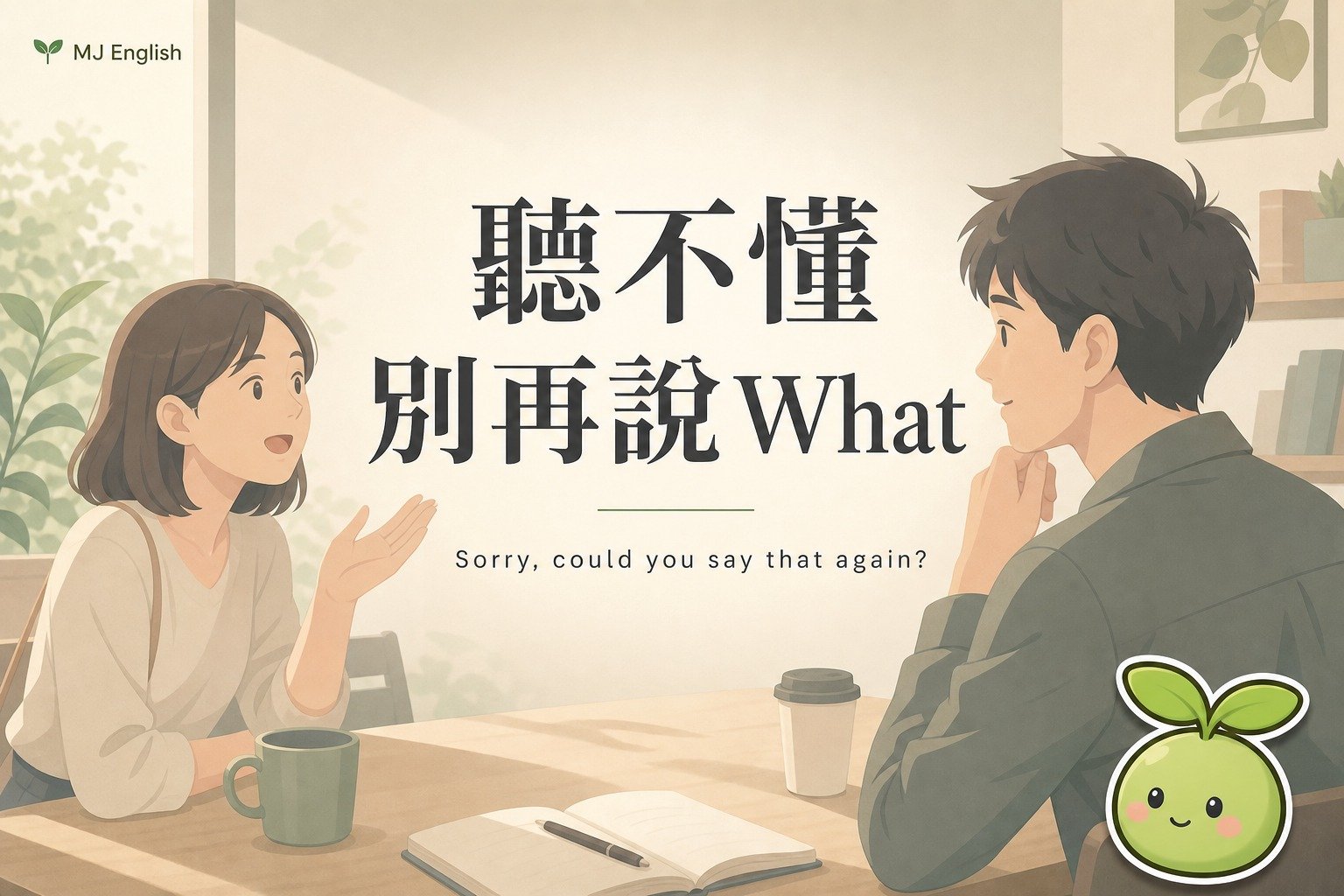
JPicture this: you’re standing at a coffee counter in the U.S., the barista rattles off a question, and it all blurs into one long sound. Your brain just goes blank. I’m Jason, and welcome back to MJ English.來,想像一下:你站在美國的咖啡櫃檯前,店員劈哩啪啦問了一串話,整句聽起來就是一團模糊的聲音,腦袋當場一片空白。我是Jason,歡迎回到MJ英語。
MThat one frozen second — you didn’t catch a single word, your mouth won’t move, and the line behind you is waiting. I’m Mary, and that feeling actually has a name: the classic ‘I froze’ moment every English learner knows way too well.那個當機的瞬間——一個字都沒聽懂,嘴巴卡住動不了,後面排隊的人還在等你。我是Mary,這種感覺其實有個名字,就是每個學英文的人都超熟悉的「當機瞬間」。
JToday we’re talking about exactly that second — the panic when someone talks too fast and your mind just can’t keep up. It happens in cafés, in meetings, on the phone, literally everywhere English is spoken.今天要聊的就是這一秒——別人講太快,你的腦袋整個跟不上的那種恐慌。這種情況在咖啡廳、開會、講電話,幾乎講英文的地方到處都會發生。
MAnd here’s the good news right up front: this isn’t about understanding more English. It’s about having one calm, ready line for that frozen second — so today we’re giving you a whole toolkit of them.先講個好消息:這集不是要你聽懂更多英文,而是讓你在當機的那一秒,手上就有一句冷靜的台詞可以用——所以今天要給你一整套實用句型。
JHere’s the reframe: not understanding isn’t a Taiwan problem or a beginner problem — it’s universal. Native speakers say ‘I didn’t catch that’ to each other constantly, in fast restaurants, loud bars, bad phone signal. Missing words is just part of being human.先來個心態上的翻轉:聽不懂不是台灣人才有的問題,也不是初學者的問題,這其實是全世界共通的。母語人士也常常對彼此說 I didn’t catch that(我沒聽清楚),在吵雜的餐廳、吵的酒吧、訊號不好的電話裡都會這樣說。漏聽本來就是人之常情。
MRight, so the real skill isn’t hearing every single word — it’s having a natural response ready the second your brain blanks out. That’s what actually separates confident speakers from nervous ones: not comprehension, just reaction time.對啊,所以真正的關鍵不是聽懂每一個字,而是腦袋一片空白的那一秒,手邊有個自然的反應可以用。真正拉開自信講者跟緊張講者差距的,從來不是聽力,而是反應速度。
JSo let’s start with three lifesaver lines you can use anywhere. First one: ‘Sorry, could you say that again?’ Simple, polite, works in almost any situation, and nobody will think twice about it.那先來三句救命台詞,隨時都能用。第一句:Sorry, could you say that again?(不好意思,可以再說一次嗎)簡單、有禮貌,幾乎任何場合都能用,也不會有人多想。
MSecond lifesaver: ‘I didn’t catch that.’ It’s the exact phrase native speakers use on each other, so it never sounds like a learner mistake — it just sounds like normal, everyday English.第二句救命台詞:I didn’t catch that.(我沒聽清楚)這句根本就是母語人士彼此在用的說法,所以聽起來完全不像學生腔,反而就是很自然的日常英文。
JAnd third: ‘Could you slow down a bit?’ That one’s for when you understood the words but the speed itself is the problem. All three lines are short enough to say instantly, without thinking.第三句:Could you slow down a bit?(可以講慢一點嗎)這句是給那種你其實聽得懂單字,但問題出在速度太快的情況。三句都短到可以不用想就馬上說出口。
MPicture the café example again: the barista asks something fast, and instead of freezing, you just say ‘Sorry, could you say that again?’ Same voice, same face, completely calm — that’s the whole trick.再回到咖啡廳的例子:店員很快問了一串話,這次你不用當機,直接說 Sorry, could you say that again? 語氣一樣、表情一樣,完全冷靜——這就是整個訣竅所在。
JOr you’re lost on a street in a new city, someone gives directions at full speed, and you say ‘Could you slow down a bit?’ Now they slow down, you actually catch the street names, and you get where you’re going.或是你在陌生城市迷路,有人用超快速度跟你講路怎麼走,這時候說 Could you slow down a bit?,對方就會放慢速度,你才聽得清楚路名,然後真的順利走到目的地。
MOn the phone it’s even trickier because you can’t see the person’s face or lips. So ‘I didn’t catch that’ becomes your best friend — it buys you a few extra seconds without any awkward silence at all.講電話又更難,因為你看不到對方的臉跟嘴型。這時候 I didn’t catch that 就是你的救星,能幫你多爭取幾秒鐘,而且完全不會出現尷尬的沉默。
JEven at work, if a coworker rushes through instructions in a meeting, you can just say it there too. Nobody assumes you’re less capable — they just repeat themselves, and the meeting moves right on.就算在公司也一樣,如果同事開會講指示講太快,你一樣可以直接說這句。沒有人會覺得你能力比較差,對方只會再說一次,會議照常繼續進行。
MNow, two classic traps for Taiwanese speakers. First one: just saying ‘What?’ on its own. It sounds blunt, almost annoyed, even if that’s not what you meant at all — the tone lands completely wrong.接下來講兩個台灣人很容易踩到的地雷。第一個:只單獨說一個 What?(什麼)聽起來會很衝、甚至有點不耐煩的感覺,就算你完全不是那個意思,語氣還是會傳錯。
JThe fix is tiny: just add ‘sorry.’ Our friend Nina actually learned this the hard way — she said ‘I just said ‘What?’ and he looked annoyed.’ One word, ‘sorry,’ changes the whole vibe: ‘Sorry, what was that?’解法超簡單:只要加一個 sorry 就好。我們的朋友Nina就親身體驗過——她說 I just said ‘What?’ and he looked annoyed.(我剛剛只說了「什麼」,結果他一臉不高興)就加一個字 sorry,整個氛圍就完全不一樣:Sorry, what was that?
MSecond trap: ‘Pardon?’ We all learned it in textbooks, and grammatically it’s totally fine — but in everyday American English, it sounds pretty old-fashioned now, almost like something your grandparents would say.第二個地雷是 Pardon?(請再說一次)我們課本都學過,文法上完全沒問題,可是在現在的美國日常對話裡,這句聽起來蠻老派的,有點像你阿公阿嬤才會說的話。
JSo swap it out for ‘Sorry, could you say that again?’ instead. Same politeness, same respect, but it actually sounds like how people talk today — modern, natural, and completely age-appropriate for any conversation.所以直接換成 Sorry, could you say that again? 就好。禮貌程度一樣、尊重程度也一樣,但聽起來就是現代人真正在講的話,自然又完全不會顯得突兀。
MLittle softeners matter too: adding ‘a bit’ or ‘a little’ makes any request feel gentler. ‘Could you slow down a bit?’ sounds so much softer than just ‘Slow down’ — same request, totally different feeling.小小的軟化詞(softener)也很重要:加一個 a bit 或 a little,整句話聽起來就會柔和很多。Could you slow down a bit? 聽起來就比單純的 Slow down 溫和超多,同樣的要求,感覺完全不一樣。
JAnd here’s a line that quietly changes everything: ‘I’m still learning English.’ Say that once, and people naturally get more patient, speak more clearly, and stop rushing you — it’s honestly a little bit magic.還有一句話會悄悄改變一切:I’m still learning English.(我還在學英文)講出這句之後,對方自然會更有耐心,講話更清楚,也會放慢速度——說真的有點像魔法一樣。
MNow here’s my favorite trick, the half-repeat. If you caught part of what someone said, just repeat that part back and let your voice trail off at the end — you don’t need the whole sentence.接下來是我最愛的技巧,半句重複法(half-repeat trick)。如果你聽懂了一部分,就把那部分直接重複回去,然後語尾故意拖長、留一個空白——完全不用整句重講。
JKevin actually coaches Nina through this exact move at the café: ‘A medium latte with… what kind of milk?’ She only repeats what she’s sure of, so the barista only has to repeat the one word she missed.Kevin在咖啡廳現場就是這樣教Nina的:A medium latte with… what kind of milk?(一杯中杯拿鐵,配…哪一種奶)她只重複自己確定的部分,店員就只需要再說一次她漏掉的那個字就好。
MA few bonus lines for specific moments. If someone’s just talking too quietly, try ‘Could you speak up a bit?’ — that’s about volume, not speed, and it works great in noisy places like cafés or trains.再送幾句加分句型。如果對方講話太小聲,可以說 Could you speak up a bit?(可以講大聲一點嗎)這是在講音量、不是速度,在咖啡廳、電車這種吵的地方超好用。
JIf you heard every word but the meaning still didn’t land, try ‘Could you put that another way?’ It tells the other person the words were fine — you just need a different angle on the idea.如果每個字都聽到了,但意思還是沒抓到,可以說 Could you put that another way?(可以換個說法嗎)這是在告訴對方,單字沒問題,只是需要換個角度說明。
MAnd for names, addresses, or anything tricky, just ask ‘Could you spell that?’ Nobody minds spelling out a name for you — honestly, native speakers ask each other that all the time too, especially for tricky spelling.遇到人名、地址這種難字,直接問 Could you spell that?(可以拼一下嗎)沒有人會介意幫你拼字,說真的母語人士彼此也常常這樣問,尤其是遇到拼法特別的字。
JIf you only remember one line from this whole episode, let it be this: ‘Sorry, could you say that again?’ Say it with me right now, quietly, out loud — feel how natural and easy it actually sounds.如果整集只能記住一句,那就記這句:Sorry, could you say that again? 現在就跟著我小聲唸一次看看——感受一下這句話講起來有多自然、多輕鬆。
MNone of these lines make you sound less fluent. Honestly, using them smoothly, without panic, makes you sound more confident than someone who just nods along pretending they understood every single word.這些句子完全不會讓你聽起來不流利。老實說,冷靜順順地講出這些句子,反而比那種明明沒聽懂還一直點頭裝懂的人,聽起來更有自信多了。
JOkay, we’ve given you the whole toolkit — let’s do one last thing before we wrap. Let’s hear Nina and Kevin’s whole conversation one more time, from the very beginning at that café counter.好,整套工具都給你了,那在收尾之前再做最後一件事:我們把Nina跟Kevin的整段對話從頭再聽一次,回到那個咖啡櫃檯前。
MAnd this time, really listen for the exact second Nina goes from completely frozen to totally fine — that’s the whole episode happening in just a few seconds of real conversation.這次仔細聽,聽出Nina從完全當機到恢復正常的那個確切瞬間——整集想講的東西,其實就濃縮在這短短幾秒的真實對話裡。
🔁 [DIALOGUE REPLAY] 重播情境對話
JThe second time through, you can hear it clearly — the difference was never about understanding more, it’s about having one line ready. ‘Sorry, could you say that again?’ That’s honestly the whole episode in one sentence.第二次聽完你應該聽得出來了——差別從來不是聽懂比較多,而是手邊有一句準備好的台詞。Sorry, could you say that again? 這句話老實說就是這整集的重點所在。
MSo tell us in the comments: which line are you trying first, or when’s a time you totally froze like Nina did? We’d love to hear your story, so go ahead and share it below.留言跟我們說:你想先試哪一句?或是分享一下你曾經整個當機的那個瞬間吧,我們很想聽聽你的故事,歡迎留言分享。
JThat’s it for today’s MJ English — go say that line out loud once, okay?今天的MJ英語就到這邊,現在就大聲唸一次那句台詞吧,好嗎?
MSee you next time — take care, everyone!下次見,大家保重囉!