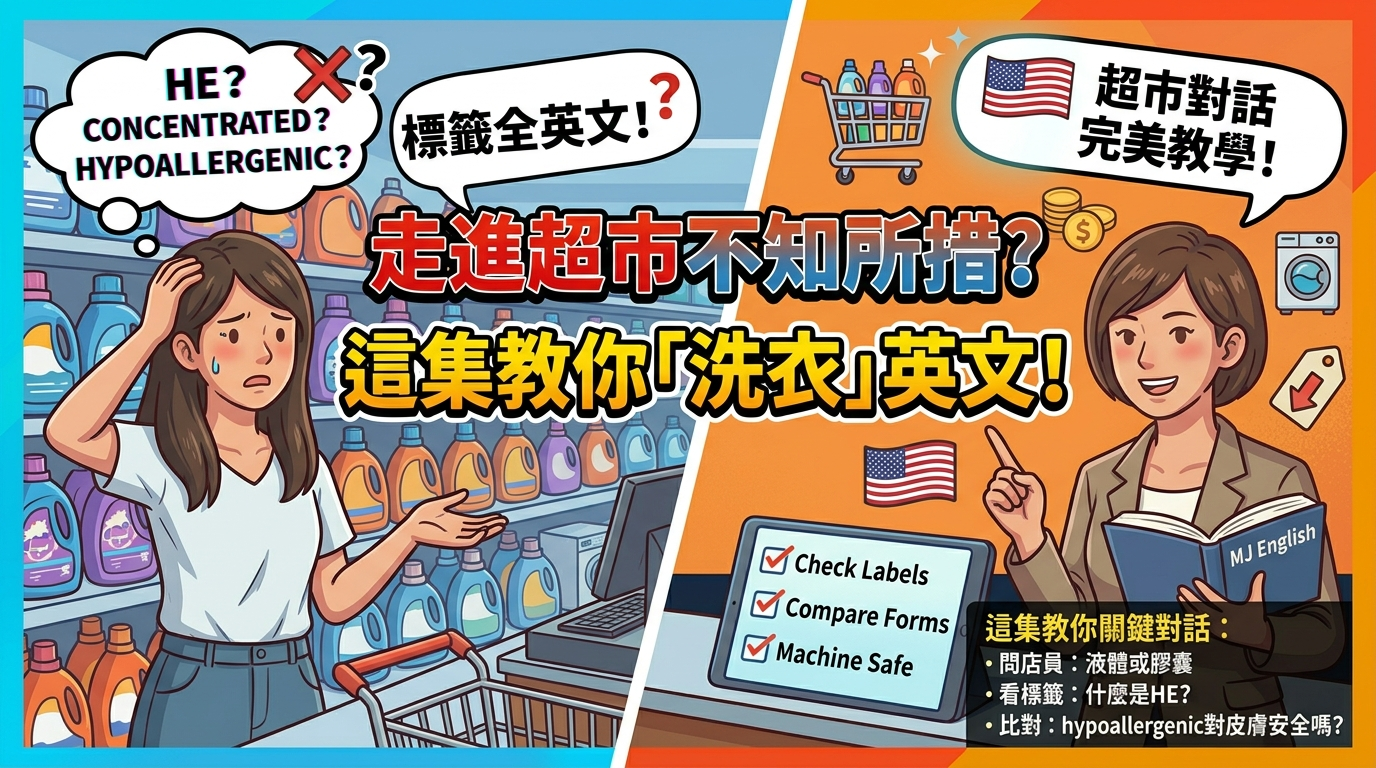
第一次走進美國超市的洗衣精走道,會發現整面牆都是藍藍紫紫的瓶子,標籤上寫著 HE、concentrated、hypoallergenic,然後你站在那裡假裝在看,其實心裡只有一句話:「到底差在哪?」
這集帶你走一遍真實對話:問店員、看標籤、比膠囊和液體、確認對洗衣機安不安全。學完這幾句,下次站在那條走道你會知道該怎麼開口。
中性配方不傷衣、不刺激,還能強效抗菌,洗全家衣服就靠它 👉 https://s.shopee.tw/1BInskwhvo
情境對話 Dialogue
Karen 站在超市洗衣精貨架前被一整排瓶罐弄得頭暈,店員 Brian 走過來問她需不需要幫忙。
重點單字與片語 重點句型
English Dialogue
Karen: Excuse me, do you happen to have detergent for sensitive skin?
Brian: Sure. Are you shopping for the whole family or just yourself?
Karen: My toddler, mostly. He breaks out from anything with fragrance.
Brian: Then I’d go with this one—fragrance-free, dye-free, hypoallergenic. It’s a top pick for kids.
Karen: It says here “concentrated formula.” Does that mean I use less per load?
Brian: Exactly. Half a cap covers a regular load. The bottle lasts about sixty washes.
Karen: What’s the difference between pods and liquid? My friend swears by pods.
Brian: Pods are super convenient, but pricier per load. Liquid gives you more control, especially if your loads are small.
Karen: Got it. Is this safe for my high-efficiency washer?
Brian: Yep, see the HE symbol on the label? That’s your green light.
Karen: One more thing—do you carry a stain remover that won’t bleach colors?
Brian: This spray right here. Pre-treat the spot, toss it in the wash, done. No bleach, no fading.
Karen: You just saved my Saturday. Thank you!
中文翻譯
Karen:不好意思,請問你們有沒有敏感肌可以用的洗衣精?
Brian:當然有。是要全家用的還是你自己用?
Karen:主要給小朋友用。他碰到有香味的東西就起疹子。
Brian:那我會建議這款——無香、無染料、低敏配方,是小孩款的熱門首選。
Karen:上面寫「濃縮配方」,意思是每次用的量比較少嗎?
Brian:沒錯。一般一桶洗衣量倒半個瓶蓋就夠,這瓶大概可以洗六十次。
Karen:膠囊和液體有什麼差?我朋友超愛膠囊。
Brian:膠囊很方便,但每次成本比較高。液體可以自己調量,衣服少的時候比較划算。
Karen:了解。這個我家滾筒洗衣機可以用嗎?
Brian:可以,看到瓶身上的 HE 標誌嗎?那就是給滾筒用的綠燈。
Karen:還有一個問題,有沒有不會把顏色漂掉的去污劑?
Brian:就這支噴霧。先在污漬上預噴一下,再丟進洗衣機就好,不漂白、不褪色。
Karen:你救了我整個週六,謝啦!
重點單字 Vocabulary Boost
- detergent / dɪˈtɜːrdʒənt / n. → 洗衣精;清潔劑
(在洗衣走道單講 detergent 就是 laundry detergent)
I need to grab some detergent on the way home.(我回家路上要買點洗衣精。) - fragrance-free / ˈfreɪɡrəns friː / adj. → 無香的
(unscented 是同義字,瓶身常並列出現)
We use fragrance-free soap for the baby.(我們給寶寶用無香肥皂。) - hypoallergenic / ˌhaɪpoʊˌæləˈdʒɛnɪk / adj. → 低敏配方的
(行銷用語,不是嚴格醫學標準,但代表減少過敏成分)
This pillow is hypoallergenic.(這顆枕頭是低敏配方。) - concentrated / ˈkɑːnsənˌtreɪtɪd / adj. → 濃縮的
(一樣的洗淨力濃縮在更小瓶裡,每次用量更少)
This is a concentrated formula, so use half the usual amount.(這是濃縮配方,用一半的量就好。) - load / loʊd / n. → 一批洗衣量;一桶
(do a load、throw in a load 都是道地說法)
I’ve got two loads to finish before bed.(睡前還有兩桶要洗。) - pod / pɑːd / n. → 洗衣膠囊
(也叫 laundry pod,丟進洗衣機就會溶解)
Just toss one pod into the drum.(丟一顆膠囊進滾筒就好。) - high-efficiency / HE / ˌhaɪ ɪˈfɪʃənsi / adj. → 高效節能(滾筒洗衣機專用)
(HE 機台用水少、需要低泡沫專用洗衣精)
Make sure the detergent is safe for high-efficiency machines.(要確認這洗衣精能用在 HE 機。) - stain remover / steɪn rɪˈmuːvər / n. → 去污劑
(噴霧、棒狀、液體都有,分有色衣 vs. 漂白型)
Spray stain remover on it before you wash it.(先把去污劑噴上去再洗。) - pre-treat / ˌpriːˈtriːt / v. → 預先處理(污漬)
(清潔產品廣告常見字,意思是「下水洗之前先處理」)
Pre-treat the collar before tossing the shirt in.(衣領先處理過再丟洗衣機。) - break out / breɪk aʊt / phr.v. → 起疹子;長痘
(皮膚過敏、壓力大、換保養品都會 break out)
I always break out when I switch lotions.(我每次換乳液就會起疹子。)
重點句型 Sentence Patterns
- Do you happen to have …? → 你們有沒有剛好…?(客氣探問句)
Do you happen to have this in a smaller size?(這款有沒有小一點的尺寸?)| 替換詞:Do you carry(有沒有賣)/ Would you happen to have(更客氣)
💡 比直接問 “Do you have…?” 多一層緩衝,給對方「沒有」也不尷尬的台階。逛超市、藥妝、五金行都萬用,是顯得很 local 的小細節。
- I’d go with … → 我會選/推薦…
I’d go with the unscented one.(我會選無香那款。)| 替換詞:I’d recommend(我推薦)/ I’d say go with(我會說選)
💡 給建議的軟性說法,比 You should buy 客氣得多。餐廳推薦、購物推薦、決策建議都能用,不會讓人覺得你在指揮。
- What’s the difference between A and B? → A 和 B 有什麼差別?
What’s the difference between liquid and pods?(液體和膠囊有什麼差?)| 替換詞:How’s A different from B(A 和 B 哪裡不同)/ Which one’s better, A or B(A、B 哪個比較好)
💡 搞不清楚兩種選項時的萬用救命句。藥局、餐廳、診所、3C 店都用得上,比直接亂買或亂選好太多。台灣人常用的「請問哪個比較好?」直譯成英文反而生硬,這個句型才道地。
- It says here … → 上面寫說…
It says here the store closes at nine.(上面寫說店九點打烊。)| 替換詞:The label says(標籤上寫)/ It mentions here(這裡有提到)
💡 把標籤、菜單、告示拉進對話的優雅方式。不用整個拿給對方看,直接 “It says here…” 就把證據秀出來,又不會顯得在挑釁。
- Is this safe for …? → 這個對…安全嗎?/可以用嗎?
Is this safe for wool sweaters?(這個可以洗羊毛衣嗎?)| 替換詞:Can I use this on(可以用在)/ Will this damage(會不會損傷)
💡 確認相容性的萬用問句。敏感肌、寵物、洗衣機、特殊布料、特定機型都能套。問清楚比事後賠錢省事。
逐字稿 Transcript
J: Did you catch that opening line? “Do you happen to have something for sensitive skin?” Such a small phrase, doing so much heavy lifting in a real store.
有聽到 Karen 第一句嗎?「Do you happen to have something for sensitive skin?」一句話小小的,卻把整段對話的氣氛都鋪好了。
M: Welcome back to MJ English. I’m Mary, and yeah—Karen walked into that aisle with one specific need, and she got it solved in under two minutes. That’s the magic of asking the right way.
歡迎回到 MJ English,我是 Mary。Karen 帶著明確的需求走進那條走道,兩分鐘內就搞定,這就是會問問題的威力。
J: I’m Jason. Today we’re on the laundry aisle, which I genuinely think is one of the most underrated places to practice English. Bottles everywhere, words you’ve never seen, and you’re standing there reading labels like it’s a final exam.
我是 Jason。今天我們站在洗衣精走道,這條走道其實是練英文的隱藏寶地。瓶子滿坑滿谷,字看都沒看過,你站在那裡讀標籤好像在考期末考。
M: It really is. So let’s break down what made this conversation work, starting with that first phrase—”Do you happen to have.” Such a soft, polite way to ask if something’s in stock.
真的就是這樣。我們從第一個句型 “Do you happen to have” 開始拆,這個說法很軟、很客氣,問東西在不在最好用。
J: Right. If Karen had just said “Where’s the detergent for sensitive skin?” she would’ve gotten an answer too. But “do you happen to have” gives the staff room to say no without it being awkward. It’s the kind of phrasing that makes you sound like a regular shopper, not a tourist.
對。如果 Karen 直接問 “Where’s the detergent for sensitive skin?” 也能得到答案,但 “do you happen to have” 給了店員一個可以說「沒有」的台階。這種小細節會讓你聽起來像在地人,而不是觀光客。
M: And speaking of detergent—this word trips up a lot of learners. Detergent. Three syllables. The stress is on the second one: de-TER-gent. It’s a general word for cleaning agents, but in the laundry aisle it almost always means liquid laundry detergent.
講到 detergent,這個字很多人發音卡住。三個音節,重音在第二音,de-TER-gent。它本來是清潔劑的通稱,但在洗衣走道它幾乎都是指洗衣精。
J: Or pods. Or powder. Which leads us to the next great question Karen asked: “What’s the difference between pods and liquid?” That structure—”what’s the difference between A and B”—is your secret weapon at any store, restaurant, or even doctor’s office.
也可能是膠囊或粉狀。這就帶到 Karen 下一句神問題:「What’s the difference between pods and liquid?」這個句型不管在商店、餐廳,甚至診所都是你的秘密武器。
M: I use it constantly. What’s the difference between this size and that size, what’s the difference between organic and regular, what’s the difference between this medicine and that one. It opens up a real conversation instead of forcing you to guess.
我超常用。What’s the difference between 這個跟那個尺寸、有機跟一般的、這款藥跟那款藥。問了之後對方會跟你解釋,你不用憑感覺亂猜。
J: And Brian’s answer was great, by the way. Pods are convenient but pricier per load. He didn’t lecture her, he gave her the trade-off in one sentence. That’s how natives explain things in retail—short, useful, decisive.
而且 Brian 回得很漂亮。膠囊方便但每次成本高,他沒有給對方上課,用一句話講完取捨。零售場景的英文就是這樣——短、實用、給結論。
M: Then Brian says “I’d go with this one.” Anytime you want to make a recommendation without sounding pushy, “I’d go with” is your friend. It’s much softer than “you should buy.”
接著 Brian 說 “I’d go with this one”。要給建議又不想顯得強勢,”I’d go with” 是你的好朋友,比 “you should buy” 軟很多。
J: Try it next time someone asks you for a restaurant suggestion. “I’d go with the ramen place on the corner.” Done. Sounds natural, sounds like you, no preachiness.
下次有人問你餐廳推薦就試試。”I’d go with the ramen place on the corner.” 一句搞定,自然又沒有說教感。
M: Now let’s talk about the fragrance-free, dye-free, hypoallergenic combo. These three words show up on every “gentle” product in the US. Fragrance-free means no added scent. Dye-free means no coloring. Hypoallergenic means designed to reduce allergic reactions—though that’s a marketing word, not a strict scientific one.
來聊聊 fragrance-free、dye-free、hypoallergenic 這三連發。美國只要主打溫和的產品都會印這幾個字。Fragrance-free 是無香、dye-free 是無染料、hypoallergenic 是低敏配方,但最後這個其實是行銷用語,不是嚴格科學標準。
J: Big one to remember if you have kids or sensitive skin. The phrase “break out” came up too—Karen says her toddler “breaks out from anything fragranced.” Break out, as a phrasal verb, means to develop a rash or pimples on the skin.
家裡有小孩或敏感肌的人一定要記。Karen 說她小孩 “breaks out from anything fragranced”。Break out 當片語動詞,就是起疹子或長痘子。
M: You can break out in hives, break out from a new lotion, break out before a big meeting—stress can do it too. Super common, super useful.
可以 break out in hives 起蕁麻疹、break out from 新乳液、break out before 重要會議因為壓力,超常用。
J: Then we get the label moment. Karen reads “concentrated formula” and asks if it means she uses less per load. The pattern there is “It says here…” which is the perfect way to bring a label or sign into a conversation. It says here it’s gluten-free. It says here check-in is at three. Hands you the evidence, no awkwardness.
然後是標籤的橋段。Karen 看到 “濃縮配方” 問是不是用量比較少。”It says here…” 這個句型是把標籤帶進對話的最優雅做法。”It says here it’s gluten-free.”、”It says here check-in is at three.” 把證據秀出來,不尷尬。
M: And concentrated, by the way, just means more product packed into less liquid. Half a cap is enough. Bottle lasts longer. Same total wash power, smaller bottle. Great for small apartments, great for the environment too.
順便講 concentrated,就是把同樣份量的清潔力裝進更小的瓶子。半瓶蓋就夠,瓶子能撐更久。對小套房友善,對環境也友善。
J: Quick word on “load.” A load of laundry is one full washer cycle. Sixty washes equals sixty loads. Native speakers say “do a load,” “throw in a load,” “I’ve got two loads to do tonight.” Tiny word, huge frequency.
快速講 “load”。一個 load 就是洗衣機跑一個循環,六十次洗就是六十 load。母語者會說 “do a load”、”throw in a load”、”I’ve got two loads to do tonight.” 字小,但出現頻率超高。
M: HE—high efficiency—is a label you’ll see if you have a front-loading washer. Front-loaders use less water, so they need a special low-suds detergent.
HE 是 high efficiency,滾筒洗衣機都會看到。滾筒用水少,需要低泡沫的專用洗衣精。
J: If you put regular detergent in an HE machine, you get bubbles everywhere. So look for the HE symbol. It’s a small thing that saves a flooded laundry room.
如果用一般洗衣精倒進 HE 機,泡泡會炸開。所以一定要找 HE 標誌,這個小細節能救你免於洗衣間淹水。
M: And finally, stain remover. Pre-treat means you spray or rub the product on the stain before throwing the clothes in the wash. Pre-treat is one of those compound verbs you hear in every cleaning product ad.
最後是 stain remover 去污劑。Pre-treat 就是衣服丟進洗衣機之前先把產品噴或抹在污漬上。Pre-treat 是清潔用品廣告裡的招牌動詞。
J: Karen also slipped in “Is this safe for my high-efficiency washer?” That’s a beautiful question to keep in your back pocket. Is this safe for sensitive skin, is this safe for kids, is this safe for delicate fabrics. One sentence, instant clarification.
Karen 還丟了一句 “Is this safe for my high-efficiency washer?” 這句很值得記在口袋裡。Is this safe for 敏感肌、小孩、細緻布料,一句話立刻把疑問解掉。
M: Alright, time to test your ears one more time. Listen for “do you happen to have,” “what’s the difference between,” and “I’d go with.” Three small phrases that carry the whole conversation.
來,再考一次你的耳朵。注意聽 “do you happen to have”、”what’s the difference between”、”I’d go with” 這三個關鍵句型,整段對話的骨架就在這。
[DIALOGUE REPLAY]
[重播情境對話]
M: Better the second time? You probably caught how Brian never lectured Karen—he answered, gave her one trade-off, and let her decide. That’s good retail English right there. Not over-explaining, not under-explaining.
第二次有沒有比較清楚?你應該有發現 Brian 完全沒在上課,他回答、給一個取捨、讓 Karen 自己決定。這就是好的零售英文,剛剛好不囉唆。
J: Exactly. And notice Karen never apologized for asking. She walked in, asked clearly, got what she needed. That’s the energy we want.
對。而且 Karen 從頭到尾用抱歉的心態去詢問,她走進去、問清楚、拿到她要的東西。這個能量就是我們要學的。
M: All the words and patterns are below the episode—pods, liquid, fragrance-free, hypoallergenic, HE, stain remover, pre-treat. Save them, screenshot them, take them to your next supermarket run.
所有單字句型都在下方連結,pods、liquid、fragrance-free、hypoallergenic、HE、stain remover、pre-treat 都收齊了。存起來、截圖、下次逛超市帶著去。
J: Next time you’re standing in the laundry aisle staring at fifty bottles, remember—you don’t need to know every word on the label. You just need to know how to ask the right question.
下次你站在洗衣精走道前面對著五十瓶發愣,記得:你不用看懂每個字,只要知道怎麼問對的問題。
M: keep it gentle, keep it clean.
保持溫柔、保持整潔。
J: And keep it simple. This has been MJ English.
還有,簡單就好。這裡是 MJ English。