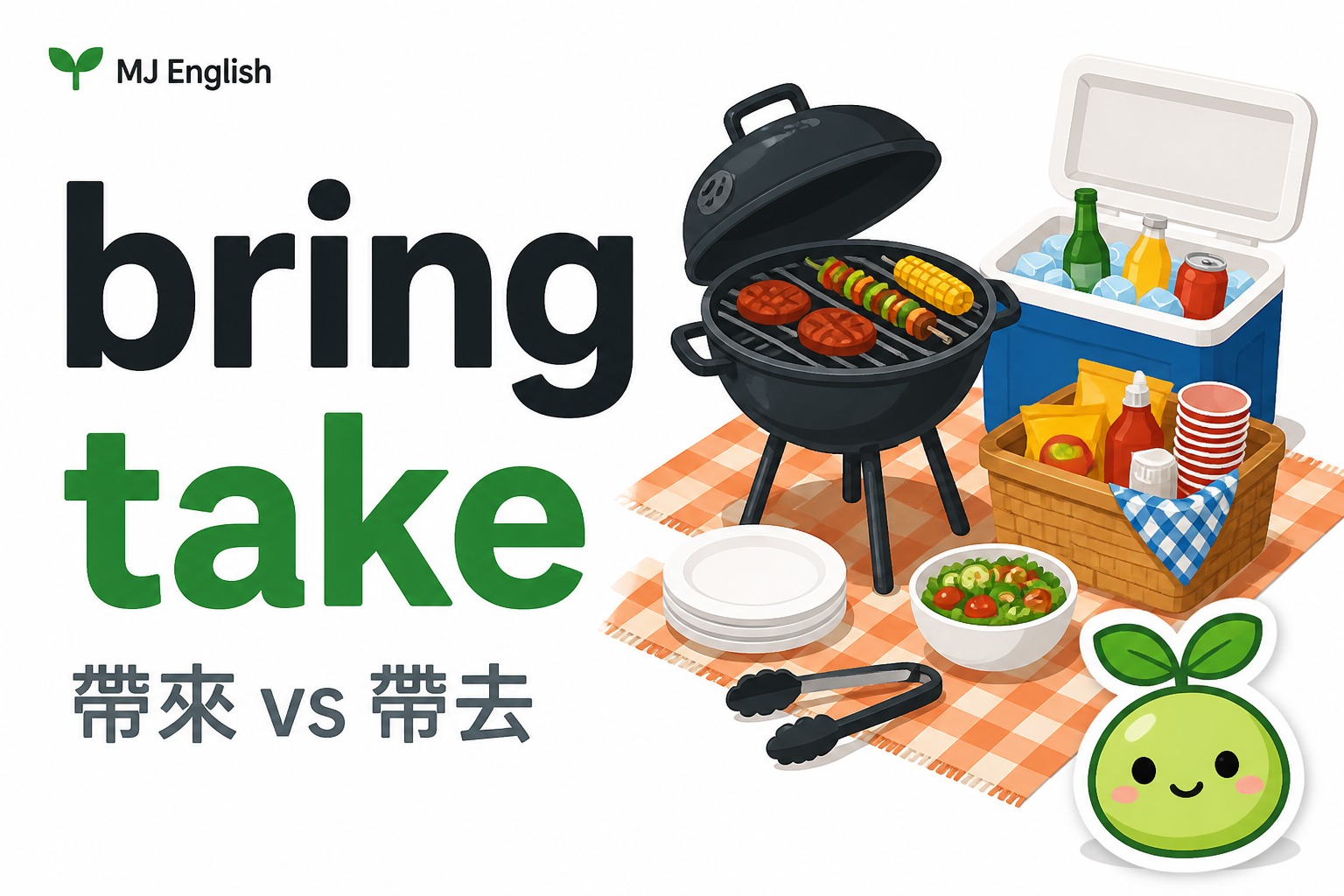
中文一個「帶」到底,英文為什麼要看方向?bring vs take 差在哪

2026 07 23 en bring vs take 2 Daily English | 生活英語

朋友週末要辦 BBQ,你順口說了句 “Can you take some drinks here?”——結果對方愣住,因為方向整個講反:東西要「來」這裡,該用的是 bring,不是 take。

搞懂 bring take 差別bring=帶「來」——朝說話者或聽者的方向;take=帶「去」——離開這裡、往別處。

🎧 邊聽邊學

完整 podcast 已上架,挑你習慣的平台播

Apple Podcasts
Spotify

💡 先搞懂:中文一個「帶」不分方向,英文看的是「東西要往哪走」

中文的「帶」是方向中性的字,不管帶來或帶去都用同一個字;但英文從一開始就把這個動作按「方向」拆成兩個字,用錯方向,母語者聽了會愣一下。

這套「靠近用一個字、遠離用另一個字」的邏輯不只用在 bring/take,come/go 也是同一套規則,可以到 BBC Learning English 找更多方向動詞的練習。

台灣人最容易卡的雷:想到「帶」就直接套 bring,卻沒注意東西到底要往哪個方向動,尤其出門帶東西走的時候最常喊反。


情境對話 Dialogue

場景:Ryan 週六要在家辦 BBQ,Chloe 面對面問他該帶什麼過去,Ryan 一路把 bring、take 用反,Chloe 每次都自然糾正他。


Chloe

Hey, are we still on for your barbecue this Saturday?

欸,你週六的 BBQ 還是照辦嗎?

Ryan

Yes! Could you take some drinks to my place?

對啊!你可以帶一些飲料過來我家嗎?

Chloe

Wait, shouldn’t that be “bring,” since I’m coming to you?

等等,這裡是不是該用 bring(帶來),因為我是要「來」你這邊?

Ryan

Oh, right — bring the drinks here, take them when you leave somewhere else.

喔對——來這裡用 bring,離開去別的地方才用 take(帶去)。

Chloe

Exactly. Come and go follow the same direction rule.

沒錯。come(來)跟 go(去)邏輯一樣,都是看方向。

Ryan

Got it. So tonight, should I bring my umbrella when I leave?

懂了。那我今晚出門,該 bring 雨傘嗎?

Chloe

Actually, take it — you’re leaving here, not coming toward someone.

其實是 take——你是要離開這裡,不是往誰那邊去。

Ryan

Right, take is for going away, bring is for coming this way.

對,take 才是「往外去」,bring 是「往這裡來」。

Chloe

Nailed it. For the barbecue, since I’ll be there, always say bring.

抓到重點了。BBQ 那天因為我會在現場,一律講 bring。

Ryan

What about Dan? He’s skipping the barbecue — should I still bring him a drink?

那 Dan 呢?他不去 BBQ——我還是該 bring 一杯飲料給他嗎?

Chloe

No, take — he’s not there, so it’s moving away from him.

不對,是 take——他不在現場,等於是離開他的方向。

Ryan

Makes sense. It’s all about where the listener will be.

有道理,重點是看聽的人會不會在那裡。

Chloe

So, will you bring dessert on Saturday?

那你週六會帶甜點過來嗎?

Ryan

I’ll bring a cake. See you then!

我會帶一個蛋糕過去。到時候見!


下次這樣說 Next Time

這三個場景最容易把 bring 和 take 用反,記起來就到位。

① 叫朋友帶東西「來」這裡

❌ 中文腦會說

Can you take it here?

你可以把它帶過來這裡嗎?(老外聽了會覺得方向很怪)

✅ 該這樣說

Can you bring it here?

你可以把它帶來這裡嗎?

為什麼:take 是往外帶、離開這裡的方向,叫人帶東西過來你這邊,方向要用 bring 才對。

② 出門「帶」傘或證件走

❌ 中文腦會說

Bring your umbrella when you leave.

你出門要帶雨傘走。(聽起來像雨傘要「朝你」過來,方向反了)

✅ 該這樣說

Take your umbrella when you leave.

你出門要帶雨傘走。

為什麼:離開一個地方、往外走的動作用 take,bring 只用在東西朝說話者或聽者靠近的時候。

③ 把東西帶「去」派對或公司

❌ 中文腦會說

Should I bring it to the party?

我該把它帶去派對嗎?(如果對方根本不在派對現場,這樣講方向就不對)

✅ 該這樣說

Should I take it to the party?

我該把它帶去派對嗎?

為什麼:判斷關鍵是「你問的這個人會不會在那個地點」,對方也在現場才用 bring,對方不在就用 take。


重點單字 Vocabulary Boost

bring/brɪŋ/ 動詞

帶來——往這裡、說話者或聽者所在的方向移動東西。

Can you bring the drinks here?(你可以把飲料帶來這裡嗎?)

take/teɪk/ 動詞

帶去——離開這裡,往別處移動東西,方向背離說話者。

Take your umbrella when you leave.(出門要帶雨傘走。)

come/kʌm/ 動詞

來——人往說話者或聽者的方向移動,跟 bring 是同一套方向邏輯。

Can you come to my place on Saturday?(你週六能來我家嗎?)

go/goʊ/ 動詞

去——人離開這裡往別處移動,跟 take 是同一套方向邏輯。

I have to go home now.(我現在得回家了。)

fetch/fɛtʃ/ 動詞

去拿、去取——去某處把東西帶回來,強調「去+回來」的來回動作。

Can you fetch some napkins from the kitchen?(你可以去廚房拿一些餐巾紙嗎?)

carry/ˈkæri/ 動詞

提、搬——單純描述用手或身體搬運東西的動作,不涉及方向。

This bag is too heavy to carry.(這包太重了提不動。)

drop off/drɑp ɔːf/ 片語動詞

把……送到、放下就走——把人或東西送到某處後立刻離開。

I’ll drop off the dessert before the party starts.(我會在派對開始前先把甜點送到。)

pick up/pɪk ʌp/ 片語動詞

去接、去拿——去某處把人或東西接走、拿走。

Can you pick me up from the station?(你可以去車站接我嗎?)

bring along/brɪŋ əˈlɔːŋ/ 片語動詞

一起帶來——強調「順便一起帶著」,常搭人或小東西。

Feel free to bring along a friend.(想帶朋友一起來也可以。)

take away/teɪk əˈweɪ/ 片語動詞

帶走、外帶——把東西帶離現場,也是點餐「外帶」的說法。

Can I take this away, or should I eat here?(這個可以外帶嗎,還是要在這裡吃?)

🎯 30 秒快速複習

bring=帶「來」、往說話者或聽者方向;take=帶「去」、離開這裡往別處——come/go 也是同一套邏輯。

bring 帶來(往這裡/聽者方向)
take 帶去(離開這裡/往別處)
come 來(=bring 的方向)
go 去(=take 的方向)
fetch 去拿回來
pick up 去接、去拿
drop off 送到就走
❌ take it here → ✅ bring it here

重點句型 Sentence Patterns

1. bring + 東西 + here / to me → 帶來這裡、帶給某人

bring 後面加地點 here 或 to + 人,表示東西朝說話者或聽者的方向移動。

例:Can you bring it here?(你可以把它帶來這裡嗎?)
例:Please bring the report to me by noon.(麻煩中午前把報告拿給我。)
例:She brought flowers to the party.(她帶了花來派對。)
只要對方(聽者)之後會在那個地點,講 bring 就對了,就算你現在還沒到那裡。

2. take + 東西 + there / away → 帶去、帶走

take 後面加 there 或 away,表示東西正在離開說話者所在地,往別處去。

例:Take your umbrella, it might rain later.(帶把傘走,等等可能會下雨。)
例:Can you take this box to the office?(你可以把這箱東西帶去辦公室嗎?)
例:I’ll take the leftovers home.(我會把剩菜帶回家。)
出門、離開一個地方時,「帶走」的東西幾乎都用 take,不會用 bring。

3. come(來)=bring 方向、go(去)=take 方向

come 和 go 也是同一套方向邏輯:靠近說話者用 come、離開用 go;差別只在帶著東西移動時,就換成 bring/take。

例:Can you come to my place tonight?(你今晚能來我家嗎?)
例:I have to go home now.(我現在得回家了。)
例:She’s coming to the party with a cake.(她會帶著蛋糕來參加派對。)
分不清 bring/take 時,先想這句話如果換成 come/go 會怎麼講,答案通常一樣。

4. bring/take + 人 + 東西 → 雙受詞句型

bring/take 都可以接雙受詞(人+東西),句型跟 give 一樣。

例:Can you bring me the menu?(可以把菜單拿給我嗎?)
例:I’ll take him some soup later.(我等等會帶點湯給他。)
例:Bring your friends some snacks next time.(下次帶點零食給你朋友吧。)
帶人帶物、兩個受詞的句子也一樣看方向:帶「來找我」用 bring、帶「去找他」用 take。

5. bring along / take away → 常用片語

bring along 強調「順便一起帶來」,take away 除了「帶走」,也常指外帶餐點。

例:You can bring along a friend if you want.(想帶朋友一起來也可以。)
例:I’d like to take this away, please.(我想要外帶這個,謝謝。)
例:Don’t forget to take away your trash.(別忘了把你的垃圾帶走。)
在英式英語裡,take away 甚至可以直接當名詞用,指外帶餐點本身。

逐字稿 Transcript

J
Quick question — if someone said, “Can you take that over here?” would that sound a little off to you?先問一句——如果有人說「Can you take that over here?」,你會不會覺得哪裡怪怪的?That tiny mismatch is exactly what trips up so many Mandarin speakers with bring and take, and it happens way more often than people expect.這個小地方,就是超多講中文的人在 bring 和 take 上最容易踩到的雷,而且比你想的還常發生。
M
It’s such a common slip, because Mandarin really only has one word for moving things around, no matter which direction they’re headed.這真的超常見,因為中文不管東西往哪個方向動,講來講去就是同一個「帶」字。Bring, come, take, go — English splits all of that by direction, and Mandarin just doesn’t bother making that distinction.bring、come、take、go——英文全部按方向拆開講,中文完全懶得分。
J
I’m Jason, by the way, and this mix-up shows up constantly, from dinner invitations to something as small as an umbrella on a rainy evening.對了,我是 Jason,這個搞混超常出現,從邀請朋友聚餐,到下雨天帶把傘出門,都可能中招。Ryan is hosting a barbecue Saturday, and Chloe asks him what to bring — but Ryan gets it backwards from his very first line.Ryan 週六要辦 BBQ,Chloe 問他該帶什麼過去——結果從第一句開始,就是 Ryan 自己講反了。
M
I’m Mary!我是 Mary!Ryan opens with, “Could you take some drinks to my place?”Ryan 一開口就說:「Could you take some drinks to my place?」And that’s backwards — the drinks are heading toward him, toward where he’ll actually be standing, so the correct word here should be bring.這句其實方向講反了——飲料是要往他那邊、他人會在的地方去,正確應該用 bring 才對。
J
Chloe catches it instantly: “Wait, shouldn’t that be ‘bring,’ since I’m coming to you?”Chloe 馬上聽出來:「Wait, shouldn’t that be ‘bring,’ since I’m coming to you?」One quick line, and she’s already nailed the entire rule without even trying.就這麼一句,她根本沒特別想,就已經抓到整條規則的重點。
M
Ryan owns it right away: “Oh, right — bring the drinks here, take them when you leave somewhere else.”Ryan 也馬上承認:「Oh, right — bring the drinks here, take them when you leave somewhere else.」Bring points toward wherever the speaker or listener will be; take points away from that spot, no exceptions.bring 是朝說話者或聽者所在的方向,take 則是離開那個點,沒有例外。
J
Chloe adds one more clue right after: “Come and go follow the same direction rule.”Chloe 緊接著又補了一個線索:「Come and go follow the same direction rule。」Come is basically the verb version of bring, and go is the verb version of take.簡單說,人自己移動用 come/go,帶著東西一起移動就換成 bring/take,方向完全對得起來。
M
So if you’d naturally say “come here,” the object version of that sentence is always bring.所以你如果會自然說「come here」,那把東西一起帶過來就一定是 bring。And if “go there” fits better, you’re solidly in take territory — the two pairs always match up.如果比較適合說「go there」,那就穩穩是 take 的地盤——這兩組永遠對得起來。
J
There’s also fetch, which adds a little twist — it means going somewhere, grabbing something, and coming right back with it.還有 fetch(去拿回來),這個字帶點小變化——意思是去某個地方拿東西,再帶回來。Think “fetch some napkins from the kitchen” — that’s a round trip, not just one direction.像「fetch some napkins from the kitchen」——這是個來回的動作,不只是單一方向。
M
And carry is different again — it’s purely physical, just describing the act of holding or hauling something, with no direction built in at all.carry(提、搬)又不一樣——它純粹講的是「拿著、搬運」的動作,完全不牽涉方向。You can carry a bag toward someone or away from them, and the word itself never tells you which.你可以 carry 一個包往某人那邊走,也可以往反方向走,這個字本身完全不會告訴你是哪一種。
J
Okay, back to Ryan — this time the mix-up isn’t about drinks, it’s about an umbrella.好,回到 Ryan——這次搞混的不是飲料,是雨傘。He asks, “Got it. So tonight, should I bring my umbrella when I leave?”他問:「Got it. So tonight, should I bring my umbrella when I leave?」
M
And Chloe catches him again, just as fast: “Actually, take it — you’re leaving here, not coming toward someone.”Chloe 一樣馬上抓到:「Actually, take it — you’re leaving here, not coming toward someone。」Same trap, opposite direction — bring only works when something’s headed toward a listener, not away from one.同一個陷阱、方向相反——bring 只有在東西是往聽者那邊送的時候才成立,往外走就不行。
J
Ryan repeats it back to lock it in: “Right, take is for going away, bring is for coming this way.”Ryan 跟著複誦一遍,把它記牢:「Right, take is for going away, bring is for coming this way。」Two mistakes down, and he’s already correcting himself before Chloe has to say a word.兩次錯誤過去了,這次他甚至不用 Chloe 開口就自己糾正回來。
M
Chloe’s ready for the barbecue question too: “Nailed it. For the barbecue, since I’ll be there, always say bring.”講到 BBQ 這個問題,Chloe 也接得上:「Nailed it. For the barbecue, since I’ll be there, always say bring。」Because she’ll physically be standing at that barbecue, anything moving toward it counts as bring, no matter who’s carrying it.因為她本人會實際出現在那場 BBQ,任何往那個方向送去的東西都算 bring,不管是誰帶去的。
J
It’s not really about the event itself.重點根本不是那個活動本身。It’s about where the person you’re talking to will actually be standing when the thing shows up.而是東西送到的時候,你講話的對象會不會人就在那裡。
M
So Ryan tests the edge case himself: “What about Dan? He’s skipping the barbecue — should I still bring him a drink?”於是 Ryan 自己丟出一個邊緣狀況:「What about Dan? He’s skipping the barbecue — should I still bring him a drink?」Third mistake, same pattern — he’s still thinking bring instead of checking where Dan will actually be.第三次講錯,同樣的模式——他還是直覺用 bring,沒先確認 Dan 到底會不會在現場。
J
Chloe corrects him instantly, one more time: “No, take — he’s not there, so it’s moving away from him.”Chloe 又一次立刻糾正:「No, take — he’s not there, so it’s moving away from him。」Same barbecue, same exact drinks, completely different word, all because the listener changed.同一場 BBQ、同樣的飲料,字卻完全不一樣,差別只在於聽的人換了。
M
That’s genuinely the whole trick — forget the event, forget the location, and just focus on the listener.這真的就是全部的訣竅——別管活動、別管地點,只看聽的人是誰。Ask yourself: will this specific person actually be standing there when the thing finally arrives, or somewhere else entirely?問自己:東西送到的時候,這個人會不會真的在現場,還是根本在別的地方?
J
If yes, bring. If no, take.會,就用 bring;不會,就用 take。It really is that mechanical once you see it laid out this clearly.攤開來看,其實就是這麼機械化的判斷。Ryan finally sums it up himself: “Makes sense. It’s all about where the listener will be.”Ryan 最後自己下了總結:「Makes sense. It’s all about where the listener will be。」
M
A couple more useful ones before we move on — pick up and drop off.再補兩個好用的——pick up(去接、去拿)和 drop off(送到就走)。“Can you pick me up from the station” means come get someone; “I’ll drop off the dessert” means deliver it and leave.「Can you pick me up from the station」是去接某人;「I’ll drop off the dessert」是把東西送到就離開。
J
And take away has a second life too — order food “to take away” and you’re basically saying “to go.”take away(外帶)還有第二種用法——點餐說「to take away」,基本上就是「外帶」的意思。Same take, same direction, just applied to a burger instead of a person.一樣是 take、一樣是那個方向,只是這次帶走的是漢堡,不是人。
M
Before you hear their full conversation again, try this along with us.在你再聽一次完整對話之前,先跟我們一起做個練習。Every time Ryan says bring or take, guess before Chloe does whether he’s got the direction right.每次 Ryan 說 bring 或 take,搶在 Chloe 糾正之前,先自己猜猜看他這次方向對不對。
🔁 [DIALOGUE REPLAY] 重播情境對話
J
Okay, now that you’ve heard it twice — did you catch it?好,聽第二次之後——你抓到了嗎?Ryan flipped the direction all three times, and Chloe caught every single one, right on the spot.Ryan 三次都把方向講反了,而 Chloe 每一次都當場抓包糾正。
M
Notice she never got it wrong once — not the drinks, not the umbrella, not Dan.你會發現她一次都沒講錯過——飲料、雨傘、Dan,全部都對。She stayed completely consistent from her very first line to her very last.從第一句到最後一句,她的用法完全沒有失手過。
J
That tracks — Ryan keeps stumbling exactly where Mandarin doesn’t draw a line.這很合理——Ryan 卡住的地方,正好就是中文沒有分清楚的地方。Come and go feel obvious because Mandarin already has two separate words for arriving and leaving.come 和 go 感覺很直覺,因為中文本來就有兩個不同的字分別講「到達」和「離開」。Bring and take feel harder because Mandarin keeps using that same single word no matter which way you’re headed.bring 和 take 才難,是因為中文不管往哪個方向,講來講去都是同一個字。
M
So here’s your challenge this week: next time you invite someone over, actually pause on the word before it leaves your mouth.這週給你的挑戰是:下次你邀人過來的時候,話講出口前先停一下。Ask “will they be there?” before you say bring or take, and let the listener’s location choose it for you.問自己「他會不會在那裡?」再決定用 bring 還是 take,讓聽的人在不在場來幫你選字。
J
Thanks so much for hanging out with us today.超級謝謝你今天陪我們這一集!See you next time on MJ English!下次 MJ English 見!
M
Bye, everyone — go bring some friends to your next barbecue!大家掰掰——下次辦 BBQ 記得 bring 幾個朋友一起來!

延伸學習 Keep Going

同樣是台灣人最容易搞混的英文,一起補起來。


你是不是也曾經對外國朋友說過 “Take it here”?

留言用今天學的 bring/take 造一句,分享你最容易喊反的一次經驗!

追蹤 MJ英語 podcast,下次見。

標題和URL已復制