JHere’s something a lot of learners believe: in, on, and at are just random, so you have to guess. Honestly, that’s not the whole story. There’s a simple pattern, and today we’ll find it together. I’m Jason.很多學習者都相信:in、on、at 根本是亂用的,只能用猜的。老實說,事情沒那麼簡單。其實有個簡單的規律,今天我們一起把它找出來。我是 Jason。
MAnd I’m Mary. I love that, because I used to guess too. I’d just pick one and hope for the best. So today, we’ll use one little story about Brian and Kate to make the pattern stick.我是 Mary。我超愛這個主題,因為我以前也是用猜的,隨便挑一個碰運氣。所以今天我們用 Brian 和 Kate 的一個小故事,讓這個規律記起來。
JSo here’s the story. Brian is a guy from Taiwan, and he calls his American friend Kate. They want to set up their language exchange. Kate starts by asking, “So when do you want to do our language exchange this week?”故事是這樣的。Brian 是台灣人,他打電話給美國朋友 Kate,想約語言交換的時間。Kate 一開始問:「So when do you want to do our language exchange this week?」
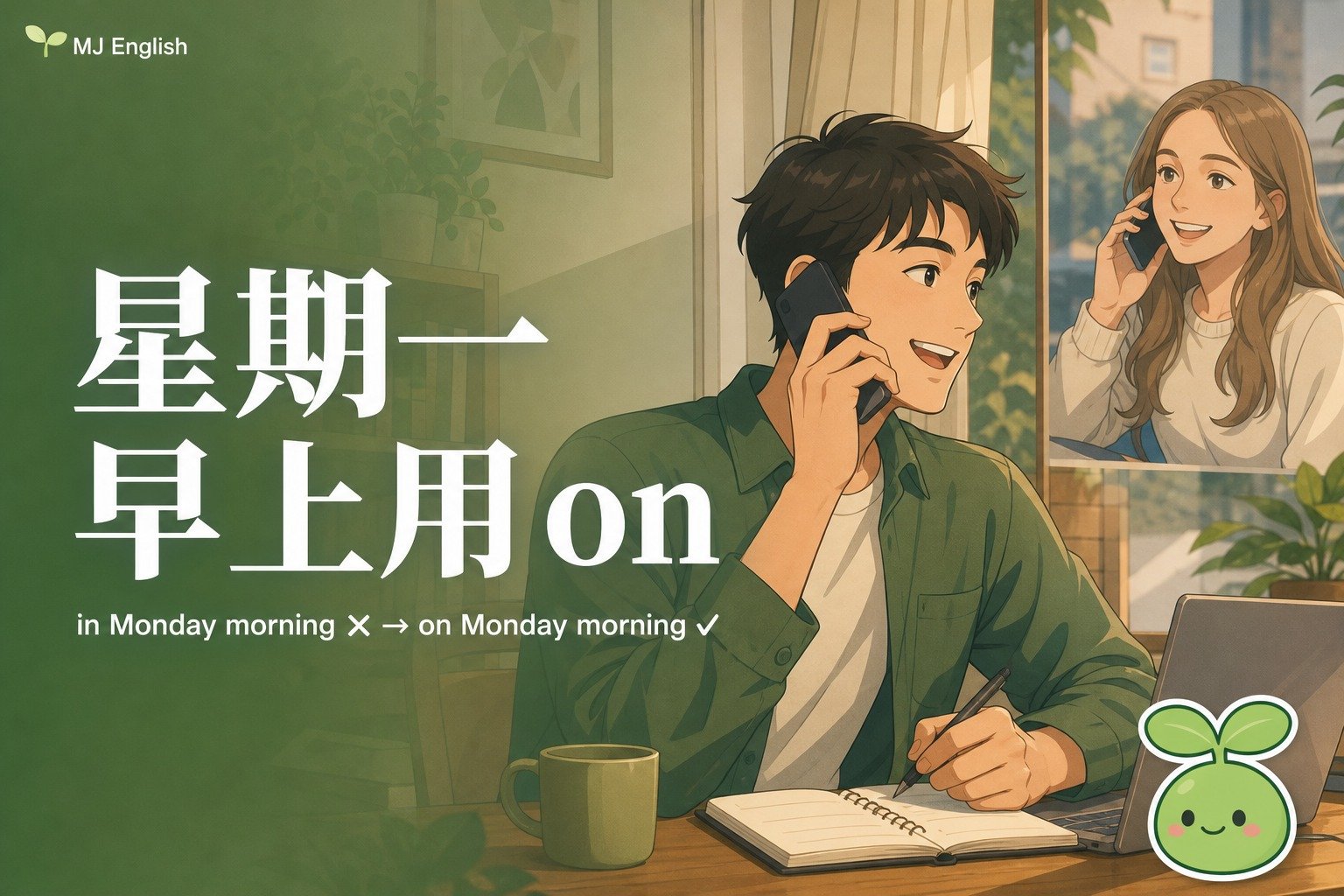
MThen Brian answers, “How about in Monday morning? I don’t have class.” Okay, hold on. That one is the mistake we’re fixing today. It sounds close, but it’s not right.然後 Brian 回答:「How about in Monday morning? I don’t have class.」等一下,這句就是我們今天要修的錯。聽起來很接近,但不對。
JRight. Kate says, “On Monday morning works for me. We say on, because Monday is a day.” That’s the first big idea. A day on the calendar, like Monday, or October twenty-eighth, or my birthday, gets on.對。Kate 說:「On Monday morning works for me. We say on, because Monday is a day.」這是第一個大重點。日曆上的某一天,像星期一、10 月 28 日、我的生日,都用 on。
MSo here’s the one line, from small to big. AT is a point on the clock: at ten, at noon. ON is a day on the calendar: on Monday, on my birthday. IN is a longer stretch: in November, in the summer, in twenty twenty-six.所以這是一條由小到大的線。AT 是時鐘上的一個點:at ten、at noon。ON 是日曆上的一天:on Monday、on my birthday。IN 是比較長的一段時間:in November、in the summer、in 2026。
JNice. Think of it as zooming out. At is one tiny dot. On is one day. In is a bigger chunk of time. And Brian says, “Oh, but you say in the morning, right?” That’s a smart question, because he’s right.很好。你可以想成慢慢把鏡頭拉遠。at 是一個小點,on 是一天,in 是一大段時間。然後 Brian 說:「Oh, but you say in the morning, right?」這問題很聰明,因為他沒說錯。
MHe is! Kate says, “Right. In the morning, but on Monday morning. Once there’s a day, it’s on.” By itself, the morning is a long stretch, so we use in. Add Monday, and it becomes on.他說得對!Kate 說:「Right. In the morning, but on Monday morning. Once there’s a day, it’s on.」單獨說早上,它是一段時間,所以用 in。加上星期一,就變成 on。
JYes, and that’s trap number one. Once a day shows up, use on. We say on Monday morning, on Friday night, on Sunday afternoon. We don’t say “in Monday morning.” Try saying them out loud a few times.對,這就是第一個陷阱。只要有「某一天」出現,就用 on。我們說 on Monday morning、on Friday night、on Sunday afternoon,不會說「in Monday morning」。大聲唸幾遍看看。
MNow the night exception. Most of the time we say in the morning, in the afternoon, in the evening. But for night, we say at night. Brian does it right when he says, “I’m free at night.” Nobody says “in night.”接著是 night 的例外。大部分時候我們說 in the morning、in the afternoon、in the evening。但晚上是說 at night。Brian 就說對了:「I’m free at night.」沒有人會說「in night」。
JGood catch. And Kate says, “At night is perfect. How about at seven? We can grab dinner first.” Seven is a point on the clock, so it’s at seven. Easy. I do the same when I plan dinner with my sister.抓得好。然後 Kate 說:「At night is perfect. How about at seven? We can grab dinner first.」七點是時鐘上的一個點,所以用 at seven。很簡單。我跟我姊姊約吃飯時也是這樣說。
MI’ll be honest, I used to mix these up. Last year I told my boss I’d send a file “on next Friday.” She was really nice about it, but I caught my mistake. Now I just say, next Friday.老實說,我以前也會搞混。去年我跟老闆說我會「on next Friday」把檔案寄給她。她處理得很客氣,但我自己發現說錯了。現在我就只說 next Friday。
JHa, that’s a perfect lead-in to trap number two. Brian says, “And on next Friday, do you want to watch a movie?” Kate answers, “Sure! Just next Friday, no on. With next, last, this, or every, we skip it.”哈,這剛好接到第二個陷阱。Brian 說:「And on next Friday, do you want to watch a movie?」Kate 回答:「Sure! Just next Friday, no on. With next, last, this, or every, we skip it.」
MSo the rule is simple. When you see next, last, this, or every, drop the little word. Next Friday. Last night. This weekend. Every morning. No at, no on, no in. Brian says, “No on. Okay.” He gets it right away.所以規則很簡單。看到 next、last、this、every,就把那個小字拿掉。next Friday、last night、this weekend、every morning。不用 at、on、in。Brian 說:「No on. Okay.」他馬上就懂了。
JMost of the time, that’s the whole rule. Next week, this summer, every Monday, all without a little word. If you only remember one thing, remember this: next, last, this, every, and then just say the time.大部分時候,規則就這樣。next week、this summer、every Monday,通通不加小字。如果只能記一件事,就記這個:next、last、this、every,後面直接講時間就好。
MWeekend is a little special. In American English, people usually say on the weekend. In British English, it’s usually at the weekend. But if you say this weekend, you don’t need anything. Easy, right?weekend 有點特別。美式英文通常說 on the weekend,英式英文通常說 at the weekend。但如果說 this weekend,就什麼都不用加。很簡單吧?
JSuper easy. So let’s do a quick self-check. I’ll give you three times, and you pick the little word. Number one, Monday morning. Number two, seven o’clock. Number three, November. Pause if you want to think.超簡單。來做個小小的自我測驗。我給你三個時間,你選出那個小字。第一,Monday morning。第二,seven o’clock。第三,November。想一下的話可以先暫停。
MOkay, here are the answers! Number one is on Monday morning, because there’s a day. Number two is at seven o’clock, because it’s a point on the clock. Number three is in November, because it’s a longer stretch. How did you do?好,公布答案!第一個是 on Monday morning,因為有「某一天」。第二個是 at seven o’clock,因為是時鐘上的一個點。第三個是 in November,因為是一段比較長的時間。你答對了嗎?
JOne more. What goes before every morning? The answer is nothing! Every morning, no little word. If you got that, you’ve got the second trap too. That’s a big win.再一題。every morning 前面要放什麼?答案是什麼都不用加!every morning,沒有小字。如果你答對了,第二個陷阱你也搞定了,這是大進步。
MLet’s put it all on one small card. At ten. On Monday. In the morning. In November. At night. On Monday morning. Next Friday. This weekend. Every morning. Say those out loud once, and they’ll start to feel natural.我們把全部整理在一張小卡上。at ten、on Monday、in the morning、in November、at night、on Monday morning、next Friday、this weekend、every morning。大聲唸過一遍,就會慢慢變自然。
JBack to our story. At the end, Brian says, “Deal. Monday at ten, and next Friday at seven. My calendar is getting full!” Notice what he got right: Monday at ten, next Friday at seven. Clean and clear.回到故事。最後 Brian 說:「Deal. Monday at ten, and next Friday at seven. My calendar is getting full!」注意他說對了什麼:Monday at ten、next Friday at seven。乾淨又清楚。
MYes! At the start, Brian makes two small mistakes. Can you hear both? Kate fixes each one so gently. It’s how a real language exchange feels.對!一開始 Brian 犯了兩個小錯,你聽得出來嗎?Kate 改得很溫柔。真正的語言交換就是這種感覺。
JAnd that’s the point. Mistakes are no big deal. Just fix them, smile, and keep talking.重點就在這裡。犯錯沒什麼大不了,改過來、笑一笑,繼續聊就好。
MTime to hear the whole call from the top. Ears ready, friends. Here we go.現在來聽完整的通話,從頭開始。朋友們,耳朵準備好。開始囉。
🔁 [DIALOGUE REPLAY] 重播情境對話
JHere’s your takeaway. In this replay, Brian still says “in Monday morning” and “on next Friday.” Listen for Kate’s fixes, then say the right versions after her.這是今天的重點。這段重播裡,Brian 還是會說「in Monday morning」和「on next Friday」。聽聽 Kate 怎麼改,然後跟著她把正確的版本唸一遍。
MIf this helped, tell us in the comments: which little time word trips you up the most? Your answers help us pick the next topic for MJ English. We read every one.如果這集有幫到你,歡迎留言告訴我們:哪一個時間小字最容易讓你搞混?你的回答會幫我們選下一個主題。每一則我們都會看。
JThanks for learning with us today, friends.謝謝你們今天跟我們一起學,朋友們。
MHave a wonderful day, and see you soon!祝你有美好的一天,我們很快見!