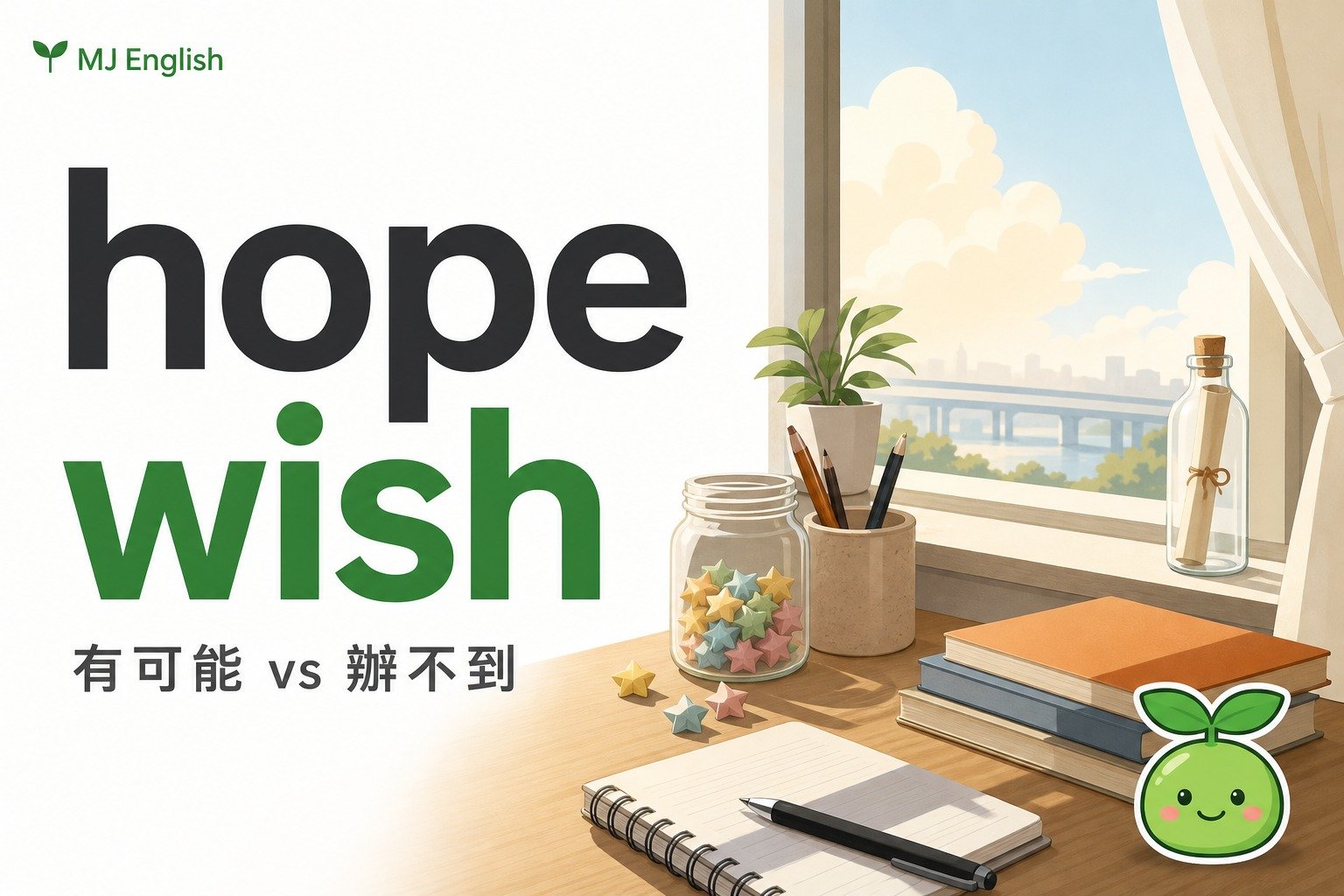
JHi everyone, I’m Jason. Someone said, ‘I wish I pass it,’ about tomorrow’s exam. That sentence sounds strange in English, and today we’re explaining exactly why — and how to fix it.哈囉大家好,我是Jason。有人說,他考試前一天講「I wish I pass it」,這句其實聽起來怪怪的。今天就來搞懂為什麼,順便把它修好。
MI’m Mary — native speakers would never say that. ‘Wish’ and ‘hope’ feel like the same idea, but they work totally differently. One means something’s possible. The other means it’s basically impossible, or against reality.我是Mary,對啊,母語人士絕對不會這樣講。wish(希望,但用在不太可能發生的事)跟hope(希望,用在有可能發生的事)感覺很像,但用的場合完全不一樣。一個是「有可能」,一個是「基本上不可能,或跟現實相反」。
JRight. Passing tomorrow is totally possible — it hasn’t happened yet, and it could go either way. That’s when we use ‘hope.’ You say, ‘I hope I pass,’ because the outcome is still open.對,明天考試這件事根本還沒發生,完全有可能通過,這種時候就要用hope。所以要說「I hope I pass」,因為結果還沒定,是真的有機會的。
MSo ‘wish’ is the wrong tool. It’s for things unlikely, impossible, or already past and unchangeable. Mixing them up is super common for Taiwanese learners, since Mandarin often uses one word for both.所以用wish在這裡就用錯工具了。wish是用在不太可能、根本不可能,或已經是過去、改不了的事情上。這個混淆超常見,尤其台灣人常常搞混,因為中文很多時候一個「希望」兩邊都能用。
JLet’s break down the grammar. With ‘hope,’ the verb stays completely normal — present or future, just like any other sentence. So it’s ‘I hope you pass,’ or ‘I hope it goes well.’ Nothing changes there.來拆解一下文法。hope後面動詞完全正常,該現在式現在式、該未來式未來式,跟平常句子一樣。所以是「I hope you pass」、「I hope it goes well」,動詞完全不用變。
MBut ‘wish’ pulls the verb backward, away from reality. For something happening now, use ‘were’ or ‘could,’ even with ‘I.’ So it’s ‘I wish I were taller,’ not ‘I wish I am taller.’但wish會把動詞往後拉,好像在說「這不是真的」。講現在的事情,要用were或could,就算主詞是I也一樣。所以是「I wish I were taller」,不是「I wish I am taller」,動詞故意往後退一格。
JFor the past, ‘wish’ pairs with ‘had’ plus the past participle. ‘I wish I had studied more.’ That’s regret — something finished that you can’t fix. The grammar itself says: this didn’t happen.講過去的事,wish要配had加過去分詞。「I wish I had studied more」,這就是後悔——事情已經結束了,回不去也改不了。文法本身就在告訴你:這件事沒發生。
MIt’s a neat pattern. Hope plus a normal verb equals a real future chance. Wish plus ‘were’ or ‘could’ equals something not true now. Wish plus ‘had’ plus past participle equals regret from the past.整理起來很好記。hope加正常動詞=真的有未來機會;wish加were或could=現在不是真的;wish加had加過去分詞=對過去的後悔。三種組合,三種情境。
JHere’s the classic mix-up. Nervous about tomorrow, someone says, ‘I wish I pass the exam.’ But passing is totally possible — it hasn’t been decided yet. So the fix is simple: ‘I hope I pass the exam.’來看經典錯誤。有人明天要考試,緊張地說「I wish I pass the exam」,但通過考試完全有可能,結果還沒出來,所以正確講法很簡單,換成「I hope I pass the exam」就對了。
MIt flips the other way too. Someone says, ‘I hope I was more careful,’ about a mistake already made. That’s backwards — the moment’s over, unchangeable. The correct version is, ‘I wish I had been more careful.’反過來也會錯。假設有人已經做錯事了,卻說「I hope I was more careful」,這就講反了,因為那個瞬間已經過去、改不了了。正確講法是「I wish I had been more careful」。
JThere’s one fixed expression that breaks the pattern: wishing someone well. You never say ‘hope you luck.’ It’s always ‘I wish you luck,’ no matter how likely the outcome is. That phrase never changes.還有一個固定用法,會打破前面講的規則:祝福別人的時候。絕對不會說「hope you luck」,一定是「I wish you luck」,不管這件事到底有多大機會發生,這句話就是固定不變的。
MRemember it as a pair. ‘I wish you luck’ before something happens, and ‘I hope you crush it’ for that same moment. Only one of them takes the word ‘luck.’ Small detail, but it trips people up.記成一組就好。「I wish you luck」用在事情發生之前,「I hope you crush it」也可以在同一個場合用,但只有前面那句會用到luck這個字,這個小細節很多人會搞混。
JOkay, that’s the grammar map: hope for what’s possible, wish for what’s unlikely or unchangeable, and ‘wish you luck’ as the one fixed phrase to memorize. Let’s hear this trip someone up in real conversation.好,整理一下文法地圖:可能發生的事用hope,不太可能或改不了的事用wish,「wish you luck」是唯一要死背的固定用法。接下來就來聽聽這件事在真實對話裡怎麼搞出笑話的。
MAlright, here’s Ryan and Emma the night before her exam. Notice which word she reaches for first, and which one Ryan hands back instead. It happens fast, so keep your ears open.好,這就是Ryan跟Emma考前一晚的對話,注意聽她一開始選了哪個字,Ryan又把哪個字丟回去給她,整段其實很快,耳朵放亮一點聽那個交換的瞬間。
🔁 [DIALOGUE REPLAY] 重播情境對話
JDid you catch that first correction? Emma said, ‘I wish I pass it,’ and Ryan jumped in: ‘You mean “I hope I pass.” Use hope — passing is totally possible.’ That’s the exact fix.有聽到第一個糾正嗎?Emma說「I wish I pass it」,Ryan馬上接話:「You mean ‘I hope I pass.’ Use hope — passing is totally possible.」這就是我們剛剛講的那個修正方式。
MPassing hasn’t happened yet, so it’s still open, still realistic — hope’s territory. Emma reached for ‘wish’ out of habit, probably because her first language doesn’t split these feelings as clearly as English.考試還沒發生,結果還開放、還算合理,所以是hope的地盤。Emma會反射性地用wish,大概是因為她的母語沒有把這兩種語感分得像英文這麼清楚。
JRight after, Emma flips it. She says, ‘Oh. Then… I hope I was more prepared.’ That’s about how she feels tonight, before the exam — a present, unchangeable situation, so hope is the wrong word there.接著Emma馬上反著講一次,她說「Oh. Then… I hope I was more prepared」,講的是她今晚、現在準備得夠不夠。這其實是現在、改不了的狀態,所以用hope反而用錯了。
MRyan catches it: ‘There it flips — that’s “I wish I were more prepared.” It’s about now, and you can’t change it.’ Notice ‘were,’ not ‘was,’ even with ‘I’ — that backward shift signals wish.Ryan馬上抓出來,說「There it flips — that’s ‘I wish I were more prepared.’ It’s about now, and you can’t change it.」注意是were不是was,就算主詞是I,這個往後退的動詞就是wish的訊號。
JEmma sums up the whole rule herself: ‘Got it. Hope for what could happen, wish for what can’t.’ Honestly, that’s the cleanest one-line summary of this entire lesson you’ll hear today.Emma自己把整條規則總結出來了,她說「Got it. Hope for what could happen, wish for what can’t.」老實說,這大概是整堂課最乾淨俐落的一句總結了。
MRyan gives two more examples to lock it in: ‘I hope it goes well’ about tomorrow, since that’s open, and ‘I wish I’d started earlier,’ since that’s already too late to change.Ryan接著連丟兩個例句加強印象,他說「I hope it goes well」講明天,因為那還沒定;再說「I wish I’d started earlier」,因為那已經來不及改變了。
JNotice ‘I’d started’ — short for ‘I had started,’ the past participle pattern again. Regret about something finished always leans on ‘had,’ even when contracted down in casual, natural speech like this.注意那個「I’d started」,其實是「I had started」的縮寫,還是同一個過去分詞的模式。對已經結束的事情的後悔,一定會靠這個had結構,就算日常對話會把它縮短講。
MThen Emma asks the fixed-phrase question: ‘So do I wish you good luck, or hope?’ Fair question — everything so far depended on whether something is possible. But luck works a little differently.接著Emma問了那個固定用法的問題:「So do I wish you good luck, or hope?」這個問題很合理,因為前面全部都在看「有沒有可能」,但祝福這件事玩法不太一樣。
JRyan explains, ‘That one’s fixed — “I wish you luck.” And “I hope you crush it.”‘ Wishing luck never changes, but you can still add hope on top for the specific outcome you’re picturing.Ryan解釋:「That one’s fixed — ‘I wish you luck.’ And ‘I hope you crush it.’」所以祝好運這句話永遠不變,但你還是可以另外加一句hope,去講你心裡想的那個具體結果。
MThat’s a useful pair to memorize as one chunk. ‘I wish you luck’ before the exam, and ‘I hope you crush it’ right alongside it. No need to calculate — just say both together.這組真的很值得整包背起來。考試前說「I wish you luck」,旁邊再補一句「I hope you crush it」,不用去算文法,兩句一起講就對了。
JFinally, Emma wraps it all up in one clean line: ‘Okay — I hope I pass, and I wish I’d slept more. Thanks, Ryan!’ Both directions, hope and wish, used correctly together.最後Emma把學到的東西全部收進一句話:「Okay — I hope I pass, and I wish I’d slept more. Thanks, Ryan!」一句話裡hope跟wish兩個方向都用對了。
MThat last line is a perfect little test for yourself. If you can build a sentence like that — one hope, one wish, both correct — you’ve genuinely got this pattern down.這句根本就是給自己的小測驗,如果你也能造出這種句子——一個hope、一個wish,都用對——那你這個文法點真的抓住了,值得好好慶祝一下。
JSo, to recap: hope is for what’s still possible, wish is for what’s unlikely or already over, and ‘I wish you luck’ is the one fixed phrase you just memorize and never overthink.整堂課重點:還有可能發生的事用hope,不太可能或已經過去的事用wish,「I wish you luck」是唯一那句要直接背起來、不用想的固定用法。
MNext time you catch yourself about to say ‘I wish I pass,’ pause and ask: is this still possible? If yes, hope. If it’s already done or basically impossible, wish. One question fixes most mix-ups.下次差點要說「I wish I pass」的時候,先停一秒問自己:這件事還有可能嗎?有的話用hope;已經定了或根本不可能,就用wish。這一個問題就能解決大部分的混淆。
JAnd don’t forget the one exception that stays fixed no matter what: ‘I wish you luck.’ Memorize that phrase as a whole chunk, so you never need to stop and calculate mid-conversation.還有那個永遠不變的例外別忘了:「I wish you luck」。把這句整包背起來,之後就不用臨場停下來算文法了。
MAlright, tell us in the comments which word trips you up most, hope or wish, or something else entirely — we read every comment, and your answer might become our next episode.好,留言告訴我們hope跟wish,或是其他哪個字最容易讓你搞混,我們每則留言都會看,說不定就變成下一集的題目。
JSee you next time on MJ English!我們下次MJ英語再見!