💡 先搞懂:機場英文是一套「固定劇本」
地勤每天問的就那幾句,順序也幾乎不變:要飛哪、托運幾件、靠窗還走道、這是登機證。換句話說,只要把這套問答背起來,你就像照著菜單點餐一樣輕鬆。其中最容易混淆的是行李:carry-on(隨身行李)是帶上飛機的小包,check a bag(托運行李)則是交給櫃台、放進機腹貨艙的大箱。一個跟著你,一個進貨艙,講錯就尷尬了。
layover 和 transit 也常被搞混。layover(中途轉機停留)是兩段航班之間的等待;如果行李是 checked through(直掛)到終點站,你轉機時就不用領出來重掛。安檢能帶什麼上飛機,可以參考 美國運輸安全管理局(TSA)的隨身行李規定,液體 100ml 那條全世界都通用。
台灣人最容易卡的雷:想說「托運行李」,腦中冒出 “throw my luggage”(聽起來像把行李扔了)——正確說法是 “check a bag”。還有 aisle(走道)這個字,s 不發音,唸起來跟 “I’ll” 一樣。
- 情境對話 Dialogue
- 下次這樣說 Next Time
- 重點單字 Vocabulary Boost
- 重點句型 Sentence Patterns
- 1. I’m heading to ___ (with a layover in ___) → 我要前往…(中途在…轉機)
- 2. Are you checking any bags, or just a carry-on? → 您要托運行李,還是只帶隨身?
- 3. Would you like a window or an aisle seat? → 您想要靠窗還是走道的座位?
- 4. Is it okay / a problem if ___? → 如果…可以嗎/會有問題嗎?
- 5. Anything to declare? — Nothing to declare. → 有要申報的嗎?—— 沒有要申報的。
- 逐字稿 Transcript
情境對話 Dialogue
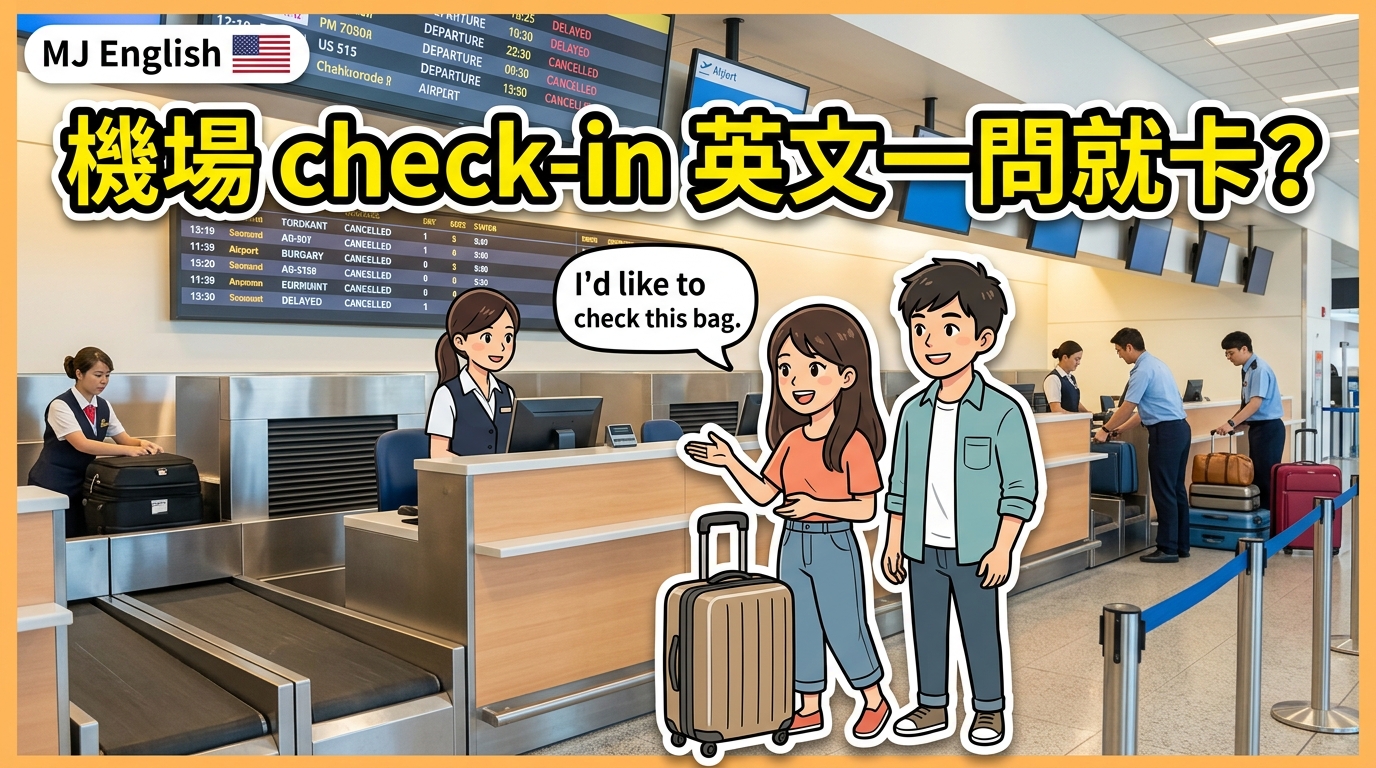
場景:Amy 在機場航空櫃台辦登機,準備飛溫哥華、中途在東京轉機;David 是地勤櫃台人員。
David
Good morning! May I see your passport? Where are you flying today?
早安!可以給我看一下您的護照嗎?今天要飛去哪裡呢?
Amy
Hi! I’m heading to Vancouver, with a layover in Tokyo.
嗨!我要去溫哥華,中途會在東京轉機(layover)。
David
Got it. Are you checking any bags, or just bringing a carry-on?
了解。您有要托運行李(check bags),還是只帶隨身行李(carry-on)?
Amy
Just one to check. Is it a problem if it’s a little heavy?
只有一件要托運。如果有點重會有問題嗎?
David
Let’s see… it’s two kilos overweight, so there’d be an excess baggage fee.
我看看……超重兩公斤,所以會有一筆超重行李費(excess baggage fee)。
Amy
Oh no. Can I move a few things to my carry-on to avoid that?
糟糕。我可以把一些東西移到隨身行李,避免那筆費用嗎?
David
Sure, go ahead. Would you like a window or an aisle seat?
當然,沒問題。您想要靠窗還是走道的位子(aisle seat)?
Amy
Aisle, please — I like to stretch my legs on long flights.
走道,謝謝——長途飛行我喜歡伸伸腿。
David
All set. Your bag’s checked all the way through to Vancouver, so no need to grab it in Tokyo.
都辦好了。您的行李會直掛(checked through)到溫哥華,所以在東京不用領出來。
Amy
Oh, that’s a relief. Where do I go through security?
喔,那我就放心了。請問安檢要往哪邊走?
David
Right behind you. Here’s your boarding pass — gate 24, boarding starts at 10:40.
就在您後面。這是您的登機證(boarding pass)——24 號登機門,10:40 開始登機。
Amy
Perfect. Thanks so much for your help!
太好了。真的很謝謝您的幫忙!
下次這樣說 Next Time
機場最容易卡的 3 個場景,學會這幾句,櫃台到海關全程都不用比手畫腳。
① 想說「我要托運這件行李」
I want to throw my big luggage.
我想要丟我的大行李。
I’d like to check this bag.
我想托運這件行李。
為什麼:throw 是「丟、扔」,聽起來像你要把行李甩了。「托運」的標準動詞是 check——check a bag 就是把行李交給櫃台放進貨艙,跟「檢查」沒關係。
② 想要走道的座位
I want the seat near the road.
我要靠近馬路的位子。
Could I get an aisle seat?
可以給我走道的座位嗎?
為什麼:飛機上的走道不是 road,是 aisle。aisle seat(走道座位)對上 window seat(靠窗座位),記這一組就夠用。提醒一下,aisle 的 s 不發音,唸起來跟 “I’ll” 一樣。
③ 海關被問「有東西要申報嗎」
No, I don’t have.
不,我沒有。
Nothing to declare.
沒有要申報的。
為什麼:”I don’t have” 後面沒接受詞,句子是斷的,老外會愣一下。海關固定回答就是 “Nothing to declare.”,三個字乾淨俐落,直接過關。
重點單字 Vocabulary Boost
check in/ tʃek ɪn / phr. v.
辦理登機報到(在櫃台或機器領登機證、託運行李)。名詞寫成 check-in(報到櫃台、報到手續)。”online check-in”(線上報到)現在超常用,可以先在家辦好。
I’d like to check in for my flight to Vancouver. (我想辦理飛溫哥華的登機報到。)
carry-on/ ˈkæri ɑːn / n.
隨身行李(可以帶上飛機、放頭頂置物櫃或座位下的小包)。對上 checked baggage(託運行李)。英式英文也說 hand luggage,但機場廣播多半用 carry-on。
Just bringing a carry-on today. (今天只帶隨身行李。)
check a bag/ tʃek ə bæɡ / phr.
託運行李(把行李交給櫃台放進貨艙)。這裡的 check 不是「檢查」,而是「交付保管」。”How many bags are you checking?”(您要託運幾件?)是櫃台必問句。
I need to check one bag. (我要託運一件行李。)
layover/ ˈleɪoʊvər / n.
中途轉機停留(兩段航班之間的等待時間)。”a two-hour layover”(轉機等兩小時)。英式英文常說 stopover,意思接近,過夜的長停留尤其用 stopover。
I have a short layover in Tokyo. (我在東京有短暫的轉機停留。)
overweight/ ˌoʊvərˈweɪt / adj.
(行李)超重。”Your bag is overweight.”(您的行李超重了)。形容人「過重」也用這個字,但機場語境固定指行李超過限重。
It’s two kilos overweight. (它超重兩公斤。)
excess baggage fee/ ɪkˈses ˈbæɡɪdʒ fiː / n.
超重(超件)行李費。excess=超出的部分。聽到這個詞就知道「要多付錢了」。聰明的旅客會像 Amy 一樣,把東西移到隨身行李來避開。
There’d be an excess baggage fee for that. (那樣會有一筆超重行李費。)
aisle seat/ aɪl siːt / n.
走道座位(對上 window seat 靠窗座位、middle seat 中間座位)。aisle 的 s 不發音,唸起來像 “I’ll”。喜歡上廁所方便、想伸腿的人通常選 aisle。
Could I get an aisle seat, please? (可以給我走道座位嗎?)
checked through/ tʃekt θruː / phr.
行李直掛(一路掛到最終目的地,轉機時不用領出來重掛)。”Your bag’s checked through to Vancouver.”(您的行李直掛到溫哥華)。聽到這句就可以安心,轉機站不必再碰行李。
Is my bag checked through to the final stop? (我的行李有直掛到終點站嗎?)
boarding pass/ ˈbɔːrdɪŋ pæs / n.
登機證(上面有 gate 登機門、seat 座位、boarding time 登機時間)。紙本或手機電子版都叫 boarding pass。過安檢、登機都要出示它。
Here’s your boarding pass — gate 24. (這是您的登機證——24 號登機門。)
go through security/ ɡoʊ θruː sɪˈkjʊrəti / phr.
過安檢。同款句型 go through customs=過海關。”Where do I go through security?”(安檢要往哪走?)是找路必備句,把 security 換成 customs 就能問海關。
Where do I go through security? (安檢要往哪邊走?)
重點句型 Sentence Patterns
1. I’m heading to ___ (with a layover in ___) → 我要前往…(中途在…轉機)
講「我要去哪」最自然的口語是 heading to,比 “I will go to” 順耳得多。後面接 with a layover in… 就能一句話交代轉機點。
例:We’re heading to Osaka tomorrow. (我們明天要去大阪。)
例:She’s heading to London with a short layover in Dubai. (她要去倫敦,中途在杜拜短暫轉機。)
2. Are you checking any bags, or just a carry-on? → 您要托運行李,還是只帶隨身?
這是地勤必問句,先聽懂、再會答,報到就過一半。回答超簡單:要託運就說 “Just one to check.”,不託運就說 “Just a carry-on.”。
例:Just one to check, thanks. (託運一件就好,謝謝。)
例:No, just a carry-on. (不用,只有隨身行李。)
3. Would you like a window or an aisle seat? → 您想要靠窗還是走道的座位?
選位的固定問句。聽到就直接回 “Window, please.” 或 “Aisle, please.”,要加理由也行(像 Amy 說想伸腿)。Would you like…?是禮貌詢問偏好的萬用開頭。
例:Aisle, please — I like to stretch my legs. (走道,謝謝——我想伸伸腿。)
例:A window seat, if there’s one left. (靠窗,如果還有的話。)
4. Is it okay / a problem if ___? → 如果…可以嗎/會有問題嗎?
禮貌試探的萬用句。怕行李超重、想換位子、想多帶一件,都用這個開頭先問,比直接要求柔軟很多。後面接一個完整子句即可。
例:Is it okay if I switch to an aisle seat? (我換到走道座位可以嗎?)
例:Is it okay if I bring this on board? (這個我帶上飛機可以嗎?)
5. Anything to declare? — Nothing to declare. → 有要申報的嗎?—— 沒有要申報的。
過海關的固定問答。declare=申報。沒帶需申報的東西,就回 “Nothing to declare.”;有的話如實說明。這組短句記起來,落地過關零壓力。
例:No, nothing to declare. (沒有,沒有要申報的。)
例:Yes, I have some food to declare. (有,我有一些食物要申報。)
逐字稿 Transcript
J: Here’s a small English moment that trips up even confident travelers. You’ve waited in line, you finally reach the counter, and the agent asks something completely normal — “Checking any bags today, or just a carry-on?” — and your brain just freezes. Not because the English is hard, but because nobody ever taught you the airport script. I’m Jason, this is MJ English, and today we’re walking you through that script, counter to gate, so the next time you fly, none of it catches you off guard.
J: 有個小小的英文時刻,連很有自信的旅客都會卡。你排了好久的隊,終於走到櫃台,地勤問了一句再正常不過的話——”Checking any bags today, or just a carry-on?”(今天要託運行李,還是只帶隨身?)——然後你的腦袋一片空白。不是英文太難,而是從來沒人教過你機場那套「固定劇本」。我是 Jason,這裡是 MJ English,今天我們就帶你把這套劇本走一遍,從櫃台到登機門,下次出國這些通通難不倒你。
M: I’m Mary. And the good news about airport English is that it’s incredibly predictable — the agent asks the same handful of questions every single time. So once you know them, you’re basically reading off a menu. Listen to Amy. She’s flying to Vancouver, and the very first thing she says is, “I’m heading to Vancouver, with a layover in Tokyo.” Heading to sounds so much more natural than “I will go to.” And a layover is the stop you make between two flights — not your final destination, just a pause along the way.
M: 我是 Mary。機場英文有個好消息:它超級好預測——地勤每次問的就那幾句。所以只要你記起來,基本上就像照著菜單念。聽聽 Amy。她要飛溫哥華,開口第一句就是 “I’m heading to Vancouver, with a layover in Tokyo.”(我要去溫哥華,中途在東京轉機)。Heading to(要前往)聽起來比 “I will go to” 自然太多了。而 layover(中途轉機停留)就是兩段航班之間的那個停留點——不是終點,只是路上的一個喘息。
J: Then David, the agent, asks the big one: “Are you checking any bags, or just bringing a carry-on?” This is where a lot of Taiwanese travelers freeze, because in Chinese we use one word for all of it. But English splits it in two. A carry-on is the small bag that goes on the plane with you, into the overhead bin. And to check a bag — here “check” has nothing to do with inspecting. It means handing your suitcase over to be loaded into the plane’s belly. Amy says, “Just one to check,” meaning one suitcase goes under, and the rest stays with her.
J: 接著地勤 David 問了關鍵那句:”Are you checking any bags, or just bringing a carry-on?”(您要託運行李,還是只帶隨身?)。很多台灣旅客就卡在這,因為中文一個「行李」全包了。但英文分成兩個。carry-on(隨身行李)是跟你一起上飛機、放進頭頂置物櫃的小包。而 check a bag(託運行李)——這裡的 check 跟「檢查」一點關係都沒有,它是指把行李交出去、裝進飛機的貨艙。Amy 說 “Just one to check.”,意思就是一件進貨艙,其他的留在身邊。
M: Now comes the little drama every traveler dreads. Amy asks, “Is it a problem if it’s a little heavy?” and David checks the scale: “It’s two kilos overweight, so there’d be an excess baggage fee.” Overweight is easy enough, but excess baggage fee is the phrase you really want to recognize, because that’s the one that costs you money. And notice Amy’s smart move — she doesn’t panic, she just asks, “Can I move a few things to my carry-on to avoid that?” That’s the real-world fix: shift the weight into the bag that doesn’t get weighed. Totally normal, and the agent won’t bat an eye.
M: 接著是每個旅客都怕的小劇場。Amy 問 “Is it a problem if it’s a little heavy?”(如果有點重會有問題嗎?),David 看了一下磅秤:”It’s two kilos overweight, so there’d be an excess baggage fee.”(超重兩公斤,所以會有一筆超重行李費)。overweight(超重)很好懂,但 excess baggage fee(超重行李費)才是你真正要聽懂的詞,因為這個會讓你掏錢。注意 Amy 的聰明反應——她沒慌,只是問 “Can I move a few things to my carry-on to avoid that?”(我可以把一些東西移到隨身行李避開那筆費用嗎?)。這就是現實中的解法:把重量挪到不會被秤的那個包。超級正常,地勤連眉頭都不會皺一下。
J: With the bag sorted, David asks the seat question: “Window or an aisle seat?” Amy goes for the aisle, and her reason is so relatable: “I like to stretch my legs on long flights.” Quick pronunciation note — aisle is spelled a-i-s-l-e, but you don’t say the s. It just sounds like “I’ll.” Then David says something that quietly saves Amy a huge headache: “Your bag’s checked all the way through to Vancouver.” Checked through means her suitcase travels to the final destination on its own — she does not have to grab it during her layover in Tokyo and re-check it. One less thing to worry about.
J: 行李搞定後,David 問座位:”Window or an aisle seat?”(靠窗還是走道?)。Amy 選了 aisle(走道座位),理由超有共鳴:”I like to stretch my legs on long flights.”(長途飛行我喜歡伸伸腿)。順帶提一下發音——aisle 拼成 a-i-s-l-e,但那個 s 不發音,唸起來就像 “I’ll”。然後 David 說了一句默默幫 Amy 省下大麻煩的話:”Your bag’s checked all the way through to Vancouver.”(您的行李直掛到溫哥華)。checked through(行李直掛)的意思是她的行李會自己跑到終點站——她不用在東京轉機時把它領出來重掛。又少操一份心。
M: Finally, the payoff: “Here’s your boarding pass — gate 24, boarding starts at 10:40.” Your boarding pass is your ticket onto the plane, and the gate is the door you leave from. David points her to security, and she’s off. Now, one thing the dialogue doesn’t show, but you’ll always hit on the other end, is customs. When you land, an officer might ask, “Anything to declare?” That just means: are you carrying anything you need to report — like large amounts of cash, or certain foods. If you’re not, the answer is easy: “Nothing to declare.” Three words, and you walk right through.
M: 最後就是收成的時刻:”Here’s your boarding pass — gate 24, boarding starts at 10:40.”(這是您的登機證——24 號登機門,10:40 開始登機)。boarding pass(登機證)是你上飛機的票,gate(登機門)是你出發的那道門。David 指了安檢方向,她就走了。對了,有個對話裡沒演、但你落地後一定會碰到的,就是海關。下飛機時,海關人員可能會問 “Anything to declare?”(有東西要申報嗎?)。意思就是:你有沒有帶任何需要申報的東西——像大筆現金,或某些食物。如果沒有,答案很簡單:”Nothing to declare.”(沒有要申報的)。三個字,直接走過去。
J: So before we replay it, here’s your map of the whole journey in English: you check in, you decide what to check and what to carry on, you pick a seat, you grab your boarding pass, you clear security, and on arrival you breeze through customs. Listen for the anchor phrases this time — checking a bag, carry-on, layover, aisle seat, checked through. Once they’re in your ear, the whole airport stops feeling like a test and starts feeling like a routine.
J: 那在我們重播之前,先給你一張整趟旅程的英文地圖:你 check in(報到)、決定哪件託運哪件隨身、選位子、拿登機證、過安檢,落地再輕鬆過海關。這次重聽,注意抓那幾個關鍵片語——checking a bag、carry-on、layover、aisle seat、checked through。它們一旦進到你耳朵裡,整座機場就不再像考試,而開始像例行公事。
[DIALOGUE REPLAY]
[重播情境對話]
M: Played back, did you catch how short every one of Amy’s lines is? She never makes a speech. “Just one to check.” “Aisle, please.” “Where do I go through security?” That’s the secret of airport English — it rewards short and clear, not fancy. The agent deals with hundreds of travelers a day, so a clean, simple answer is exactly what keeps your line moving and your nerves calm.
M: 重播之後,你有發現 Amy 每句話都超短嗎?她從不長篇大論。”Just one to check.”(託運一件就好)、”Aisle, please.”(走道,謝謝)、”Where do I go through security?”(安檢往哪走?)。這就是機場英文的祕密——它要的是又短又清楚,不是花俏。地勤一天要應付好幾百個旅客,乾淨、簡單的回答,剛好能讓你的隊伍順順往前、心情穩穩不慌。
J: So here’s your challenge before your next trip: say the whole sequence out loud once at home — “one bag to check, aisle seat, where’s security” — until it’s muscle memory. Then the real counter feels like a rerun. Drop us a comment with the airport phrase that always trips you up, and we’ll cover it. I’m Jason — wishing you smooth check-ins and zero excess baggage fees. Catch you next time on MJ English.
J: 所以這是你下趟出國前的小挑戰:在家把整段流程大聲念一次——”one bag to check, aisle seat, where’s security”(一件託運、走道座位、安檢在哪)——念到變成肌肉記憶。那真正站到櫃台前,就像重播一遍而已。留言告訴我們那個老是讓你卡住的機場句子,我們之後幫你解。我是 Jason——祝你報到順利、零超重費。下次 MJ English 再見。
出國辦登機,哪一句英文最常讓你當機?
留言告訴我們——是 carry-on 還是 check a bag 搞不清?還是海關被問 “Anything to declare?” 時腦袋空白?我們幫你練到不卡。
追蹤 MJ英語 podcast,下次見。