💡 先搞懂:在美國,廁所叫 restroom
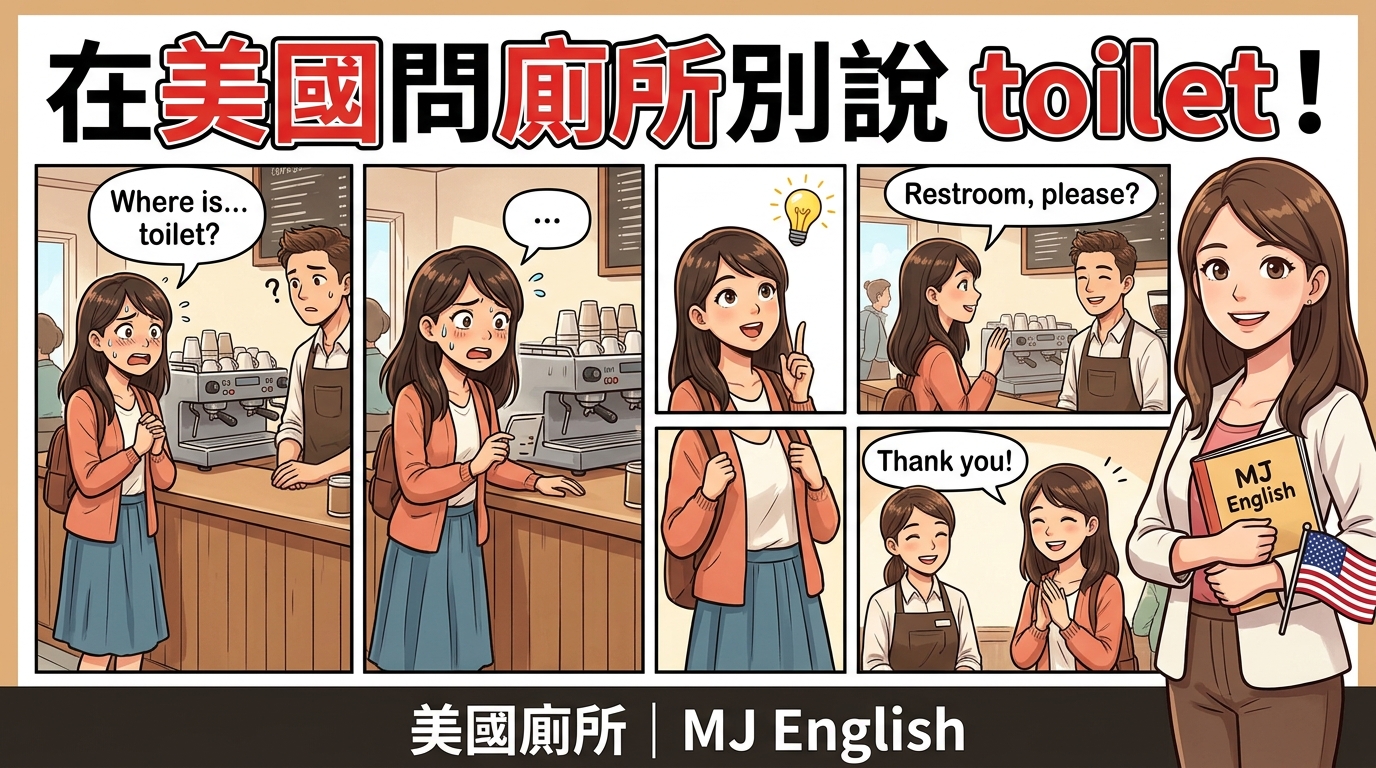
在公共場所(咖啡廳、餐廳、商場)問廁所,美國人最常用的字是 restroom。bathroom 也行,比較偏家裡的廁所,但美國人在外面也常混著用。千萬別用 “toilet”——那個字在美國指「馬桶」這個馬桶本身,當面問「toilet 在哪」聽起來就像在問「馬桶在哪」,有點直白失禮。課本教的 “WC” 更是英式、歐洲用法,美國人根本不講。
還有一個台灣人想不到的點:美國很多店的廁所不是隨便進的。常常寫著 “Customers only”(僅供消費者使用),門上有密碼鎖,密碼印在你的收據上。私人商店有權限制廁所只給消費者使用,「有廁所」跟「免費對外開放」是兩回事——所以先買杯咖啡,問題就解決了。
台灣人最容易卡的雷:把廁所講成 toilet、聽不懂對方指路的方位詞(in the back、down the hall、on your left)。這集把這兩塊一次補起來。
情境對話 Dialogue
場景:Amy 在美國一家咖啡廳,剛買完咖啡、急著找廁所,向店員 Kevin 開口問路。
Amy
Excuse me, where’s the restroom?
不好意思,請問廁所在哪(restroom)?
Kevin
It’s in the back, just past the counter on your left.
在後面(in the back),過了櫃台就在你左邊(on your left)。
Amy
Got it. Is it for customers only?
懂了。是只給消費者用的嗎(customers only)?
Kevin
Yeah, but you’re good — you just bought a coffee.
對,不過你沒問題(you’re good)——你剛買了咖啡啊。
Amy
Oh, do I need a key or a code?
喔,那我需要鑰匙或密碼嗎(code)?
Kevin
There’s a code on your receipt. Just punch it in on the keypad.
你的收據上有密碼。在按鍵板上輸入就好(keypad)。
Amy
Perfect. Is there just one, or…?
太好了。只有一間,還是……?
Kevin
Just one for everyone. If it’s locked, someone’s in there — just wait.
大家共用一間。如果鎖著,就是有人在裡面——稍等一下就好。
Amy
Sounds good. Sorry, one more — which way again?
好的。抱歉,再問一次——往哪邊走來著(which way again)?
Kevin
No worries. Head straight back, past the plants, and it’s the door on your left.
別擔心(no worries)。直直往後走(head straight back),過了那些盆栽,就是你左邊那扇門。
Amy
Thank you so much!
真的太謝謝你了!
Kevin
You bet. There’s a sign on the door — you can’t miss it.
不客氣(you bet)。門上有標示——你一定找得到(you can’t miss it)。
下次這樣說 Next Time
在美國問廁所,這 3 個地方最容易卡。學會這幾句,開口問、聽方位、回謝謝都到位。
① 開口問廁所在哪
Where is the toilet?
廁所(馬桶)在哪?
Excuse me, where’s the restroom?
不好意思,請問廁所在哪?
為什麼:在美國,toilet 指「馬桶」本身,當面問有點失禮。公共場所問廁所一律用 restroom,前面加 “Excuse me” 更有禮貌。
② 問附近有沒有廁所
I want to go to the WC.
我想去 WC(廁所)。
Is there a restroom around here?
這附近有廁所嗎?
為什麼:WC 是英式、歐洲說法,美國人不講、可能還聽不懂。想問「附近有沒有」,用 “Is there a restroom around here?” 最自然。
③ 對方幫你指路後回應
Please say it again.
請再說一遍。
Sorry, which way again?
抱歉,往哪邊走來著?
為什麼:”Please say it again” 太生硬、像命令。沒聽清楚方向,用 “which way again?” 又輕鬆又道地,對方會很樂意再講一次。
重點單字 Vocabulary Boost
restroom/ ˈrestruːm / n.
(公共)廁所。美國在外面問廁所最標準、最有禮貌的字。記這一個字就能走天下。
Where’s the restroom? (廁所在哪?)
bathroom/ ˈbæθrʊm / n.
廁所、浴室。偏指家裡的廁所,但美國人在外面也常用,跟 restroom 幾乎可以互換。聽到別人用,別困惑。
Can I use the bathroom? (我可以用一下廁所嗎?)
in the back/ ɪn ðə bæk / phr.
在後面、在店的最裡面。指路超高頻詞——美國店家的廁所幾乎都 “in the back”。聽到這句就往店內最裡面走。
It’s in the back, past the counter. (在後面,過了櫃台。)
on your left / right/ ɑn jɔr lɛft / phr.
在你的左邊/右邊。指路必聽方位詞。注意是 “on your left”(用 on),不是 “in your left”。
It’s the door on your left. (就是你左邊那扇門。)
customers only/ ˈkʌstəmərz ˈoʊnli / phr.
僅供消費者使用。美國很多店的廁所門上會貼這個牌子,意思是要買東西才能用。看到別硬闖。
Is it for customers only? (是只給消費者用的嗎?)
you’re good/ jʊr ɡʊd / phr.
你沒問題、你 OK 了(不是「你很好」)。美國人超愛用,表示「你符合條件、不用擔心」。店員說這句=你可以用、放心去。
You bought a coffee, so you’re good. (你買了咖啡,所以沒問題。)
code / keypad/ koʊd / ˈkiːpæd / n.
密碼/按鍵板。美國廁所常上密碼鎖,code 印在收據上,keypad 就是門邊輸入密碼的那塊按鍵板。
Punch the code in on the keypad. (在按鍵板上輸入密碼。)
You bet/ juː bet / phr.
不客氣、沒問題(回應謝謝的道地說法)。美國人除了 “You’re welcome”,超常用 “You bet”,輕鬆又友善。被謝謝時回這句很自然。
— Thank you! — You bet. (——謝謝!——不客氣。)
you can’t miss it/ juː kænt mɪs ɪt / phr.
你一定找得到、絕對不會錯過(很明顯,一看就知道)。美國人指完路最愛補這句,給你信心。
There’s a big sign — you can’t miss it. (有個大標示——你一定找得到。)
重點句型 Sentence Patterns
1. Excuse me, where’s the ___? → 不好意思,請問 ___ 在哪?
問任何東西在哪的萬用句。前面加 “Excuse me” 是禮貌的開場,把 restroom 換成別的字就能問所有東西。
例:Excuse me, where’s the elevator? (不好意思,電梯在哪?)
例:Excuse me, where’s the exit? (不好意思,出口在哪?)
2. Is there a ___ around here? → 這附近有 ___ 嗎?
問「附近有沒有」的句型。around here=這附近。找廁所、便利商店、提款機都能套。
例:Is there an ATM around here? (這附近有提款機嗎?)
例:Is there a pharmacy around here? (這附近有藥局嗎?)
3. It’s + 方位(in the back / on your left / past the ___)→ 講方位
聽懂指路的關鍵。對方會把方位詞串起來告訴你怎麼走:in the back(在後面)、past the counter(過了櫃台)、on your left(在你左邊)。
例:It’s past the counter, on your left. (過了櫃台,在你左邊。)
例:It’s around the corner. (在轉角過去。)
4. Do I need a ___? → 我需要 ___ 嗎?
確認需不需要某樣東西。在美國廁所常要密碼或鑰匙,用這句先問清楚,免得到門口才發現進不去。
例:Do I need a key? (我需要鑰匙嗎?)
例:Do I need to buy something first? (我需要先買東西嗎?)
5. You can’t miss it → 你一定找得到
指路後的招牌結尾。字面是「你不可能錯過它」,意思是「很明顯,一看就知道」。聽到這句代表目標很好認,放心走。
例:Big red door, you can’t miss it. (紅色大門,你一定找得到。)
例:Follow the signs, you can’t miss it. (跟著標示走,你一定找得到。)
逐字稿 Transcript
J: Quick myth to bust before we start. You learned the word “toilet” in school, right? In the U.S., please don’t walk up to a stranger and ask, “Where is the toilet?” It’s not that it’s wrong — it’s that “toilet” means the actual porcelain bowl, so you’re basically asking where the bowl is. It sounds a little blunt, a little off. I’m Jason, this is MJ English, and today we’re fixing the single most common travel mistake: how to ask for the bathroom in America.
J: 開始前先破除一個迷思。你在學校學的是 “toilet” 這個字對吧?在美國,拜託別走到一個陌生人面前問:”Where is the toilet?”(廁所在哪?)。不是說它文法錯——而是 “toilet” 指的是那個馬桶本身,所以你等於在問「那個馬桶在哪」。聽起來有點直白、有點怪。我是 Jason,這裡是 MJ English,今天我們來修正旅遊時最常見的一個錯誤:在美國怎麼問廁所。
M: I’m Mary. And the fix is one easy word: restroom (廁所). That’s the polite, standard word in any public place — a café, a mall, a restaurant. There’s also “bathroom,” which Americans use too, even outside the home, so don’t be confused when you hear it. But “restroom” is your safe bet every time. Just say, “Excuse me, where’s the restroom?” Clean, polite, done. Drop the “toilet,” drop the “WC” — that one’s British and Europeans, Americans basically never say it.
M: 我是 Mary。而解法就是一個簡單的字:restroom(廁所)。在任何公共場所——咖啡廳、商場、餐廳——這都是最有禮貌、最標準的字。還有一個 “bathroom”,美國人也會用,連在外面也講,所以聽到別困惑。但 “restroom” 永遠是你最安全的選擇。只要說 “Excuse me, where’s the restroom?”(不好意思,廁所在哪?)。乾淨、有禮貌、搞定。把 “toilet” 丟掉,把 “WC” 也丟掉——後者是英式、歐洲人用的,美國人基本上不講。
J: So let’s listen to Amy. She’s in an American café, she just grabbed a coffee, and nature is calling. She nails the opener: “Excuse me, where’s the restroom?” And Kevin, the barista, gives her the classic American answer: “It’s in the back, just past the counter on your left.” Three direction words right there. In the back (在後面) — that’s where the restroom almost always is. Past the counter (過了櫃台). And on your left (在你左邊). String those together and you can follow any direction in America.
J: 那我們來聽 Amy。她在一家美國咖啡廳,剛買了咖啡,然後尿意來了。她開場開得很漂亮:”Excuse me, where’s the restroom?”(不好意思,廁所在哪?)。而店員 Kevin 給了她一個很經典的美式回答:”It’s in the back, just past the counter on your left.”(在後面,過了櫃台就在你左邊)。一句裡就三個方位詞。In the back(在後面)——廁所幾乎都在那。Past the counter(過了櫃台)。還有 on your left(在你左邊)。把這幾個串起來,你在美國就能聽懂任何指路。
M: Now here’s the part that surprises a lot of Taiwanese travelers. Amy asks, “Is it for customers only?” Customers only (僅供消費者使用) — that’s a sign you’ll see on a lot of restroom doors in the States. The bathroom isn’t always free to the public; sometimes you have to buy something first. Kevin reassures her: “Yeah, but you’re good — you just bought a coffee.” You’re good (你沒問題) does not mean “you are a good person.” It means “you’re fine, you qualify, no problem.” Americans say it constantly, and it’s such a warm little phrase.
M: 接下來這部分會讓很多台灣旅客嚇一跳。Amy 問:”Is it for customers only?”(是只給消費者用的嗎?)。Customers only(僅供消費者使用)——這是你在美國很多廁所門上會看到的牌子。廁所不一定免費對外開放;有時你得先買點東西。Kevin 安慰她:”Yeah, but you’re good — you just bought a coffee.”(對,不過你沒問題——你剛買了咖啡啊)。You’re good(你沒問題)不是說「你是個好人」。它的意思是「你 OK 了、你符合條件、沒問題」。美國人超常講,是個很溫暖的小句子。
J: Then comes the next very American twist: the code. Amy asks, “Do I need a key or a code?” and Kevin says, “There’s a code on your receipt. Just punch it in on the keypad.” So a lot of U.S. restrooms are locked. The code (密碼) is often printed right on your receipt, and the keypad (按鍵板) is that little number pad by the door. Lesson for life: in America, don’t throw your receipt away too fast — your bathroom code might be on it. Amy uses the perfect question too — “Do I need a code?” — simple, clear, exactly what you want to ask before you walk all the way back.
J: 然後是下一個很美式的轉折:密碼。Amy 問:”Do I need a key or a code?”(我需要鑰匙或密碼嗎?),Kevin 說:”There’s a code on your receipt. Just punch it in on the keypad.”(你的收據上有密碼。在按鍵板上輸入就好)。所以美國很多廁所是上鎖的。Code(密碼)常常就印在你的收據上,而 keypad(按鍵板)就是門邊那個小小的數字鍵盤。一個受用一生的教訓:在美國,別太快把收據丟掉——你的廁所密碼可能就在上面。Amy 用的問句也很完美——”Do I need a code?”(我需要密碼嗎?)——簡單、清楚,正是你走到最裡面之前最該先問的。
M: I love how natural Amy stays even when she doesn’t catch everything. She says, “Sorry, one more — which way again?” Which way again? (往哪邊走來著?) is so much better than the stiff textbook “Please say it again.” It’s relaxed, it’s friendly, and it tells the other person exactly what you missed — the direction. And Kevin doesn’t mind at all: “No worries. Head straight back, past the plants, and it’s the door on your left.” No worries (別擔心) is the easygoing American “it’s totally fine.” And notice “head straight back” — head (往…走) used as a verb just means “go that direction.”
M: 我超喜歡 Amy 就算沒全聽懂,還是很自然。她說:”Sorry, one more — which way again?”(抱歉,再問一次——往哪邊走來著?)。Which way again?(往哪邊走來著?)比生硬的課本句 “Please say it again.”(請再說一遍)好太多了。它輕鬆、friendly,而且精準告訴對方你漏聽的是什麼——方向。而 Kevin 一點也不介意:”No worries. Head straight back, past the plants, and it’s the door on your left.”(別擔心。直直往後走,過了那些盆栽,就是你左邊那扇門)。No worries(別擔心)是美國人很隨和的「完全沒關係」。還有注意 “head straight back”——head(往…走)當動詞用,就是「往那個方向走」。
J: And the ending is the cherry on top. Amy says, “Thank you so much!” and Kevin replies, “You bet.” You bet (不客氣) is one of the most American ways to say “you’re welcome.” Casual, friendly, a little upbeat. You’ll hear “You bet,” “No problem,” “Of course,” way more than the textbook “You’re welcome.” Then Kevin finishes with the line every American adds after giving directions: “There’s a sign on the door — you can’t miss it.” You can’t miss it (你一定找得到) isn’t a warning — it’s a reassurance. It means “it’s super easy to spot, don’t stress.”
J: 而結尾是畫龍點睛。Amy 說:”Thank you so much!”(真的太謝謝你了!),Kevin 回:”You bet.”(不客氣)。You bet(不客氣)是美國人說「不客氣」最道地的講法之一。隨意、friendly、有點輕快。你會聽到 “You bet”、”No problem”、”Of course”,遠比課本的 “You’re welcome” 多。然後 Kevin 用每個美國人指完路都會補的那句收尾:”There’s a sign on the door — you can’t miss it.”(門上有標示——你一定找得到)。You can’t miss it(你一定找得到)不是警告——是安慰。它的意思是「超好認,別緊張」。
[DIALOGUE REPLAY]
[重播情境對話]
M: Hearing it again, notice how short and easy every line is. This isn’t advanced English — it’s the right English. One word, restroom, saves you from the awkward “toilet” moment. A handful of direction words — in the back, on your left, past the counter — and you can follow anyone. That’s the whole secret to travel English: you don’t need big words, you need the exact small ones, used with confidence.
M: 再聽一次,注意每句有多短、多簡單。這不是進階英文——是「對的」英文。一個字,restroom,就讓你免去那個尷尬的 “toilet” 時刻。幾個方位詞——in the back、on your left、past the counter——你就能聽懂任何人指路。這就是旅遊英文的全部祕密:你不需要大字,你需要的是精準的小字,加上自信地用出來。
J: So next time you’re in the States and nature calls, you’re ready. You won’t freeze, you won’t say “toilet.” You’ll smile and go, “Excuse me, where’s the restroom?” You’ll catch “in the back, on your left,” you’ll ask “Do I need a code?”, and when they help you, you’ll know it’s “Thank you” — “You bet.” Everything’s in the notes below. I’m Jason.
J: 所以下次你人在美國、尿意來襲時,你準備好了。你不會卡住,不會說 “toilet”。你會微笑著說:”Excuse me, where’s the restroom?”(不好意思,廁所在哪?)。你會聽懂 “in the back, on your left”(在後面,在你左邊),你會問 “Do I need a code?”(我需要密碼嗎?),而當對方幫了你,你會知道是 “Thank you” 配 “You bet”。所有內容都在下方連結。我是 Jason。
M: I’m Mary. Travel light, stay curious — and now you’ll never get caught out looking for a bathroom again.
M: 我是 Mary。輕鬆出門、保持好奇——現在你再也不會在找廁所這件事上手足無措了。
J: See you next time on MJ English!
J: 下次 MJ English 再見!
M: See you next time on MJ English!
M: 下次 MJ English 再見!
你在國外找廁所,有過什麼尷尬或好笑的經驗嗎?
留言跟我們分享——或用今天學的 “Excuse me, where’s the restroom?” 造個句,練起來!
追蹤 MJ英語 podcast,下次見。