💡 先搞懂:延誤/取消時,你能凹到什麼?
關鍵分水嶺:是「航空公司的錯」還是「天氣/不可抗力」。如果是航空公司因素(機械故障、超賣、人力調度)——你通常能爭取餐券、住宿、改簽、甚至現金賠償。如果是 weather-related(天氣因素),住宿賠償不一定有,但餐券和免費改簽常常還是可以凹。先搞清楚原因,開口才有底氣。
開口三步驟:① 先問 “What are my options?”(我有哪些選擇)——逼地勤把選項攤開;② 一項項要:餐券(meal voucher)、住宿(hotel)、改搭別家航空(reroute);③ 要到的東西請對方寫下來(in writing),避免下個櫃台不認帳。
想知道你在美國航線的正式權利,可查 美國運輸部航空消費者保護(DOT Aviation Consumer Protection)。記住一個心法:地勤不會主動給,但他們有權力給——你冷靜、有禮、具體地問,成功率最高。
情境對話 Dialogue
場景:Grace 要飛回台北的班機臨時被取消,機場一片混亂。她沒有慌,走到櫃台前,一句句冷靜地跟地勤 Mark 爭取餐券、住宿和免費改簽。
Mark
I’m really sorry, ma’am. Flight BR-225 to Taipei has been cancelled due to the storm.
真的很抱歉,女士。飛台北的 BR-225 班機因為暴風雨被取消了。
Grace
Oh no. Okay — what are my options?
糟糕。好的——那我有哪些選擇(what are my options)?
Mark
I can rebook you on tomorrow morning’s flight at 9 a.m.
我可以幫你改訂(rebook)到明天早上 9 點的班機。
Grace
That works. But I’ll need somewhere to stay tonight. Will the airline cover a hotel?
那可以。但我今晚需要地方住。航空公司會負擔(cover)飯店嗎?
Mark
Since it’s weather-related, a hotel isn’t guaranteed — but let me see what I can do.
因為這是天氣因素(weather-related),飯店不一定有保障——但我看看能幫你做什麼。
Grace
I understand. And is there any compensation for the delay — a meal voucher, at least?
我理解。那這個延誤有任何賠償(compensation)嗎——至少給張餐券(meal voucher)?
Mark
Yes, I can give you meal vouchers for tonight and tomorrow morning.
可以,我能給你今晚和明天早上的餐券。
Grace
Thank you. One more thing — if there’s an earlier flight on another airline, could you reroute me?
謝謝。還有一件事——如果有別家航空更早的班機,可以幫我改搭(reroute)嗎?
Mark
Let me check… I can actually put you on a partner airline at 6 a.m., no extra charge.
我查一下……其實我可以把你安排到合作航空早上 6 點的班機,不額外收費(no extra charge)。
Grace
That would be perfect. Could I get that in writing, just in case?
那太好了。可以給我書面(in writing)嗎,以防萬一?
Mark
Of course. Here’s your new itinerary and the vouchers. You’re all set.
當然。這是你的新行程單(itinerary)和餐券。都安排好了。
Grace
I really appreciate your help. You’ve made a stressful situation a lot easier.
真的很感謝你的幫忙。你讓一個壓力很大的狀況輕鬆了很多。
Mark
Happy to help. Safe travels, ma’am.
很樂意幫忙。一路平安,女士。
下次這樣說 Next Time
3 句航班出狀況時直接拿來用的英文。台灣人最容易呆等吃悶虧,學會這幾句,餐券、住宿、改簽都爭取得到。
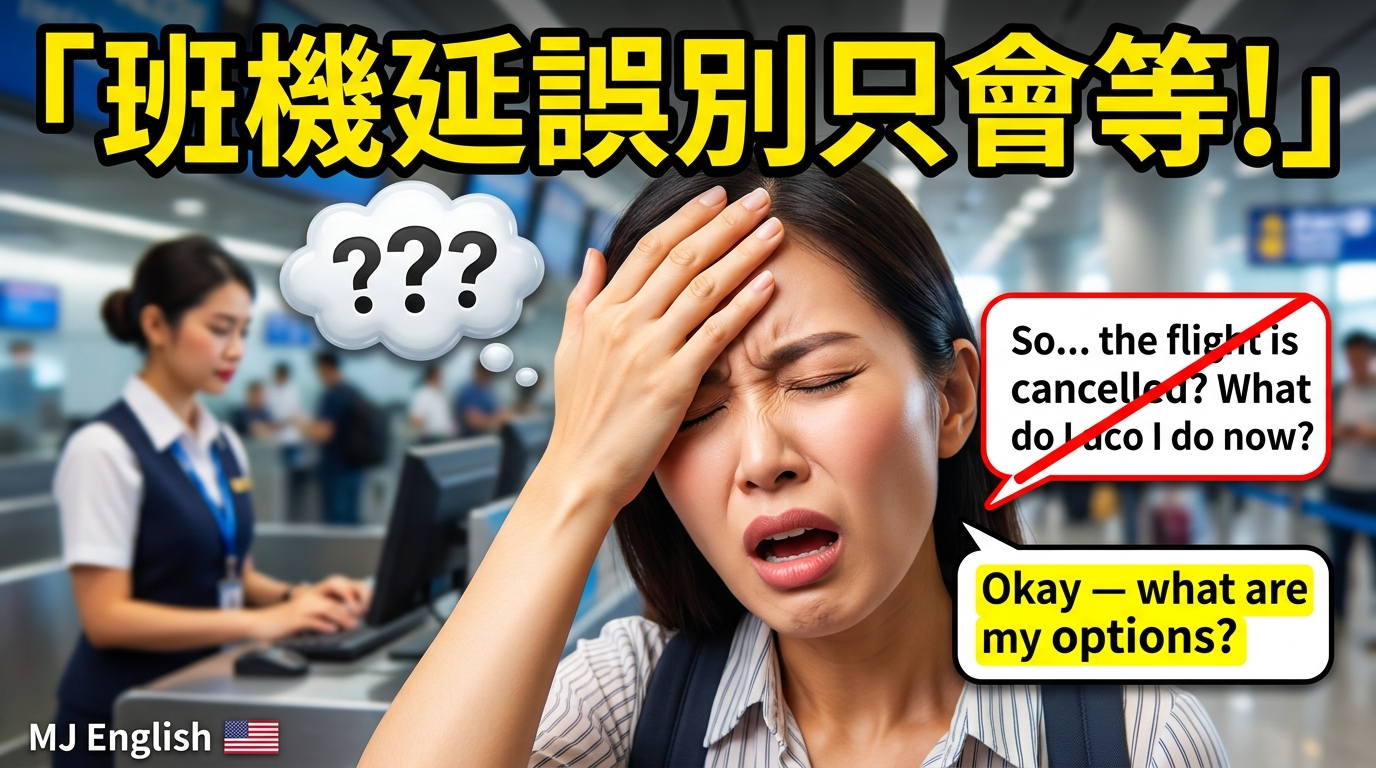
① 一聽到延誤/取消,先這樣開場
So… the flight is cancelled? What do I do now?
所以……班機取消了?那我現在怎麼辦?
Okay — what are my options?
好的——我有哪些選擇?
為什麼:”What do I do now?” 把球丟回給自己、聽起來很無助。”What are my options?”(我有哪些選擇)是逼地勤把所有選項攤開來講——改簽、住宿、賠償,全都在 options 裡。一句話從「待宰」變「主導」。
② 主動爭取住宿與賠償
Can you help me? I have no place to sleep tonight.
你可以幫我嗎?我今晚沒地方睡。
Will the airline cover a hotel? And is there any compensation — a meal voucher, at least?
航空公司會負擔飯店嗎?還有有任何賠償嗎——至少給張餐券?
為什麼:訴苦(”I have no place to sleep”)只會換來同情,換不到東西。直接問 “Will the airline cover ~?”(航空公司會負擔…嗎)和 “Is there any compensation?”(有賠償嗎)是把「權利」具體講出來。地勤有權力給,但通常你不問、他不給。
③ 凹到東西後,請對方寫下來
Okay, thank you. I remember everything.
好,謝謝。我都記得了。
Could I get that in writing, just in case?
可以給我書面嗎,以防萬一?
為什麼:口頭答應在下一個櫃台常常不算數。”Could I get that in writing?”(可以給我書面嗎)讓承諾白紙黑字,後面交接班、換人服務時你才不會被打回原形。”just in case”(以防萬一)語氣客氣,不會像在不信任對方。
重點單字 Vocabulary Boost
options/ ˈɑːpʃənz / n.
選擇、可選的方案。”What are my options?”(我有哪些選擇?)是爭取權益的萬用開場——逼對方把所有方案攤開。不只機場,退貨、客服、看醫生都能用。比 “What can I do?”(我能做什麼)更有主導感。
What are my options? (我有哪些選擇?)
rebook/ ˌriːˈbʊk / v.
改訂、改簽(把原本的訂位換到另一個班機/時間)。”rebook me on the next flight”(幫我改訂下一班)。re- 是「重新」,book 是「訂」。機票、飯店、餐廳都能 rebook。是航班出狀況時最先會聽到/用到的動詞。
I can rebook you on tomorrow morning’s flight. (我可以幫你改訂到明早的班機。)
cover/ ˈkʌvər / v.
負擔、支付(費用由某方買單)。”Will the airline cover a hotel?”(航空公司會負擔飯店嗎?)。保險、公司報帳也用:「Does insurance cover this?」(保險有給付這個嗎)。一個字問出「這筆錢誰出」,比 “pay for” 更道地。
Will the airline cover a hotel? (航空公司會負擔飯店嗎?)
compensation/ ˌkɑːmpenˈseɪʃən / n.
賠償、補償(因損失或不便而給的彌補,可以是現金、點數、餐券、住宿)。”Is there any compensation for the delay?”(這延誤有任何賠償嗎?)。爭取權益的關鍵字——把它講出來,對方才知道你知道自己有權利。
Is there any compensation for the delay? (這延誤有任何賠償嗎?)
meal voucher/ miːl ˈvaʊtʃər / n.
餐券(航空公司在延誤時發的、可在機場餐廳換餐的券)。voucher=兌換券。延誤時最容易凹到的就是它——就算天氣因素拿不到住宿,餐券通常還是要得到。主動開口問 “a meal voucher, at least?”(至少一張餐券?)。
I can give you meal vouchers for tonight. (我能給你今晚的餐券。)
weather-related/ ˈweðər rɪˌleɪtɪd / adj.
天氣因素造成的(延誤/取消的常見官方理由)。”It’s weather-related”(這是天氣因素)。為什麼要懂這字:天氣因素時,航空公司對住宿賠償的責任較小;聽到這句你就知道「住宿不一定有,但餐券和改簽可以爭取」,開口才精準。
Since it’s weather-related, a hotel isn’t guaranteed. (因為是天氣因素,飯店不一定有保障。)
reroute/ ˌriːˈruːt / v.
改道、改走別的航線(包括改搭別家航空)。”Could you reroute me?”(可以幫我改搭別的航線嗎?)。跟 rebook 的差別:rebook 多是同一家換班機,reroute 是換路線/換航空公司。想更快回家,這個字能幫你凹到別家航空的位子。
Could you reroute me on another airline? (可以幫我改搭別家航空嗎?)
no extra charge/ noʊ ˈekstrə tʃɑːrdʒ / phr.
不額外收費、免費。”at no extra charge”(不另外收費)。確認改簽、升等、加服務要不要錢的關鍵句。聽到地勤說 “no extra charge” 就代表這項是免費的——也可以反問 “Is there any extra charge?”(會不會額外收費?)先確認。
I can put you on a partner airline at 6 a.m., no extra charge. (我可以安排你搭合作航空 6 點的班機,不額外收費。)
in writing/ ɪn ˈraɪtɪŋ / phr.
書面、白紙黑字。”Could I get that in writing?”(可以給我書面嗎?)。口頭承諾換櫃台常不認帳,要到書面才保險。談合約、退款、保固都用得到。加 “just in case”(以防萬一)讓語氣客氣不咄咄逼人。
Could I get that in writing, just in case? (可以給我書面嗎,以防萬一?)
itinerary/ aɪˈtɪnəreri / n.
行程、行程單(含航班、時間、訂位代號的完整旅程資訊)。”your new itinerary”(你的新行程單)。改簽後對方會給你一份新 itinerary——拿到時順手確認航班時間、座位、轉機都對,避免後面又出包。旅遊高頻字。
Here’s your new itinerary and the vouchers. (這是你的新行程單和餐券。)
重點句型 Sentence Patterns
1. What are my options? → 我有哪些選擇?
爭取權益的萬用第一句。它把「請告訴我所有可能」一次問出來,逼對方攤牌。比 “What should I do?”(我該怎麼辦)有主導感——你不是求救,你是在盤點籌碼。航班、退貨、醫療、客服全用得到。
例:Before I decide, what are my options? (在我決定前,我有哪些選擇?)
例:What are my options if I cancel? (如果我取消,有哪些選擇?)
2. Will the airline cover ~? → 航空公司會負擔…嗎?
把「這筆錢誰出」直接問清楚。cover=負擔費用。後面接你想要對方買單的東西(a hotel / meals / the transfer)。換個主詞就能到處用:”Will insurance cover…?”(保險會給付…嗎)、”Does the company cover…?”(公司會報…嗎)。
例:Will the airline cover my meals? (航空公司會負擔我的餐費嗎?)
例:Will you cover the transfer to the hotel? (你們會負擔到飯店的交通嗎?)
3. Is there any compensation for ~? → …有任何賠償嗎?
把「賠償」這個權利字眼講出來的關鍵句。”any” 語氣放軟,但 compensation 一出口,對方就知道你懂規矩。後面接造成你損失的事(the delay / the cancellation / the downgrade)。客訴、退費、服務出包都通用。
例:Is there any compensation for the downgrade? (被降等有任何賠償嗎?)
例:Is there any compensation I should know about? (有什麼賠償是我該知道的嗎?)
4. Could you put me on ~? → 可以幫我安排到…嗎?
請對方把你安排到某班機/某選項的客氣說法。”put someone on a flight”=把某人安排上某班機。”Could you put me on the next flight?”(可以幫我排到下一班嗎?)。比 “I want the next flight” 客氣,又比 “Can I…?” 更明確指定你要的東西。
例:Could you put me on another airline? (可以幫我安排到別家航空嗎?)
例:Could you put me on the standby list? (可以幫我排到候補名單嗎?)
5. Could I get that in writing? → 可以給我書面嗎?
把口頭承諾變白紙黑字的保命句。”in writing”=書面形式。航班交接、換櫃台、隔天換人服務時,口頭答應常不算數。加 “just in case”(以防萬一)語氣客氣,不會像在質疑對方。談退款、保固、合約都好用。
例:Can you put that in writing for me? (可以幫我把那個寫下來嗎?)
例:I’d like it in writing, please. (我希望有書面,麻煩了。)
逐字稿 Transcript
J: Two passengers, same cancelled flight. One ends up sleeping on an airport bench, starving, waiting for morning. The other walks away with a hotel room, meal vouchers, and a free 6 a.m. seat on another airline. The difference wasn’t luck, and it wasn’t status. It was about five sentences. I’m Jason, this is MJ English, and today we’re making sure you’re the second passenger.
J: 兩個乘客,同一班被取消的飛機。一個最後睡在機場長椅、餓著肚子等天亮。另一個帶著飯店房間、餐券、還有別家航空免費的清晨 6 點機位走人。差別不是運氣,也不是會員等級。差在大約五句話。我是 Jason,這裡是 MJ English,今天我們要確保你是第二個乘客。
M: I’m Mary. And the reason this matters so much is that airlines rarely volunteer anything. The compensation, the hotel, the meal vouchers — a lot of it exists, but it’s “ask and you shall receive.” The Taiwanese instinct is to wait quietly and not make trouble. In this situation, that instinct costs you money and a night’s sleep. So watch Grace. Her flight just got cancelled, and she’s about to model exactly how to ask — calm, polite, and specific.
M: 我是 Mary。這之所以這麼重要,是因為航空公司很少主動給你任何東西。賠償(compensation)、飯店、餐券——很多其實都有,但它是「你問了才給」。台灣人的直覺是安靜地等、不要找麻煩。在這個情況,那個直覺會害你損失金錢和一夜好眠。所以看 Grace。她的班機剛被取消,她正要示範到底怎麼開口——冷靜、有禮、具體。
J: Listen to her very first move, because it sets the whole tone — “Okay, what are my options?” That phrase, what are my options (我有哪些選擇), is the single most powerful thing you can say at a service counter. Compare it to the natural Taiwanese reflex — “What do I do now?” That one sounds helpless, and it puts all the work back on you. “What are my options?” does the opposite — it forces the agent to lay everything on the table. Rebooking, hotels, compensation — they’re all hiding inside that word, options.
J: 聽她的第一個動作,因為它定調了整段——”Okay, what are my options?”(好,我有哪些選擇?)。那個片語 what are my options(我有哪些選擇),是你在服務櫃台能說的最有力的一句。對比一下台灣人的自然反射——”What do I do now?”(那我現在怎麼辦?)。那句聽起來很無助,還把所有工作丟回給你。”What are my options?” 剛好相反——它逼地勤把全部選項攤在桌上。改簽、飯店、賠償——全都藏在 options(選擇)這個字裡面。
M: Mark offers a rebooking, and here’s where Grace levels up. She doesn’t just take the first thing offered — she keeps going. “Will the airline cover a hotel?” Cover (負擔費用) is the verb that asks “who’s paying for this?” without any drama. And notice Mark’s answer — “Since it’s weather-related, a hotel isn’t guaranteed.” Weather-related (天氣因素) is the magic phrase airlines use, because when it’s weather, their obligation shrinks. The moment you hear “weather-related,” you adjust — maybe no hotel, but you can still push for meals and a rebooking.
M: Mark 提供了改訂,而這裡是 Grace 升級的地方。她沒有只拿對方先提的東西——她繼續問。”Will the airline cover a hotel?”(航空公司會負擔飯店嗎?)。Cover(負擔費用)這個動詞,是在問「這誰出錢?」而且毫無火藥味。注意 Mark 的回答——”Since it’s weather-related, a hotel isn’t guaranteed.”(因為是天氣因素,飯店不一定有保障)。Weather-related(天氣因素)是航空公司會用的關鍵詞,因為一旦是天氣,他們的義務就縮小。當你一聽到 “weather-related”,你就調整——可能沒飯店,但你還是可以爭取餐點和改簽。
J: And that’s exactly what she does. “Is there any compensation for the delay — a meal voucher, at least?” Two things to steal here. Compensation (賠償) — say that word out loud and the agent instantly knows you understand you have rights. And “at least” is a beautiful little softener — “a meal voucher, at least” means “give me something, even if it’s the smallest thing.” It’s hard to say no to. Sure enough, Mark hands over meal vouchers for two meals.
J: 而那正是她做的。”Is there any compensation for the delay — a meal voucher, at least?”(這延誤有任何賠償嗎——至少給張餐券?)。這裡偷兩個東西。Compensation(賠償)——把這個字講出來,地勤立刻知道你懂自己有權利。還有 “at least”(至少)是個漂亮的小緩衝——”a meal voucher, at least” 意思是「給我點東西,哪怕是最小的」。這很難拒絕。果然,Mark 給了兩餐的餐券。
M: Then Grace does the thing most people never think of — she asks to go further. “If there’s an earlier flight on another airline, could you reroute me?” Reroute (改搭別的航線) is different from rebook. Rebook is usually the same airline, a later flight. Reroute means switch routes — even put you on a competitor. Most passengers don’t know agents can do this, so they never ask. Grace asks, and Mark finds her a partner-airline seat at 6 a.m. — “no extra charge.” Hours earlier home, for free, just because she asked.
M: 然後 Grace 做了大多數人從沒想到的事——她要求再進一步。”If there’s an earlier flight on another airline, could you reroute me?”(如果有別家航空更早的班機,可以幫我改搭嗎?)。Reroute(改搭別的航線)跟 rebook 不一樣。Rebook 通常是同一家航空、晚一點的班機。Reroute 是換路線——甚至把你排到競爭對手的班機。大多數乘客不知道地勤能這樣做,所以從不開口。Grace 開口了,Mark 幫她找到合作航空早上 6 點的位子——”no extra charge”(不額外收費)。早好幾小時到家,免費,只因為她問了。
J: And the final, pro-level move — “Could I get that in writing, just in case?” In writing (書面) is your insurance policy. Here’s the trap nobody warns you about: the agent who promised you everything goes off shift, a new person takes over, and suddenly “there’s no record of that.” A printed itinerary, an email, a stamped voucher — that’s proof. And “just in case” keeps it polite, so you’re not accusing anyone of lying. You’re just being smart.
J: 還有最後、高手級的一招——”Could I get that in writing, just in case?”(可以給我書面嗎,以防萬一?)。In writing(書面)是你的保險。這裡有個沒人警告你的陷阱:答應你一切的地勤下班了,換了個新人接手,突然「系統裡沒有這筆紀錄」。一份印出來的行程單、一封 email、一張蓋章的餐券——那就是證據。而 “just in case”(以防萬一)讓它保持客氣,所以你不是在指控誰說謊。你只是很聰明。
M: Let’s run the whole conversation again. This round, listen for the five power phrases in order — “what are my options,” “will the airline cover,” “is there any compensation,” “could you reroute me,” and “could I get that in writing.” Notice Grace never once raises her voice. She’s not the angry passenger yelling at the counter — she’s the calm one who knows exactly what to ask for. And she walks away with more than anyone shouting ever does.
M: 我們把整段對話再跑一次。這一輪,照順序注意聽五句強力片語——”what are my options”(我有哪些選擇)、”will the airline cover”(航空公司會負擔)、”is there any compensation”(有任何賠償)、”could you reroute me”(可以幫我改搭)、”could I get that in writing”(可以給我書面)。注意 Grace 從沒提高音量。她不是在櫃台對人大吼的憤怒乘客——她是那個冷靜、清楚知道該要什麼的人。而她拿到的,比任何大吼大叫的人都多。
[DIALOGUE REPLAY]
[重播情境對話]
M: Hearing it again, you can feel the whole strategy. Grace treats it like a checklist, not a fight. Options first, then hotel, then compensation, then reroute, then get it in writing. Each question opens a door the airline wasn’t going to open for her. That’s the real lesson: the staff aren’t your enemy, but they’re also not going to do your job for you. You have to know what exists and ask for it, one calm sentence at a time.
M: 再聽一次,你能感覺到整套策略。Grace 把它當成一份清單,不是一場架。先問選擇、再問飯店、再問賠償、再問改搭、最後拿書面。每一個問題都打開一扇航空公司本來不會替她開的門。這就是真正的一課:地勤不是你的敵人,但他們也不會替你做你的功課。你得知道有什麼東西存在,然後一句一句冷靜地要。
J: So here’s your homework before your next trip. Memorize the order — options, cover, compensation, reroute, in writing. Save it in your phone if you have to. The next time a board flips to “CANCELLED” and the whole gate groans, you won’t be the one slumped in a chair. You’ll be the one walking calmly to the counter, asking the right five questions, and walking away with a hotel, a meal, and an earlier flight home. Everything’s in the notes below.
J: 所以這是你下次旅行前的作業。把順序背起來——選擇、負擔、賠償、改搭、書面。需要的話存進手機。下次當看板翻成 “CANCELLED”、整個登機口一片哀號,你不會是那個癱在椅子上的人。你會是那個冷靜走到櫃台、問對五個問題、然後帶著飯店、一餐、和更早回家班機走人的人。所有內容都在下方連結。
M: I’m Mary. Remember — calm beats loud every time. The passenger who knows what to ask always does better than the one who just gets angry. Ask like Grace.
M: 我是 Mary。記住——冷靜每次都贏過大聲。知道該問什麼的乘客,永遠比只會生氣的人結果更好。像 Grace 那樣問。
J: I’m Jason. May all your flights be on time — but if they’re not, now you’re ready. See you next time on MJ English.
J: 我是 Jason。願你的航班都準點——但萬一沒有,現在你準備好了。下次 MJ English 再見。
你有沒有遇過航班延誤/取消,卻不知道能爭取什麼,最後吃了悶虧?
留言分享你的「機場崩潰」經驗,下次用今天這 5 句,把崩潰變成至少有拿到東西。
追蹤 MJ英語 podcast,下次見。