💡 先搞懂:2026 美國小費「該給多少」分場合表
內用餐廳(有服務生 server 走到桌邊):基本 18–20%,這是底線。低於 15% 等於明示「服務差」。FTC 消費者守則提醒:6 人以上團體餐廳通常自動加 18–20% 服務費(service charge),結帳前看一下 bill,已含就不用再付。
櫃台點餐/咖啡外帶(你自己端走):完全選擇性。給 1–2 美金或 10% 算客氣,按 “no tip” 也沒人會追出來罵你。這就是 Tipflation 最被罵的灰色地帶。
其他常見場景:Uber/DoorDash 外送湊整數 + 1–2 美金;剪頭髮 15–20%;飯店房務(housekeeping)每晚 2–5 美金留床頭;機場行李員每件 1–2 美金。記住一個原則:人到桌邊服務你的 → 全額小費;你自己拿走的 → 看心情、低標 OK。
情境對話 Dialogue
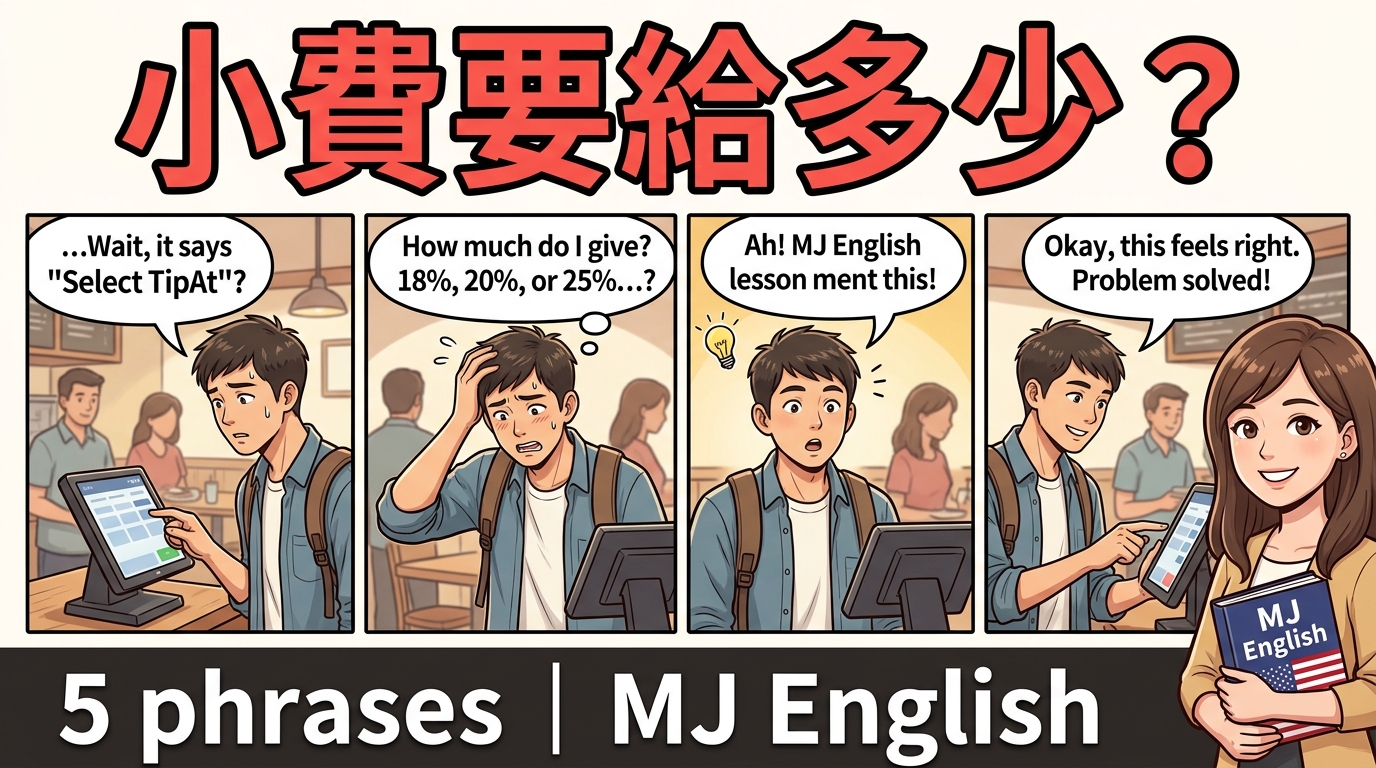
場景:Lisa 剛到紐約,跟住在當地的朋友 Eric 走進咖啡店點外帶拿鐵。店員把 iPad 一轉,跳出 18%/22%/25% 選項,她瞬間僵住。
Eric
There’s the famous tip screen — they spin it around the second you grab your coffee.
那個有名的小費螢幕(tip screen)來了——你一拿到咖啡他們就把 iPad 轉過來。
Lisa
Wait, I’m being asked to tip on a to-go latte? Should I tip on this?
等等,外帶(to-go)一杯拿鐵也要付小費?這個我要付小費嗎(tip on this)?
Eric
That’s the Tipflation everyone’s complaining about. For a regular to-go coffee, honestly, no tip is fine — just hit “no tip” and walk.
這就是大家都在罵的 Tipflation(小費通膨)。一杯普通外帶咖啡,老實說不付也 OK——按「no tip」走人就好。
Lisa
But the barista’s standing right there watching me. I feel like I’m being shamed into it.
可是店員(barista)就站在那盯著我。我覺得被羞辱式地逼著按了。
Eric
Welcome to the guilt-tip. Counter service used to be optional — now every iPad asks. You don’t owe 22% on a $5 latte.
歡迎來到「罪惡感小費」(guilt-tip)。櫃台點餐以前是選擇性的——現在每台 iPad 都在問。5 美金的拿鐵你不欠人家 22%。
Lisa
So what’s the standard? I’m worried I’ll undertip and look cheap, or overtip and run out of cash.
那標準是多少?我怕付太少(undertip)看起來小氣,付太多(overtip)又會把現金燒光。
Eric
Sit-down restaurant with a server walking to your table: 18 to 20% is the baseline. Anything less feels stingy unless the service was actually bad.
內用餐廳、有服務生(server)走到你桌邊那種:18–20% 是底線(baseline)。低於這個就會被覺得小氣,除非服務真的很差。
Lisa
What about takeout from a sit-down place? Same rules?
那從內用餐廳叫外帶(takeout)呢?規則一樣嗎?
Eric
Lower. A couple of bucks, or 10% if the order’s big. You’re not paying for table service.
低一點。幾塊錢(a couple of bucks),或訂單大的話 10%。你又沒在用桌邊服務。
Lisa
What if there’s already a service charge on the bill? Do I tip again?
那帳單上已經有服務費(service charge)了呢?還要再付小費嗎?
Eric
No. If it’s already on the bill, don’t tip again. That’s the double-tip trap. Always check the bottom of the receipt before you sign.
不用。如果已經含在帳單裡(on the bill),別再付了。那就是「重複付小費」的陷阱。簽單前永遠看一下收據最底下。
Lisa
So basically: full tip if a server walks to my table, light tip on takeout, and skip the guilt screen at the coffee counter?
所以基本上:服務生走到桌邊全額付、外帶輕付、咖啡櫃台那個罪惡感螢幕直接跳過?
Eric
Exactly. And for Uber or delivery, just round up to the nearest dollar or add a couple of bucks. You’ll be fine.
沒錯。Uber 或外送就湊整數(round up)到最近一塊錢,或加個幾塊錢。這樣就 OK 了。
下次這樣說 Next Time
3 個小費現場直接拿來用的英文。台灣人最怕當下不知道該不該付、付多少,學會這幾句就能優雅應對 Tipflation。
① 問「這個要不要付小費」
Do I need to give money? Is tip okay or not?
我需要給錢嗎?小費 OK 還是不 OK?
Should I tip on this?
這個我要付小費嗎?
為什麼:”Do I need to give money” 像在問捐款。”tip on” 是固定搭配——”tip on takeout”(外帶要不要付)、”tip on a coffee”(咖啡要不要付)。一句俐落、母語者天天用。
② 確認「已含小費了嗎」
The tip is inside this paper already?
小費已經在這張紙裡面了?
Is the tip already on the bill?
小費已經含在帳單裡了嗎?
為什麼:問之前先掃一眼帳單,看 “service charge” 或 “gratuity” 字樣。”on the bill”(在帳單上)是這場合的固定說法,問完店員會直接指給你看。簽單前永遠多問這一句,避免雙重付小費。
③ 跟外送/Uber 司機湊整數
I add some money for you. Make it round.
我加一點錢給你。讓它變圓的。
I’ll just round up to the nearest dollar.
我直接湊到最近一塊錢就好。
為什麼:”Make it round” 沒人聽得懂,”round up”(向上湊到整數)才是英文的標準說法。”round up to the nearest dollar”(湊到最近一塊錢)是外送、Uber、小額付款最常用的小費邏輯。
重點單字 Vocabulary Boost
tipflation/ ˌtɪpˈfleɪʃən / n.
小費通膨(2024 年起爆紅新詞)。意指原本不用給小費的場合也跳出小費要求、預設選項從 15% 漲到 22–25% 的現象。tip + inflation 合成詞,2024–2026 美國媒體天天罵。台灣讀者出國踩雷必懂的字。
That’s the Tipflation everyone’s complaining about. (這就是大家都在罵的小費通膨。)
tip screen/ tɪp skriːn / n.
小費螢幕(店員把 iPad 一轉問你選 18/22/25% 的那個畫面)。也叫 “tip prompt”、”tip pad”。是 Tipflation 的物理化身——本來咖啡櫃台沒這東西,現在自助結帳、外帶都跳。
They spin the tip screen around the second you grab your coffee. (你一拿到咖啡他們就把小費螢幕轉過來。)
guilt-tip/ ɡɪlt tɪp / n./v.
罪惡感小費(被店員在場的壓力逼著按下小費的現象)。”feel guilt-tipped into”(被罪惡感逼著付)。是 Tipflation 心理戰的核心——你不是真心想付,是因為店員在看才按。記這個詞代表你看穿了這場心理戰。
Welcome to the guilt-tip. (歡迎來到罪惡感小費的世界。)
to-go / takeout/ tə ɡoʊ / ˈteɪkaʊt / adj./n.
外帶。”to-go” 多用於飲料、咖啡(a to-go latte),”takeout” 多用於餐點(takeout sushi)。對應小費邏輯:to-go = 你自己拿走,付小費是選擇性的;服務生送到桌邊才是必付區。
Should I tip on a to-go latte? (外帶拿鐵我要付小費嗎?)
service charge/ ˈsɜːrvɪs tʃɑːrdʒ / n.
服務費(餐廳自動加在帳單上的小費,6 人以上團體常見、18–20%)。同義 “gratuity”。看到這個字代表小費已含——再付一次就是雙重付小費。簽單前掃一眼收據底部最重要。
If there’s already a service charge on the bill, don’t tip again. (如果帳單已含服務費,別再付一次。)
baseline/ ˈbeɪslaɪn / n.
底線、基準(不能再低的標準)。”18% is the baseline”(18% 是底線)。談錢、談標準、談談判都好用,比 “minimum” 口語、比 “standard” 多一層「不可妥協」的意味。
18 to 20% is the baseline. (18–20% 是底線。)
round up/ raʊnd ʌp / phr.v.
湊整數(向上湊到最近的整數)。”round up to the nearest dollar”(湊到最近一塊錢)。外送、Uber、小額付款最常見的小費邏輯——$8.30 直接給 $10。相反詞 “round down”(向下湊)少用,因為對服務人員不夠意思。
I’ll just round up to the nearest dollar. (我直接湊到最近一塊錢就好。)
a couple of bucks/ ə ˈkʌpəl əv bʌks / phr.
幾塊錢(buck 是 dollar 的口語)。”a couple of bucks” 字面上是「兩塊」,實際指「兩、三塊」的零頭。小費場合超常用:外帶、Uber、housekeeping 都用這個額度。比 “two dollars” 鬆、比 “some money” 精準。
A couple of bucks, or 10% if the order’s big. (幾塊錢就好,訂單大就 10%。)
undertip / overtip/ ˌʌndərˈtɪp / ˌoʊvərˈtɪp / v.
付太少/付太多(小費)。”I’ll undertip and look cheap”(我會付太少看起來小氣)、”I overtipped because I panicked”(我太慌張結果付太多)。一個動詞解決一整句的麻煩,超實用的「形容自己付小費出包」專用字。
I’m worried I’ll undertip and look cheap. (我怕付太少看起來小氣。)
stingy/ ˈstɪndʒi / adj.
小氣的(特別指該花錢時不花的那種)。比 “cheap” 多一層負面評價——cheap 是事實描述(便宜貨),stingy 是性格評斷(小器鬼)。小費場合最常被用:付不夠就會被講 stingy,是頗刺耳的形容。
Anything less feels stingy unless the service was actually bad. (低於這個就會被覺得小氣,除非服務真的很差。)
重點句型 Sentence Patterns
1. Should I tip on + N? → 這個要不要付小費?
小費場合的萬用問句。重點:用 tip on(介系詞 on)而不是 “tip for” 或 “give tip to”。on 後面接你不確定的那個場景或品項——tip on takeout、tip on a $5 coffee、tip on this bill。
例:Should I tip on a self-service kiosk? (自助結帳機要不要付小費?)
例:Should I tip on the pre-tax or post-tax amount? (小費是算稅前還稅後?)
2. Is the tip already on the bill? → 小費已經含在帳單裡了嗎?
確認是否雙重付小費的關鍵問句。”on the bill” 是固定搭配(在帳單上)。看到 “service charge” 或 “gratuity included” 就代表已含——千萬別再付一次。團體聚餐(6 人以上)特別容易遇到。
例:Is there a service charge on the bill? (帳單上有服務費嗎?)
例:It’s already on the bill, so we’re good. (已經含在帳單裡了,不用再付。)
3. ~ is the baseline → ⋯是底線
表達「最低標準」的句型。”18% is the baseline” 比 “18% is minimum” 更有「不可妥協」的味道。談小費、談薪水、談服務水準都用得到。”the baseline for X” 也常見——the baseline for tipping、the baseline for service。
例:A couple of bucks is the baseline for takeout. (外帶幾塊錢是底線。)
例:Anything below 15% feels stingy. (低於 15% 會被覺得小氣。)
4. round up to the nearest ~ → 湊到最近的⋯
小額付款最常用的小費邏輯。”round up to the nearest dollar”(湊到最近一塊錢)、”round up to the nearest five”(湊到最近五塊)。Uber、外送、咖啡店掏零錢時都用得到。相對的 “round down” 對服務業不夠意思,少用。
例:Round it up to $20 and call it a tip. (湊到 20 塊就當小費了。)
例:Just round up—don’t bother with the change. (直接湊整,零錢別管了。)
5. feel shamed / guilt-tipped into ~ → 被罪惡感逼著⋯
描述「被店員眼神/場合壓力逼著做某事」的進階說法。”shamed into tipping”(被羞辱式地逼付小費)、”guilt-tipped into 22%”(被罪惡感逼著按 22%)。是 Tipflation 心理戰的核心動詞——學會這個字就能向別人精準描述「我不是真心想付」的尷尬。
例:Don’t get guilt-tipped into 22%. (別被罪惡感逼著按 22%。)
例:The tip screen is designed to guilt-tip you. (小費螢幕就是設計來讓你罪惡感發作的。)
逐字稿 Transcript
J: You grab your latte, turn to leave, and the barista flips the iPad around. Eighteen percent. Twenty-two. Twenty-five. Your finger hovers. The line behind you waits. I’m Jason, and you’re listening to MJ English — that little frozen moment at the coffee counter is exactly what today’s episode is about.
J: 你拿了拿鐵、轉身要走,店員把 iPad 一翻過來。18%、22%、25%。你的手指停在半空中。後面排隊的人在等。我是 Jason,你正在收聽 MJ English——咖啡櫃台前那個凍結的瞬間,就是今天這集要講的。
M: I’m Mary. And the word for that whole phenomenon is Tipflation — tip plus inflation. It’s the single biggest American cultural shift in service since 2024. Coffee shops, self-checkout kiosks, even retail counters now ask for tips. Default options have crept from fifteen percent up to twenty-five. For Taiwanese visitors coming from a country with zero tipping culture, it’s a daily landmine.
M: 我是 Mary。這整個現象的英文叫 Tipflation(小費通膨)——tip 加 inflation。它是 2024 年以來美國服務業最大的文化轉變。咖啡店、自助結帳機、甚至零售櫃台都在問小費。預設選項從 15% 一路漲到 25%。對從零小費文化的台灣來的訪客,這是每天的地雷。
J: Listen to Lisa’s first line, because it nails the panic — “Wait, I’m being asked to tip on a to-go latte?” Two phrases to lock in. “To-go” — your American word for takeaway, especially drinks. And “tip on” — the preposition is on, not for, not to. “Tip on takeout,” “tip on this,” “tip on a five-dollar coffee.” That little on is what makes it sound native.
J: 聽 Lisa 的第一句話,因為它精準抓到那種慌——”Wait, I’m being asked to tip on a to-go latte?”(等等,外帶一杯拿鐵也要付小費?)兩個片語要記。”To-go”——美式的「外帶」,尤其用在飲料。還有 “tip on”——介系詞是 on,不是 for、不是 to。”Tip on takeout”、”tip on this”、”tip on a five-dollar coffee”(外帶要不要付/這個要不要付/5 美金的咖啡要不要付)。那個 on,就是道地的關鍵。
M: Then she asks the question every Taiwanese visitor needs to memorize — “Should I tip on this?” Short, direct, exactly right. Compare it to what most learners reach for — “Do I need to give money?” That sounds like you’re asking about a donation. “Should I tip on this?” gets a clean yes or no from the barista, and you move on.
M: 然後她問了每個台灣訪客都該背下來的問句——”Should I tip on this?”(這個我要付小費嗎?)短、直接、剛剛好。對比一下大多數學習者會說的——”Do I need to give money?” 那聽起來像在問捐款。”Should I tip on this?” 從店員那裡會直接得到一個 yes 或 no,然後你就走了。
M: Eric’s answer is where the cultural truth lives — “For a regular to-go coffee, honestly, no tip is fine — just hit no tip and walk.” That word “honestly” is doing a lot of work. It signals “I’m dropping the polite script and telling you what locals actually do.” Americans use “honestly” before any opinion that pushes back against the official norm — “honestly, no one tips for that.”
M: Eric 的回答就是文化真相的所在——”For a regular to-go coffee, honestly, no tip is fine — just hit no tip and walk.”(一杯普通外帶咖啡,老實說不付也 OK——按「不付」走人就好。)那個 “honestly” 字很有戲。它在說「我要丟掉客套劇本,告訴你當地人實際上怎麼做」。美國人講「跟官方規矩相反的意見」之前都加 “honestly”——「honestly, no one tips for that」(老實說,沒人為那個付小費)。
J: Lisa pushes back with the real emotion — “I feel like I’m being shamed into it.” That phrase, “shamed into,” is structural gold. “Shamed into doing X” means “pressured into X by the feeling of shame.” Same shape: “guilted into,” “tricked into,” “bullied into.” Eric replies with the name for the whole trap — “the guilt-tip.” Memorize that compound. It’s the word that makes you sound like you’ve been here three years instead of three days.
J: Lisa 反擊的那句帶著真情緒——”I feel like I’m being shamed into it.”(我覺得被羞辱式地逼著按了。)那個句型 “shamed into” 是結構性的金句。”Shamed into doing X” 意思是「被羞辱感逼著做 X」。同樣結構還有 “guilted into”(被罪惡感逼著)、”tricked into”(被騙著)、”bullied into”(被霸凌著)。Eric 回了一個給整個陷阱命名的詞——”the guilt-tip”(罪惡感小費)。把這個複合字背起來。這個字會讓你聽起來像在美國住了三年而不是三天。
M: Now for the rules themselves. Eric lays out the baseline — “Sit-down restaurant with a server walking to your table: 18 to 20% is the baseline.” Notice “baseline” — not “minimum,” not “standard.” Baseline means “the floor, anything less feels stingy.” It carries a moral weight that minimum doesn’t. If a server walked to your table, refilled your water, brought the bill — eighteen percent is not optional. That’s the rule. Anything less, you’re being stingy.
M: 接著是規矩本身。Eric 講出底線——”Sit-down restaurant with a server walking to your table: 18 to 20% is the baseline.”(內用餐廳有服務生走到你桌邊:18–20% 是底線。)注意 “baseline”——不是 “minimum”,不是 “standard”。Baseline 意思是「地板,低於這個就會被覺得小氣」。它帶著 minimum 沒有的道德重量。如果服務生走到你桌邊、幫你倒水、把帳單送來——18% 不是選擇性的。那是規矩。低於這個,你就是 stingy(小氣)。
J: But here’s the layered nuance — takeout from the same sit-down restaurant follows different rules. “A couple of bucks, or 10% if the order’s big. You’re not paying for table service.” This is the principle to lock in — you tip for the labor of someone serving you, not for the food itself. Pickup at the counter, no service, light tip or none. Restaurant where someone walked food to your table, full tip. The “couple of bucks” phrase, by the way, is your everyday-money word — flexible, casual, perfect for tipping.
J: 但這裡有層次——同一家內用餐廳的外帶,規矩不一樣。”A couple of bucks, or 10% if the order’s big. You’re not paying for table service.”(幾塊錢,訂單大就 10%。你又沒在用桌邊服務。)這是要記下的原則——小費是付給「有人服務你的勞力」,不是付給食物本身。櫃台取餐、沒服務,輕付或不付。餐廳有人把食物送到桌邊,全額付。順帶一提,”couple of bucks”(幾塊錢)是日常講錢的萬用字——彈性、輕鬆、剛剛好適合小費場合。
M: And then Eric drops the trap nobody warns you about — “If it’s already on the bill, don’t tip again. That’s the double-tip trap.” Some restaurants, especially with groups of six or more, automatically add a service charge — usually 18 to 20%. The bill arrives, looks normal, but at the bottom in small print: “gratuity included” or “service charge.” Sign without checking, and you’ve just tipped twice. The protective phrase here is “Is the tip already on the bill?” — six words, possibly saves you forty dollars.
M: 然後 Eric 講了一個沒人警告你的陷阱——”If it’s already on the bill, don’t tip again. That’s the double-tip trap.”(如果已含在帳單裡,別再付。那是雙重付小費陷阱。)有些餐廳,特別是 6 人以上的團體,會自動加服務費——通常 18–20%。帳單來了看起來很正常,但底下小字寫著「gratuity included」或「service charge」。沒看就簽,你就重複付了。這裡的保命句是 “Is the tip already on the bill?”(小費已含在帳單裡了嗎?)——六個字,可能省下 40 美金。
J: Last weapon — for Uber, delivery, small payments — “round up to the nearest dollar.” Phrasal verb. Round up. If your fare is $8.30, you give $10. If your coffee is $4.50, you make it $5. Lots of apps now have a built-in “round up” button — one tap, the math is done. The opposite, “round down,” exists grammatically but socially nobody uses it for tips. Round up only.
J: 最後一個武器——Uber、外送、小額付款——”round up to the nearest dollar”(湊到最近一塊錢)。Phrasal verb(片語動詞)。Round up(向上湊整)。車資 8.30,你給 10。咖啡 4.50,湊到 5。很多 app 現在內建「round up」按鈕——按一下,數學算好了。相反詞 “round down”(向下湊)文法上存在,但社交上沒人用在小費。只用 round up。
M: Let’s run the whole conversation one more time. This round, listen for the five anchor phrases — “should I tip on this,” “shamed into,” “is the baseline,” “on the bill,” and “round up.” Notice how Eric never lectures Lisa — he answers her actual questions and trusts her to do the math. That’s how Americans coach each other through small daily traps. Casual, specific, no judgment.
M: 我們再把整段對話跑一次。這次注意五個錨點片語——”should I tip on this”(這個要不要付)、”shamed into”(被羞辱式逼著)、”is the baseline”(是底線)、”on the bill”(在帳單上)、”round up”(湊整)。注意 Eric 從不對 Lisa 說教——他就回答她實際的問題,相信她自己會算。美國人就是這樣帶彼此走過日常的小陷阱。隨意、具體、不評斷。
J: Hearing it again, you can see the whole conversation hangs on a handful of phrases — “should I tip on,” “on the bill,” “the baseline,” “round up,” and the bigger cultural words like Tipflation and guilt-tip. Master those, and you can walk into any American café, restaurant, or rideshare without freezing at the iPad. You’re not being cheap. You’re being informed — and informed is exactly what separates tourists from people who know.
J: 再聽一次,你會看到整段對話就靠幾個片語在跑——”should I tip on”(這個要不要付)、”on the bill”(在帳單上)、”the baseline”(底線)、”round up”(湊整),還有 Tipflation(小費通膨)和 guilt-tip(罪惡感小費)這種更大的文化詞。把這些學起來,你走進任何美國咖啡店、餐廳、共乘車都不會在 iPad 前僵住。你不是小氣。你是知情的——而知情,正是觀光客和「懂的人」之間的差距。
M: I’m Mary. If you remember just one thing today, remember this — the iPad is not the rule. The default 22% button is a suggestion built to make you feel guilty, not a law. The real baseline lives in your head: server walks to your table, full tip. You walked to the counter, light tip or none. Simple as that.
M: 我是 Mary。如果今天只記一件事,就記這個——iPad 不是規矩。預設的 22% 按鈕是設計來讓你罪惡感發作的「建議」,不是法律。真正的底線在你心裡:服務生走到你桌邊,全額付。你自己走到櫃台,輕付或不付。就這麼簡單。
J: I’m Jason. Next time the barista spins that iPad around, take half a second, decide if a human served you — and tap accordingly. No guilt, no overthinking. See you next time on MJ English.
J: 我是 Jason。下次店員把 iPad 轉過來,停半秒、想一下到底有沒有人服務你——然後按下去。沒有罪惡感、沒有想太多。下次 MJ English 再見。
你在美國遇過最尷尬的小費瞬間是哪次?被 iPad 嚇到、還是被 service charge 雙重收費?
留言分享你的「Tipflation 第一次」故事,看看大家都怎麼破解。
追蹤 MJ英語 podcast,下次見。