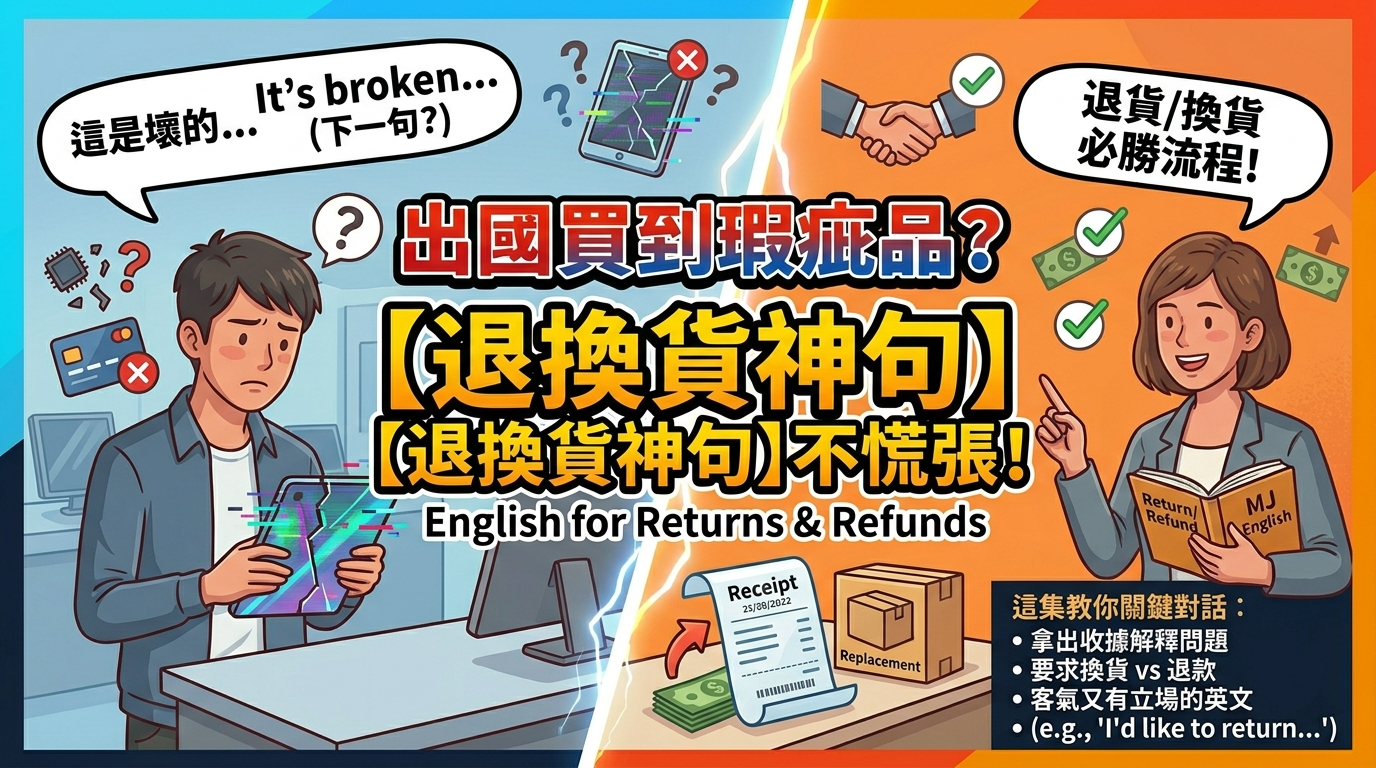
買了東西回家發現是瑕疵品、不能用,這時候要回店裡退換貨,英文要怎麼開口?很多人會卡在 “It’s broken” 講完就不知道下一句,店員問細節又支支吾吾。其實實體店家退換流程有一套很順的句型,學會就能講得不慌不忙。
這集 J 和 M 帶你跑一趟電子產品店退貨情境,從拿出收據、解釋問題、到要求換貨還是退款,把客氣又有立場的英文一次學完。下次出國買到瑕疵品,也能自信回店裡處理。
情境對話 Dialogue
Ryan 上週末買的 Bluetooth speaker 才用兩天就無法充電,他帶著收據回店裡找店員 Chloe 處理。
English Dialogue
重點單字與片語 重點句型
Ryan: Hi, I bought this Bluetooth speaker here last weekend, and it stopped charging after two days. I’d like to return it.
Chloe: Sorry to hear that. Do you have the receipt with you?
Ryan: I do — here you go. I tried two different cables, and it just won’t power up.
Chloe: Got it. Let me take a quick look… Yeah, the charging port looks fine on the outside, so it’s probably a defective unit.
Ryan: Is there any way to get a refund? I really need a working speaker for a trip this weekend.
Chloe: Since it’s within fourteen days and clearly defective, you’re entitled to a full refund or an exchange — whichever you prefer.
Ryan: Honestly, I’d rather just exchange it for the same model if you have one in stock.
Chloe: Let me check the back… Good news, we’ve got one in stock. Would you like me to test it before you take it home?
Ryan: That’d be great. The last thing I want is to drive back here on Friday.
Chloe: Totally fair. I’ll plug it in, pair it with my phone, and let you hear it.
Ryan: Perfect. While you do that, can you also throw in the original packaging? Mine got pretty banged up.
Chloe: No problem. The new one comes sealed, so you’ll get the box and all the accessories.
Ryan: You’re a lifesaver. Thanks for making this so painless.
中文翻譯
Ryan:嗨,我上週末在這裡買了這個藍牙喇叭,用兩天之後就不能充電了。我想退貨。
Chloe:聽到這個我很抱歉。請問收據有帶嗎?
Ryan:有,給你。我試了兩條不同的線,它就是開不了機。
Chloe:了解。我快速看一下…嗯,充電孔外觀看起來沒問題,所以應該是瑕疵品。
Ryan:那有辦法退錢嗎?我這週末出去玩真的需要一台能用的喇叭。
Chloe:因為還在十四天內、又確定是瑕疵,你有權選擇全額退款或換貨,看你想要哪個。
Ryan:說真的,如果你們還有同款的庫存,我寧願就換一台一樣的。
Chloe:我去後面看一下…好消息,剛好還剩一台。要不要我先測試給你看再讓你帶回家?
Ryan:那太好了。我最不想的就是星期五還要再開車回來一趟。
Chloe:完全合理。我會幫你插電、用我的手機配對,然後讓你聽聲音。
Ryan:太好了。你弄的時候,可不可以順便給我原廠包裝?我那箱已經撞得蠻爛了。
Chloe:沒問題,新的這台是未拆封的,盒子和全部配件都會給你。
Ryan:你真是救星,謝謝你把這件事處理得這麼輕鬆。
重點單字 Vocabulary Boost
- defective / dɪˈfɛktɪv / adj. → 有瑕疵的;故障的
(比 broken 更正式,店員、保固單上常用)
This batch had several defective units.(這批貨有好幾台是瑕疵品。) - receipt / rɪˈsiːt / n. → 收據;發票
(注意 p 不發音,唸「ri-SEET」常被講成「ri-SEPT」是常見錯誤)
Keep the receipt just in case you need to return it.(收據先留著,怕之後要退。) - refund / ˈriːfʌnd / n. → 退款
(也可當動詞 refund,但口語多半 “get a refund” / “give you a refund”)
I’d like a refund, please.(我想要退款,謝謝。) - exchange / ɪksˈtʃeɪndʒ / n. v. → 換貨;交換
(refund 是退錢、exchange 是換另一件,店員會問你選哪個)
Can I do an exchange instead of a refund?(我可以換貨不要退款嗎?) - entitled to / ɪnˈtaɪtəld tuː / phr. → 有權利得到
(強調是消費者「應有的權利」,常見於退換貨、保固、退款情境)
You’re entitled to a free replacement under warranty.(在保固內你有權獲得免費更換。) - in stock / ɪn stɑːk / phr. → 有庫存
(反義 out of stock 表示「沒貨了」,購物時最常聽到的兩個片語)
Is the black one still in stock?(黑色那款還有貨嗎?) - plug in / plʌɡ ɪn / phr.v. → 插電;接上電源
(plug it in 是把它插上、unplug 是拔掉,動詞片語結構別忘了)
Did you plug the charger in properly?(你充電器有插好嗎?) - banged up / bæŋd ʌp / adj. → 撞壞的;磕碰得很慘的
(口語感重,形容東西外觀有撞痕、刮傷)
The box arrived all banged up.(盒子寄來時撞得亂七八糟。) - sealed / siːld / adj. → 密封的;未拆封的
(sealed in plastic 表示原廠塑膠膜還沒撕、未開封)
Make sure the package is still sealed.(確認包裝還沒拆過。) - accessories / əkˈsɛsəriz / n. → 配件;附屬品
(不只時尚配件,3C 產品的線、轉接頭、保護套都叫 accessories)
The box includes all the original accessories.(盒裡含全部原廠配件。)
重點句型 Sentence Patterns
- I’d like to return … → 我想退…(退貨開場最標準說法)
I’d like to return this jacket — it doesn’t fit.(我想退這件外套,尺寸不合。)| 替換詞:I want to return(我要退,較直接)/ I’m here to return(我來退…)
💡 台灣人常會直接說 “I want to return”,文法沒錯但語氣略硬。”I’d like to” 是 “I would like to” 的縮寫,加上 would 就客氣很多,店員聽起來舒服、流程也會順一點。
- Is there any way to …? → 有沒有辦法…?(探詢式請求,不直接逼店員)
Is there any way to get this swapped today?(有辦法今天就換好嗎?)| 替換詞:Would it be possible to(有沒有可能)/ Can you make it work so(你能不能讓…成立)
💡 這句的妙處在「不是我命令你,是我問你有沒有辦法」。即使店員照規則說 No,雙方關係也不會緊張。比 “Can I get a refund?” 多了一層商量空間,特別適合情況比較複雜時。
- I’d rather just … → 我寧願就…(表達偏好但不強硬)
I’d rather just exchange it.(我寧願就直接換一台。)| 替換詞:I’d prefer to just(我比較想就…)/ I’d rather not(我寧願不要…)
💡 “just” 這個小字很關鍵,加上去整句變得「沒那麼麻煩」、「簡單就好」的感覺。在二選一的情境特別好用——店員給你選項時,回 “I’d rather just X” 立刻把對話收乾淨。
- Would you like me to …? → 要不要我…?(主動服務式提議)
Would you like me to wrap it up for you?(要不要我幫你包起來?)| 替換詞:Want me to(要我…嗎,較口語)/ Should I(我要不要…)
💡 服務業神級句型,店員、櫃台、餐廳都常用。重點是「我提議由我來做」,把行動主導權交給對方。學起來不只能聽懂、自己當顧客需要協助別人時也用得上。
- The last thing I want is … → 我最不想的就是…(強調極力避免某事)
The last thing I want is another delay.(我最不想再被延誤一次。)| 替換詞:I really don’t want to(我真的不想…)/ I’d hate to(我超不想…)
💡 這是「禮貌地表達強烈反感」的高階句型。比直接說 “I don’t want to” 更有重量,但又不會聽起來在抱怨。客服、退換貨、行程變更時用一下,立刻顯得成熟有溝通力。
逐字稿 Transcript
J: Did you catch how Ryan opened that conversation? He didn’t say “this is broken” or “I want my money back.” He said, “I’d like to return it.” That one line sets the entire tone of the interaction.
J:你有注意到 Ryan 開場怎麼講嗎?他不是說「這個壞了」或「我要拿回我的錢」,他說的是 “I’d like to return it.”。這一句就把整個對話的調性定好了。
M: Welcome back to MJ English, everyone. I’m Mary, and that’s Jason. Today’s situation is one we all dread but eventually face — you bought something, it doesn’t work, and now you have to go back to the store and explain. The good news is, English has a really clean playbook for this.
M:歡迎回到 MJ English,我是 Mary、那位是 Jason。今天這個情境是大家都不想遇到、但遲早會碰到的——買了東西、結果壞掉、現在得回店裡解釋。好消息是,英文處理這種事有一套很清楚的話術。
J: Let’s start with that opening line. “I’d like to return this.” The contraction “I’d” is short for “I would,” and that little “would” softens everything. Compare it with “I want to return this.” Same meaning, very different feeling. The first sounds like a customer; the second sounds like a complaint.
J:先從開場那句講起。”I’d like to return this.” 這裡的 “I’d” 是 “I would” 的縮寫,這個 would 把整句語氣都軟化了。對比 “I want to return this.”,意思一樣,感覺差很多。第一句聽起來像顧客,第二句像在抱怨。
M: And listen for what Chloe asked next — “Do you have the receipt with you?” The word “receipt” trips up so many learners because the p is silent. It’s “ri-SEET,” not “ri-SEPT.” If you mispronounce it, the staff still understands, but it’s such a common store word, worth getting right.
M:然後注意 Chloe 接下來問的——”Do you have the receipt with you?”。”receipt” 這個字很多學習者會卡,因為 p 不發音。是 “ri-SEET”,不是 “ri-SEPT”。唸錯店員還是聽得懂,可是這字實在太常出現,值得唸對。
J: Ryan’s next move was great — he didn’t just say “it’s broken.” He said, “I tried two different cables, and it just won’t power up.” Notice how he gave evidence. When you tell the staff what you already tried, you sound credible, and they treat your case more seriously. It’s a small move but it changes the whole interaction.
J:Ryan 下一步講得很漂亮——他沒只說 “it’s broken.”,他說 “I tried two different cables, and it just won’t power up.”。注意他是給了證據。你告訴店員你已經試過什麼,你聽起來比較可信、他們也會更認真處理。這個小動作影響整段互動。
M: Then Chloe used the magic word — “defective.” This is the word you want in your back pocket. “Broken” is fine, but “defective” is the term stores and warranties officially use. If you hear “this is a defective unit,” that’s actually good for you, because it usually triggers a different, better policy.
M:然後 Chloe 用了那個關鍵字——”defective”。這個字一定要記起來。”broken” 沒錯,但 “defective” 是店家和保固單上正式用的詞。如果你聽到 “this is a defective unit.”,這對你是好事,因為通常會觸發更好的退換政策。
J: Now here’s the line I really want everyone to learn — “Is there any way to get a refund?” This is huge. You’re not demanding, you’re not pleading, you’re asking if a path exists. It works for upgrades, refunds, schedule changes, anything where the staff might say no by default but could say yes if you ask right.
J:這裡有一句我真的希望大家學起來——”Is there any way to get a refund?”。這句很神。你不是在要求、不是在拜託,你是在問有沒有可能。這句適用於升等、退款、改行程,任何店員預設會拒絕、但問對方式可能會說好的場合。
M: And Chloe’s reply gave Ryan a key word — “entitled to.” “You’re entitled to a full refund or an exchange.” This phrase is about rights. When a staff member uses this word, they’re acknowledging that what you’re asking for isn’t a favor — it’s owed to you under their policy. Hear it, and you know you’re in good shape.
M:然後 Chloe 回覆給了 Ryan 一個關鍵字——”entitled to”。”You’re entitled to a full refund or an exchange.”。這個片語跟「權利」有關。當店員用這個字,他們在承認你要求的不是恩惠,而是你應得的。聽到這個字,你就知道事情會順。
J: Refund versus exchange — these two are not the same, and you’ll be asked to pick. Refund means money back. Exchange means a new item swapped for the broken one. Some travelers blur these two, but in English the distinction is sharp. If you say “refund” the staff will start the money process; if you mean a new unit, say “exchange.”
J:refund 和 exchange,這兩個不一樣、店員會請你選。refund 是退錢,exchange 是換一台新的給你。有些旅客會把這兩個混在一起,但英文這兩個分得很清楚。你說 refund,店員就會開始走退錢流程;你想要新的一台,要說 exchange。
M: Ryan picked exchange and used another smooth pattern — “I’d rather just exchange it for the same model.” That word “just” is doing real work. It signals “I’m not making this complicated, I just want the simple option.” Drop it in when you want to sound easygoing rather than picky.
M:Ryan 選了換貨,又用了一個很順的句型——”I’d rather just exchange it for the same model.”。”just” 這個字真的有功能。它傳達「我不打算把這事弄複雜,我只想選簡單的方案」。想顯得好相處、不挑剔的時候就丟一個 just 進去。
J: Then Chloe offered something extra — “Would you like me to test it before you take it home?” That’s the service phrase of the year. “Would you like me to” puts the action on the speaker but the choice on you. Servers, hotel staff, store clerks all use it. And here’s the bonus — you can use it too, when you want to politely offer to do something for someone.
J:然後 Chloe 主動提了一個服務——”Would you like me to test it before you take it home?”。這就是服務業神級句型。”Would you like me to” 把動作放在說話者、把決定權交給對方。服務生、飯店人員、店員都用。bonus 是——你自己也能用,當你想客氣地主動幫對方做點什麼的時候。
M: Ryan accepted and slipped in another gem — “The last thing I want is to drive back here on Friday.” Whenever you want to express strong reluctance without sounding whiny, use this. “The last thing I want is” plus whatever scenario you’re trying to avoid. It’s polite, it’s strong, and it makes the staff want to help you avoid it.
M:Ryan 接受了又丟出一句精華——”The last thing I want is to drive back here on Friday.”。每當你想強烈表達不想要某件事、又不想聽起來在抱怨,就用這句。”The last thing I want is” 加上你要避免的情境。客氣、有力、店員聽完還會主動想幫你避開。
J: A couple of nuts-and-bolts words to close. “In stock” means they have it; “out of stock” means they don’t. “Plug it in” — that little “in” matters, you can’t just say “plug it.” “Sealed” means the original packaging is still wrapped, never opened. And “accessories” covers cables, adapters, manuals — all the extras inside the box.
J:最後幾個基本字。”in stock” 是有貨,”out of stock” 是沒貨。”plug it in”——那個 in 很關鍵、不能只說 “plug it.”。”sealed” 是原廠包裝還沒拆過。”accessories” 涵蓋線、轉接頭、說明書,所有盒子裡的附件。
M: One last vibe note. Ryan ended with “You’re a lifesaver. Thanks for making this so painless.” That kind of closing matters in English service culture. A small genuine compliment to staff who helped you well goes a long way, and you’ll often be remembered if you walk in again.
M:最後一個氛圍小提醒。Ryan 結尾說 “You’re a lifesaver. Thanks for making this so painless.”。在英文服務文化裡這種收尾很重要。對幫你的店員講一句真誠的小讚美,影響比想像中大,你下次再去他們常會記得你。
J: Round two coming. As you listen this time, lock onto these — “I’d like to return,” “Is there any way to,” “entitled to,” and “Would you like me to.” These four are the structure of the entire scene.
J:再聽第二次。這次鎖定這幾個——”I’d like to return”、”Is there any way to”、”entitled to” 和 “Would you like me to”,這四個就是整段對話的骨架。
[DIALOGUE REPLAY]
[重播情境對話]
M: Did the rhythm feel different this time? Notice that Ryan never raised his voice, never demanded anything, but still walked out with exactly what he wanted. That’s the secret of good customer English — soft language, clear position.
M:這次節奏是不是不一樣?注意 Ryan 從頭到尾沒提高音量、沒命令任何事,但還是拿到他要的結果。這就是顧客英文的精髓——語氣軟、立場清。
J: All ten vocabulary words and five sentence patterns are sitting in the show notes below — receipt, defective, refund, exchange, entitled to, in stock, plug in, banged up, sealed, accessories. Save it, replay this episode before your next trip, and you’ll handle returns like a regular.
J:今天這十個單字和五個句型全部放在下方節目連結裡——receipt、defective、refund、exchange、entitled to、in stock、plug in、banged up、sealed、accessories。存下來、出國前再聽一次,你下次退貨就像在地人一樣順。
M: Buying things is fun; returning things is real life. Master both, and English actually starts working for you. I’m Mary.
M:買東西很爽,退東西才是真實人生。兩邊都搞定,英文才真的開始幫你做事。我是 Mary。
J: And I’m Jason. Take your receipts, take your time, and we’ll see you next time on MJ English.
J:我是 Jason。收據收好、慢慢來、我們下集 MJ English 再見。