
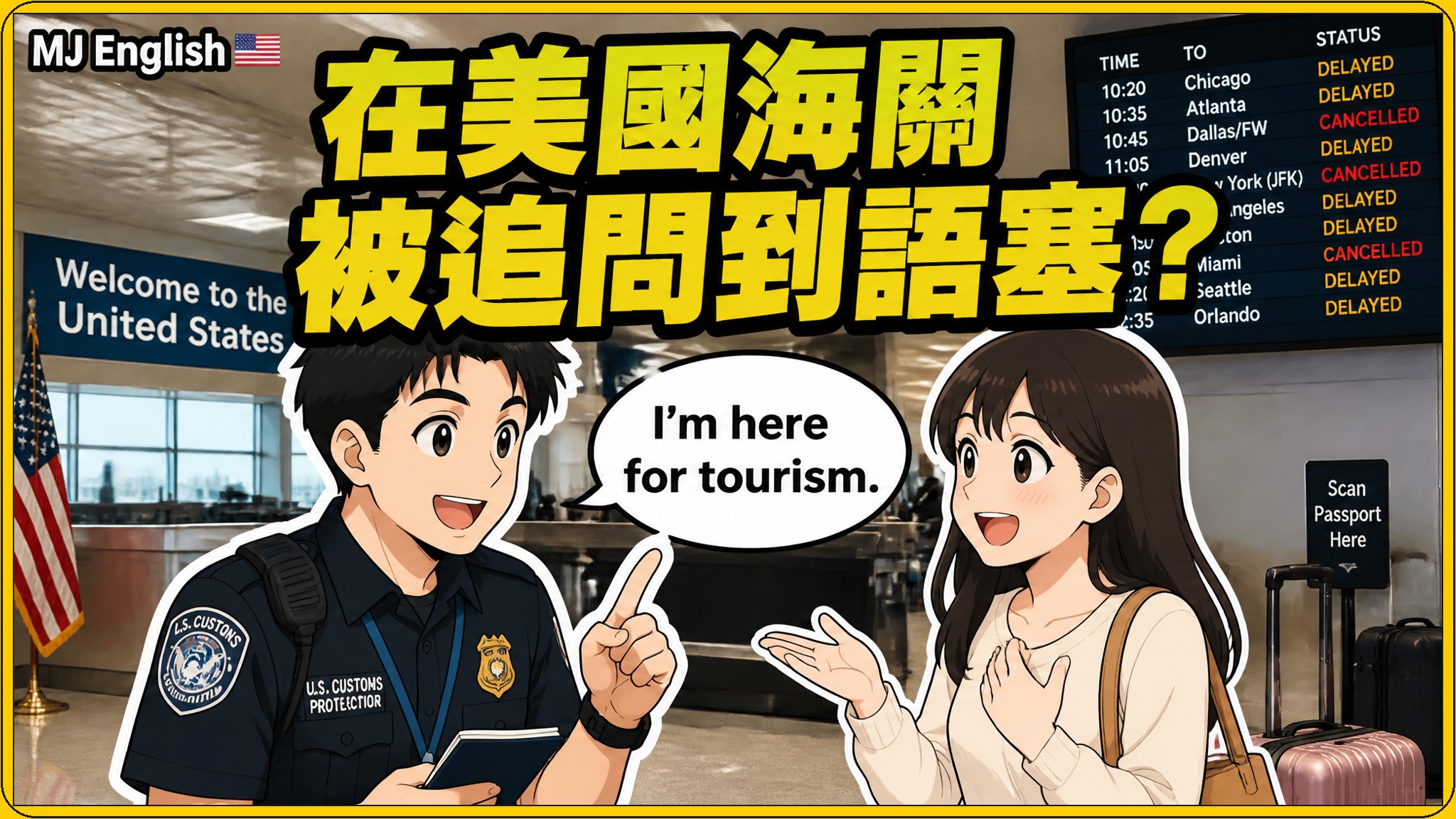
在美國海關被追問到語塞?5 個移民官必問句型,這樣答就過關

2026 07 06 en immigration arrival 1 Travel English | 旅遊英語

暑假出國,最緊張的一關不是搭飛機——是下飛機後走到移民官面前,對方一句 “What’s the purpose of your visit?” 你腦子突然一片空白。

掌握 immigration 問答的核心句型,讓移民官問什麼你都答得出來,走過海關不再腳軟。

🎧 邊聽邊學

完整 podcast 已上架,點下方收聽

Apple Podcasts

💡 先搞懂:入境審查 ≠ 海關,兩個關卡不一樣

很多人把 immigration(入境審查、護照查驗)和 customs(海關)搞混。其實是分開的兩關:先過 immigration,移民官看護照、問旅遊目的;出來拿行李之後再過 customs,申報有沒有帶違禁品或超額現金。根據 美國 CBP(海關暨邊境保衛局)官方資訊,這兩關都屬於入境程序的一部分,但問的問題完全不同。

台灣人最容易卡的雷:被問 “How long are you staying?” 很多人直接回 “14 days”——沒錯,但更自然的說法是 “For about two weeks.” 有 for 才顯得流暢;只說數字像是在背考卷答案。


情境對話 Dialogue

場景:Rachel 剛抵達洛杉磯國際機場(LAX),排隊走到 passport control,移民官開始盤問。


Officer

Passport, please. What’s the purpose of your visit?

護照。請問您此行的目的是什麼?

Rachel

I’m here for tourism. I’m on vacation — sightseeing and some shopping.

我來觀光的。是來渡假的——觀光、逛街。

Officer

How long are you staying?

您預計停留多久?

Rachel

For about two weeks. I leave on the 20th.

大約兩個禮拜。我20號離開。

Officer

Where are you staying?

您住在哪裡?

Rachel

At the Marriott in downtown LA. I have a booking confirmation here.

洛杉磯市區的萬豪酒店。我這裡有訂房確認單。

Officer

Please look directly at the camera. Good. Now place your four fingers flat on the scanner.

請直視鏡頭。好的。現在把四根手指平放在掃描器上。

Rachel

Sure, no problem. All done?

好的,沒問題。這樣就好了嗎?

Officer

Yes. What do you do for work?

是的。您的職業是什麼?

Rachel

I’m a marketing manager. I work for a company in Taipei.

我是行銷主管,在台北的公司上班。

Officer

Do you have a return ticket?

您有回程機票嗎?

Rachel

Yes. I have my e-ticket on my phone — want me to show you?

有。我手機裡有電子機票,需要給您看嗎?

Officer

That’s fine. Do you have anything to declare at customs?

好,沒關係。到海關那邊,您有任何需要申報的東西嗎?

Rachel

Nothing to declare. Just personal belongings.

沒有需要申報的。只有個人用品。

Officer

Welcome to the United States. Enjoy your stay.

歡迎來到美國。祝您旅途愉快。

Rachel

Thank you so much!

謝謝您!


下次這樣說 Next Time

這幾個場景最容易腦筋打結,學會就能從容應對移民官。

① 回答旅遊目的

❌ 中文腦會說

I come here for travel.

我來這裡旅遊。(硬翻)

✅ 該這樣說

I’m here for tourism. / I’m on vacation.

我來觀光的。/我在渡假。

為什麼:purpose of visit(入境目的)的標準答法是 tourism(觀光)、business(商務)、visiting family(探親)。”I come here for travel” 文法有點跑掉;”I’m here for…” 是更自然的口語結構。

② 說停留時間

❌ 中文腦會說

14 days.

14天。(只回數字)

✅ 該這樣說

For about two weeks. I leave on the 20th.

大概兩個禮拜。我20號離開。

為什麼:加上 “for” 聽起來更完整、更流暢,而不是在背數字。順帶說離境日期,移民官一聽就放心,省得追問。

③ 海關申報

❌ 中文腦會說

I have nothing need to declare.

我沒有需要申報的。(直翻文法跑掉)

✅ 該這樣說

Nothing to declare.

沒有需要申報的。

為什麼:這是標準固定說法,簡短有力。填入境卡時也看得到 “Nothing to declare”——記住這個詞組就對了,不用自己造句。


重點單字 Vocabulary Boost

immigration/ ˌɪmɪˈɡreɪʃən / n.

入境審查;移民局。指機場裡查驗護照、審核入境資格的那一關,也可指整個移民制度。

We waited in line at immigration for almost an hour.(我們在入境審查那邊排了快一個小時。)

customs/ ˈkʌstəmz / n.

海關。入境審查之後的另一關,負責檢查行李、收稅、確認有無違禁品。常說 “go through customs”。

My bag got pulled aside at customs for inspection.(我的行李在海關被拉到一邊檢查。)

declare/ dɪˈklɛr / v.

申報。向海關官員正式說明攜帶的物品或金額。”Nothing to declare”(沒有需要申報的)是最常用的固定說法。

You must declare any food or plants when entering the US.(進入美國時,任何食品或植物都必須申報。)

passport control/ ˈpæspɔːrt kənˈtroʊl / n.

護照查驗處。和 immigration 常互換使用,指機場裡讓你出示護照的那個窗口或閘口。

Please have your passport ready at passport control.(請在護照查驗處備好護照。)

purpose of visit/ ˈpɜːrpəs əv ˈvɪzɪt / n. phr.

入境目的。入境卡和移民官最常問的一項。標準答案:tourism(觀光)、business(商務)、transit(過境)、visiting family(探親)。

The officer asked about my purpose of visit and I said tourism.(移民官問我入境目的,我說觀光。)

return ticket/ rɪˈtɜːrn ˈtɪkɪt / n.

回程機票。移民官確認你不會非法滯留的重要依據。美式英文也說 “round-trip ticket”(來回票)。

I showed the officer my return ticket on my phone.(我把手機裡的回程機票給移民官看。)

stamp/ stæmp / n. / v.

(護照)蓋章;印章。入境通過後移民官會在護照上 stamp(蓋章)。有時也說 “get stamped”(蓋到章了)。

The officer stamped my passport and said “Welcome.”(移民官在我護照蓋了章,說歡迎光臨。)

belongings/ bɪˈlɔːŋɪŋz / n. pl.

隨身物品;個人財物。”personal belongings”(個人用品)是跟移民官或海關說沒有需要申報東西時的好用詞。

I only have personal belongings — nothing to declare.(我只有個人用品,沒有需要申報的。)

🎯 30 秒快速複習

問什麼就答什麼,簡短誠實就是最好的策略。

immigration 入境審查(護照查驗那關)
customs 海關(拿完行李再過這關)
purpose of visit? → tourism / on vacation
how long? → For about two weeks.
where staying? → At the + 飯店名
return ticket? → Yes, I have my e-ticket.
anything to declare? → Nothing to declare.
declare 申報 / stamp 蓋章 / belongings 隨身物品

重點句型 Sentence Patterns

1. What’s the purpose of your visit? → I’m here for ___. / I’m on vacation.

被問入境目的,最自然的回法是 “I’m here for + 目的名詞”,或直接說 “I’m on vacation / on a business trip”。避免說 “I come here for travel”(文法不夠道地)。

例:I’m here for tourism.(我來觀光的。)
例:I’m here on business. I have meetings in New York.(我來出差的,在紐約有開會。)
例:I’m visiting family. My sister lives in Seattle.(我來探親的,我妹妹住在西雅圖。)
移民官問這題是在確認你有合法入境資格,不是在閒聊。回答簡短正面就好,不用多解釋——說太多反而讓對方覺得你在掩飾什麼。

2. How long are you staying? → For about ___.

“For about + 時間長度” 是標準回答,有 for 聽起來才完整。可以再補一句離境日期,讓對方更放心。

例:For about two weeks. I leave on July 20th.(大約兩個禮拜。我7月20號離開。)
例:For five days. It’s a short trip.(五天。行程不長。)
例:For about a month. I’m visiting friends in multiple cities.(大約一個月。我要去幾個城市看朋友。)
說不確定的話可以用 “about”(大約),不用把行程精確到每一天。不過說的天數和簽證允許的停留天數要在合理範圍內。

3. Where are you staying? → At the ___ (hotel name).

回答住哪,用 “At the + 飯店名” 就夠了。如果住朋友家,說 “At a friend’s place in + 城市名”;住 Airbnb 可說 “At a rental apartment”。

例:At the Marriott in downtown LA.(洛杉磯市區的萬豪酒店。)
例:At a friend’s place in San Francisco.(在舊金山朋友那邊。)
例:At a rental apartment near Times Square.(時代廣場附近的租屋。)
移民官問住哪,是在確認你有合法住所、不會流浪街頭。如果你有訂房確認單或朋友地址,隨時準備好出示,主動提供更有說服力。

4. Anything to declare? → Nothing to declare.

這是海關那關的標準問答。”Anything to declare?” 是 “Do you have anything to declare?” 的口語縮法;回答 “Nothing to declare.” 即可,簡短有力。

例:Nothing to declare. Just personal belongings.(沒有需要申報的,只有個人用品。)
例:Yes, I have some food items I’d like to declare.(有,我有一些食品要申報。)
例:I have about $12,000 in cash to declare.(我有大約一萬兩千美元現金要申報。)
進美國攜帶超過 $10,000 美元現金(或等值外幣)必須申報,這不是違法,只是規定要說。食品、植物、肉類也要申報——藏起來被抓到才真的麻煩。

逐字稿 Transcript

J
You’ve just landed in the US after a twelve-hour flight, you’re exhausted, and now you’re standing in a line at immigration, watching the officer ahead stare at someone’s passport for what feels like forever.你剛下飛機,飛了十二個小時,整個人累到不行,然後排在入境審查(immigration)的隊伍裡,看著前面的移民官盯著別人的護照看,感覺站了好久。Your heart rate goes up. You start rehearsing answers in your head. What if you forget a word?心跳開始加快。你在腦子裡偷偷練習答案。萬一想不起來某個字怎麼辦?I’m Jason, and this is MJ English. Today we’re walking through everything an immigration officer can ask you — and exactly what to say back, in plain, confident English.我是 Jason,這裡是 MJ English。今天我們要把移民官可能問你的問題全部走一遍——教你用自然、不虛的英文怎麼回。
M
I’m Mary. And here’s the thing — most people are terrified of this moment not because the questions are hard, but because they’ve never practiced saying the answers out loud in English.我是 Mary。事情是這樣的——大多數人在這關超緊張,不是因為問題很難,而是因為根本沒有練習過用英文大聲說出答案。The questions are actually very predictable. Today’s dialogue walks you through the core ones — purpose of visit, how long, where you’re staying, even biometrics, and customs.其實移民官的問題非常固定。今天的對話帶你走一遍核心題型——入境目的、停留多久、住哪、生物辨識,還有海關申報,全都有。
J
The first question is almost always: “What’s the purpose of your visit?”第一題幾乎每次都是:”What’s the purpose of your visit?”(您此行的目的是什麼?)Rachel answers: “I’m here for tourism. I’m on vacation — sightseeing and some shopping.” Natural, specific, done.Rachel 回答:”I’m here for tourism. I’m on vacation — sightseeing and some shopping.” 自然、具體、搞定。Notice she doesn’t say “I come here for travel” — that’s a very common translation trap.注意她沒有說 “I come here for travel”,那是很典型的直翻陷阱。The natural structure is “I’m here for + purpose noun”: tourism, business, a conference, visiting family. Or you can just say what you’re doing: “I’m on vacation,” “I’m on a business trip.”自然的句型是 “I’m here for + 目的名詞”:tourism(觀光)、business(商務)、a conference(參加會議)、visiting family(探親)。或者直接說你在做什麼:”I’m on vacation”、”I’m on a business trip”。
M
Question two: “How long are you staying?” Rachel says, “For about two weeks. I leave on the 20th.” That “for” at the start makes a big difference.第二題:”How long are you staying?”(預計停留多久?)Rachel 說:”For about two weeks. I leave on the 20th.” 開頭那個 “for” 差很多。If you just say “14 days,” it sounds like you’re reading off a form. “For about two weeks” sounds like a person talking.如果你只說 “14 days”,聽起來像在背表格。”For about two weeks” 才像個真人在說話。And then she adds when she’s leaving — that’s a smart move. It tells the officer you have a clear departure plan. Officers love that.然後她還補了一句離開的日期——這招很聰明。直接讓移民官知道你有明確的離境計畫,他們很吃這套。
J
Third: “Where are you staying?” This is where a lot of people freeze up. They know the hotel name but they’re not sure how to say it grammatically.第三題:”Where are you staying?”(您住哪裡?)很多人在這裡腦筋打結。飯店名字知道,但不確定文法怎麼接。Simple rule: “At the + hotel name.” Rachel says “At the Marriott in downtown LA.” Short, clear, done.記這個就好:”At the + 飯店名”。Rachel 說 “At the Marriott in downtown LA.”(洛杉磯市區的萬豪酒店。)短、清楚、搞定。Staying with a friend? “At a friend’s place in Boston.” Airbnb? “At a rental apartment near the city center.” Any of those work.住朋友家?”At a friend’s place in Boston.”(在波士頓朋友那邊。)住 Airbnb?”At a rental apartment near the city center.”(市中心附近的租屋。)這幾個都可以。
M
Fourth: “Do you have a return ticket?” This one is straightforward. Just say yes and show it on your phone if they want to see it.第四題:”Do you have a return ticket?”(您有回程機票嗎?)這題很直接。說有,他們要看的話就把手機拿出來。Rachel says, “Yes. I have my e-ticket on my phone — want me to show you?” That’s confident without being pushy.Rachel 說:”Yes. I have my e-ticket on my phone — want me to show you?”(有。我手機裡有電子機票,需要給您看嗎?)自信但不強迫。By the way — American officers say “round-trip ticket” more often, but “return ticket” is totally understood. No need to worry about that difference.順帶一提——美國移民官比較常說 “round-trip ticket”,但你說 “return ticket” 完全沒問題,不用擔心這個差別。
J
Then comes the customs question — and this one trips people up because it sounds formal.然後是海關(customs)那題——這題常讓人卡住,因為聽起來很正式。The officer asks: “Do you have anything to declare?” or just “Anything to declare?”移民官會問:”Do you have anything to declare?”(您有任何需要申報的東西嗎?)或直接縮短成 “Anything to declare?”Rachel says: “Nothing to declare. Just personal belongings.” That phrase — “nothing to declare” — is the standard fixed answer. Learn it as one block. Don’t try to build your own sentence from scratch every time.Rachel 回答:”Nothing to declare. Just personal belongings.”(沒有需要申報的,只有個人用品。)”Nothing to declare” 這個說法是固定答法,把它當成一個整體記下來,別每次都自己重新造句。
M
One thing worth knowing: customs in the US is handled by CBP — the Customs and Border Protection agency.有個小知識值得知道:美國的海關是由 CBP(美國海關暨邊境保衛局)負責的。You fill out a customs declaration form on the plane, and then you hand it in when you go through customs. If you have food, plants, meat, or over ten thousand dollars in cash, you must declare it. Not declaring something you’re supposed to? That’s where the real trouble starts.你在飛機上填好入境申報單,到海關那關再交出去。如果你帶了食物、植物、肉類,或超過一萬美元現金,都必須申報。該申報的東西沒申報?那才是真正的大麻煩。
J
Also — stay calm. Officers can tell when someone is nervous, but nervous is not the same as suspicious.還有——保持冷靜。移民官看得出來你緊張,但緊張不等於可疑。What they’re really checking is whether your story is consistent and whether you’re being honest. Short, clear, honest answers — that’s the formula.他們真正在確認的是你說的話前後一致、你是不是誠實作答。簡短、清楚、誠實——這就是公式。
🔁 [DIALOGUE REPLAY] 重播情境對話
M
Catch that? The officer walked Rachel through every question — biometrics included — and she handled every one without hesitation.聽到了嗎?移民官把每個環節都問過了一遍,連生物辨識都有,Rachel 每一題都沒有停頓,穩穩回答。The key is that she didn’t over-explain. Each answer was exactly what the officer needed — no more, no less. That’s what makes you sound in control, not lucky.重點是她沒有過度解釋。每個回答都剛好是移民官需要聽到的,不多也不少。這才是讓你聽起來很穩、而不是運氣好的原因。
J
Here’s your challenge: before your next trip, say all these answers out loud — not in your head, out loud. Purpose of visit, how long, where you’re staying, return ticket, and the customs line.這是你的練習挑戰:下次出國前,把這些答案大聲說出來——不是在心裡想,是真的講出聲音。入境目的、停留時間、住哪、回程機票、海關申報那句。Say them until they come out automatically. Because when you’re standing at that counter, tired from the flight, you want those words to just come out. See you next time on MJ English!說到它們能自動跑出來為止。因為當你站在那個窗口前、飛機坐累了的時候,你希望那些話就這樣自然說出來。MJ English,下次見!
M
Bye, everyone — safe travels!掰掰,大家一路順風!

延伸學習 Keep Going

搞定入境審查,這幾個旅遊英文場景也一起補起來——同樣是台灣人出國最容易卡的關卡。


你被移民官問過最難回答的問題是什麼?

留言分享你的入境經驗——或者告訴我們你最害怕被問哪一題,我們下集幫你拆解。

追蹤 MJ英語 podcast,下次見。

標題和URL已復制